Vector Algebra: CBSE Class 12 PYQs with Worked Solutions
CBSEMathematicsVector Algebra
This guide to the Chapter 10 Vector Algebra previous-year question collection explains the ideas CBSE Class 12 board papers keep testing: components and magnitude, the scalar and vector products, angles and projections, areas and position vectors. It also shows how the 153 questions from 2022–2026 are framed and how to work through them in a sensible order.
Components, magnitude and direction: where many questions start
The largest topic group in the collection is vector components, magnitude and direction. For , the magnitude is . Dividing by this magnitude gives the unit vector in the same direction.
Several MCQs check this basic skill in a disguised form:
- finding a missing coordinate from a given magnitude,
- writing the vector that joins two points, which is the terminal point's coordinates minus the initial point's,
- building a vector of given length from conditions on the angles it makes with the axes.
A recurring pattern scales a vector by a parameter. Here the key fact is . The magnitude depends on the absolute value of , not on itself. So when runs over an interval that includes negative values or zero, find the possible values of first.

Vector Algebra | Class 12 | Previous Year Paper
In the StudentCurio app
A collection of solved CBSE Class 12 previous-year questions on vector operations, components, scalar and vector products, projections, angles and geometric applications. Helps students practise exam-style questions and review worked solutions.
Scalar product: perpendicularity, angles and projections
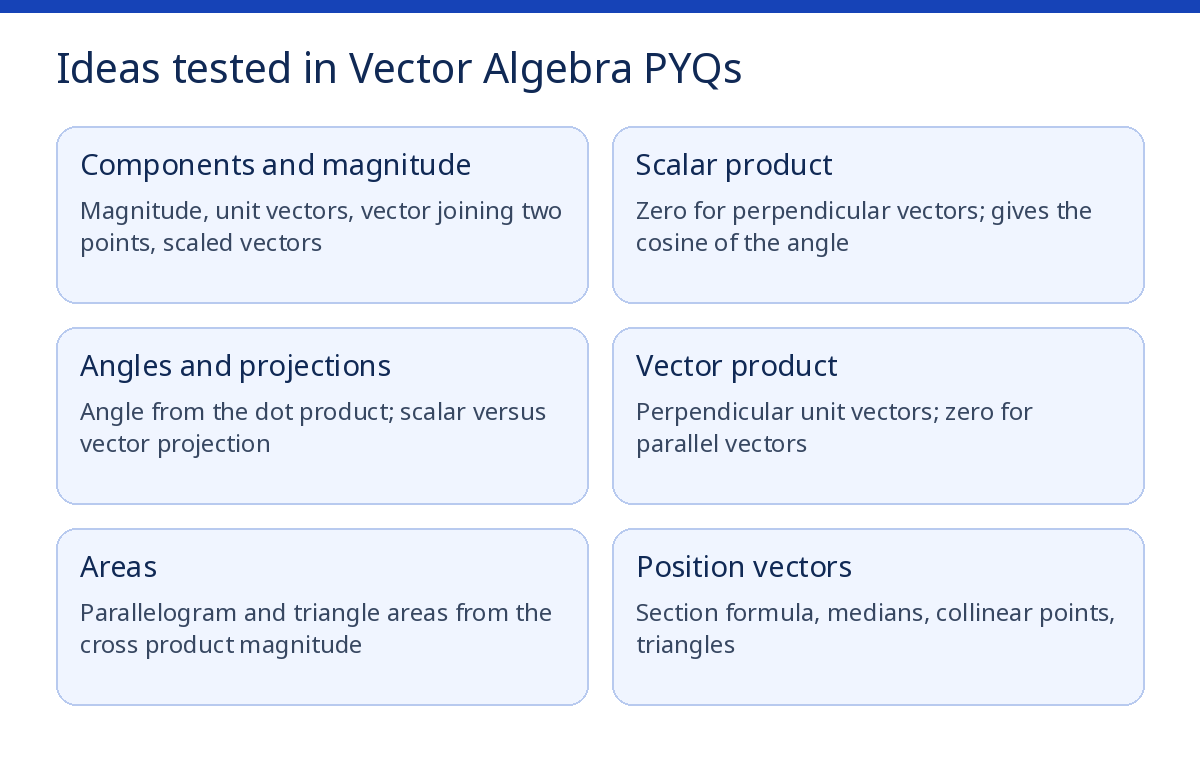
The scalar (dot) product is tested more often than almost any other idea. In components it equals . Three uses recur.
Perpendicularity. Non-zero vectors are perpendicular exactly when . Many questions give one unknown component and ask for its value. One applied stem treats the two strips of a Red Cross sign outside a clinic as vectors and asks for the missing component that makes them perpendicular.
Angles. Rearranging gives . Questions on obtuse angles turn into a sign condition on the dot product, which produces an inequality in a variable. The source notes specifically flag domain and sign conditions in such cases.
Projections. The scalar projection of on is , where is the unit vector along . The projection vector is this number multiplied by . Keep the scalar and the vector forms separate, and notice which vector is being projected onto. Questions comparing the projection of on with that of on test exactly this.
Vector product: parallel vectors, perpendicular unit vectors and areas
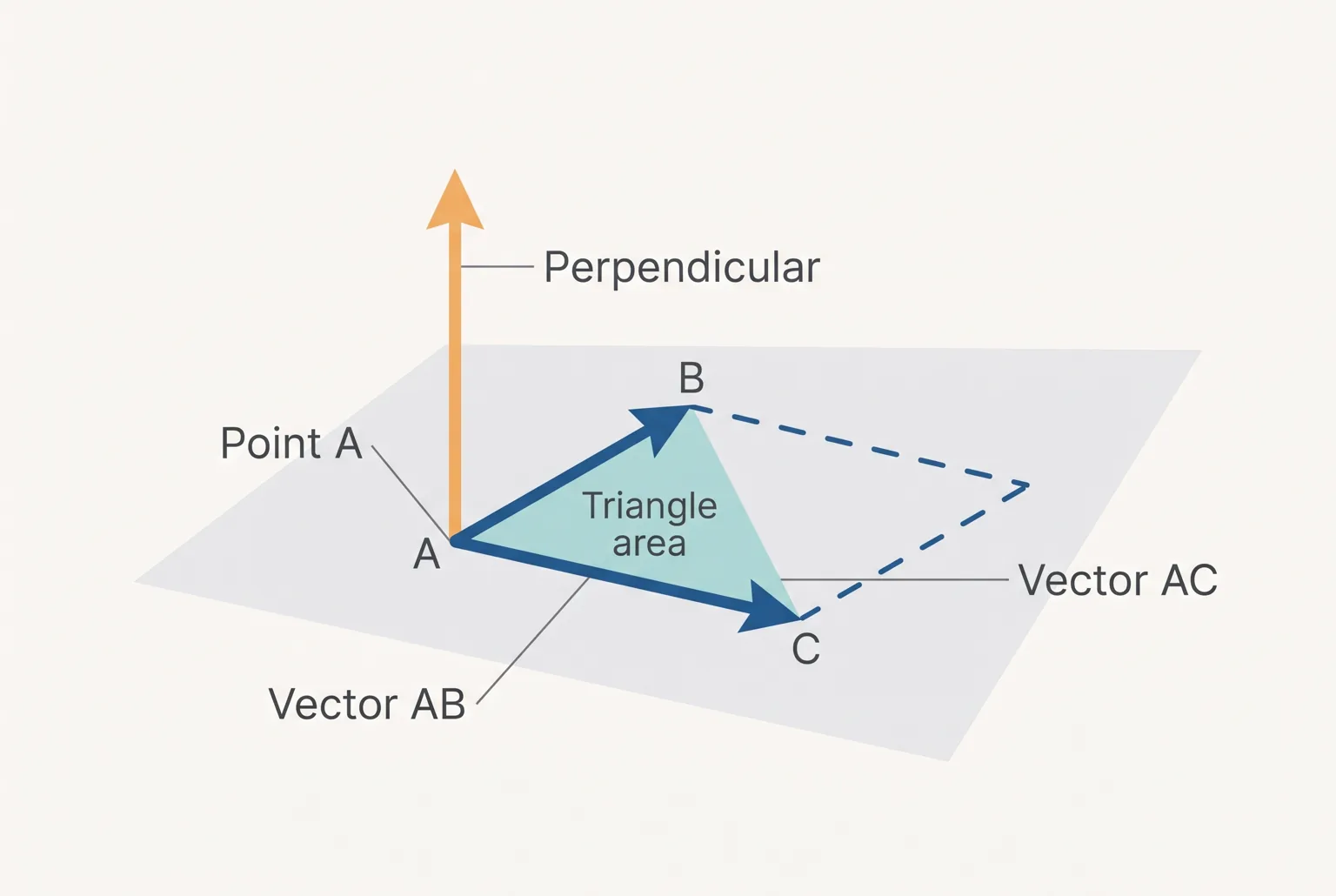
The vector (cross) product has magnitude . Its direction is perpendicular to both and . Board questions use it in three ways.
- Unit vector perpendicular to two vectors. Compute by the determinant method, then divide by its magnitude. The negative of that vector is also perpendicular to both.
- Parallel vectors. For non-zero vectors, means they are parallel. Equivalently, one is a scalar multiple of the other, so corresponding components are in the same ratio. One applied stem has a student tying two ropes parallel to each other and asks for the missing component of the second rope's direction.
- Areas. The area of a parallelogram with adjacent sides and is . The area of is .
Mixed questions combine both products. Because the sine and cosine forms share , comparing with leads to a condition on . Squaring and adding the two leads to a condition through .
Position vectors, the section formula and collinear points
The position vectors and geometric relations group covers points rather than free vectors. If and have position vectors and , then . A point dividing internally in the ratio has position vector . The midpoint is the case .
Recurring tasks include:
- chaining the section formula, for example finding a midpoint of a segment whose endpoint was itself found by division,
- finding the length of a triangle's median from two side vectors,
- testing whether three points are collinear. Collinearity holds when the vector from the first point to the second is a scalar multiple of the vector from the second point to the third.
Triangle questions also ask whether three vectors close into a triangle. They then classify the triangle using magnitudes, or using dot products to check for a right angle.
How the four question formats are framed
The collection prints 153 questions with exam-year labels from 2022 to 2026. It keeps the original serial order:
- Q1–Q79 are single-correct objective items: 70 MCQs and 9 assertion-reason questions.
- Q80–Q153 contain 72 subjective questions and 2 case-based questions.
Labels show sets, Delhi papers and compartment papers. Marks are not printed, so the collection omits them.
MCQs usually test one formula: a perpendicularity value, a magnitude or an area. Assertion-reason items pair two statements about properties such as collinearity, commutativity, opposite unit vectors and the dot–cross identity. You must judge each statement separately before deciding whether the reason explains the assertion.
Subjective and case-based questions combine topics. The topic finder lists 20 items under case-based and multi-concept applications, where you are expected to show each step, not just a final value.
Common mistakes the solutions correct
The complete solutions are all labelled Added solution. The original source provided only 78 MCQ answer-key letters, one MCQ entry marked "Scan QR", and QR links for subjective answers. Solutions are set out in numbered steps. Source notes separate printed errors, non-unique answers and domain or sign conditions from the final result. Typical slips to watch for:
- treating as , which can wrongly give a negative magnitude,
- confusing the scalar projection with the projection vector, or dividing by the wrong magnitude,
- forgetting the factor for a triangle's area,
- reversing initial and terminal points when writing the vector joining two points,
- giving only one perpendicular unit vector when the question allows both signs.
Where a printed question or key is inconsistent, the solution explains the issue and states any extra assumption. Read these notes rather than simply copying the final line.
Practising chapter by chapter with the topic finder
A practical order follows the topics:
- Components and magnitude
- Scalar product and orthogonality
- Angles and projections
- Vector product
- Areas
- Position vectors
The clickable topic finder lets you pick each group without disturbing the serial order. A question may appear under more than one topic.
After each topic, attempt its assertion-reason items. Then move to the subjective block and the two case-based questions as mixed practice. Use View Solution only after a full attempt.
Quick self-check: Does the order of the vectors matter in , and in ? Why can a dot product of unit vectors never exceed 1 in absolute value?
Frequently asked questions
Which years and how many questions does this Vector Algebra PYQ collection include?
It prints 153 questions, each with a complete worked solution, labelled from CBSE exams in 2022, 2023, 2024, 2025 and 2026.
Are marks shown for each question?
No. The source questions do not print marks, so the collection omits them. Year, set, Delhi and compartment labels are kept.
Who wrote the worked solutions?
The original source had only answer-key letters and QR links. All 153 complete solutions were added and are labelled 'Added solution', covering every subpart and OR alternative.
Spotted an error? Report a correction. Practise this in the app: notes, formula sheets and mind maps.





























































































































































Loading comments…