CBSE Class 12 Mathematics 2024: Solved Paper 65/2/1
CBSEMathematics2024 Previous Year Paper
Paper code: 65/2/1 · 2024Practise the full English-version CBSE Class 12 Mathematics main examination paper from 2024, set 65/2/1. Use the original paper for a three-hour attempt, then use the linked worked solutions to review your choice of method, assumptions and steps.
This set is one of the year's papers. See every set from 2024, grouped by series.
Know the five sections before you start
This year-wise file contains one complete paper across the Class 12 Mathematics syllabus, rather than a chapter-wise question bank. The paper has 38 questions, carries 80 marks and allows three hours. Calculators are not allowed. The file keeps the original English question layout, options and diagrams, so you can practise reading the paper as it was set.
Section A contains 18 multiple-choice questions followed by two assertion–reason questions, all worth one mark each. Sections B, C and D contain very short, short and long answers worth two, three and five marks per question, respectively. Section E has three case studies worth four marks each. There is no overall choice: answer every question number, but select one branch where an internal OR is printed. The worked solutions cover both branches, which lets you revisit the unattempted alternative after the timed sitting.

Mathematics 2024 | Class 12 | Previous Year Paper | Code 65/2/1
In the StudentCurio app
Complete solved CBSE Class 12 Mathematics paper 65/2/1 from 2024, with questions spanning functions, matrices, calculus, vectors, three-dimensional geometry, linear programming and probability. Helps students practise board-exam questions and review solution methods.
Good to remember: A function comes with its sets
The paper tests functions in several ways: classifying a mapping, finding the domain and range of an inverse-trigonometric expression, and considering how a change of codomain affects whether a function is onto. Read the domain and codomain before working with the formula. One-one concerns whether distinct allowed inputs can produce the same output; onto concerns whether every element of the stated codomain is attained. The range is the set of outputs actually attained, so it need not equal the codomain.
For inverse trigonometry, distinguish the allowed inputs to the inverse function from the values it returns on its principal branch. When the input is itself an expression, first ask which original inputs make that expression admissible. The paper also includes an equivalence-relation proof. In reviewing that alternative, look for separate checks of reflexivity, symmetry and transitivity rather than treating one property as evidence for the others.
Use the calculus questions to practise choosing a method
Calculus appears in questions on continuity, differentiation, monotonicity, extrema, integration and differential equations. In a piecewise continuity problem, the points where the formula changes deserve particular attention: the left-hand limit, right-hand limit and function value must agree for continuity at a join. In a monotonicity argument, keep track of the interval on which a derivative sign has been established. A sign calculation at a single point does not justify a claim about the whole domain.
The integration questions include definite and indefinite forms, as well as an area problem. When reviewing, distinguish using properties of the bounds from finding an antiderivative, and check which curves or axes enclose the requested region before setting up an area integral. For differential equations, notice whether the prompt asks for a general solution or a particular solution. The given condition in a particular-solution problem is part of the task, not an optional check.
Common mistakes: Read the indices and the geometry
The matrix questions move between individual entries, determinants, products, transposes and inverses. For an entry written as , the first index denotes the row and the second denotes the column. Reversing them can change which statement you are testing. In a matrix proof, also check the order of the factors: transposing a product reverses their order. Use the solution’s concept label to identify which property was needed before comparing the algebra line by line.
The vector and three-dimensional geometry questions ask for different kinds of objects, including an angle, a point and an equation of a line. Keep a point on a line separate from a vector that gives its direction. When reading a symmetric equation, rewrite it in a common parameter if a coordinate carries a coefficient or a minus sign; this makes the direction easier to read without dropping a sign or scale factor.
Read each case study as a mathematical model
The three case studies involve fuel consumption, diet cost and conditional probability. In the fuel model, distinguish the value of a quantity from its rate of change. Consumption per hundred kilometres is also not the same quantity as total fuel for a journey. Keep the units attached to intermediate quantities so you can tell whether the final result answers the subpart being asked.
In the diet case, use the printed graph to read the constraints separately from the cost expression. The constraints govern which choices are allowed; the objective compares their costs. Do not infer the existence of a minimum merely from the shape of an unbounded region: this question explicitly supplies an assumption about the minimum. In probability, name the event being conditioned on before choosing a rule, and check that it has positive probability. This guide leaves out the numerical survival example because the wording shifts between there being survivors and passengers surviving.
Quick self-check: Can you explain your first step?
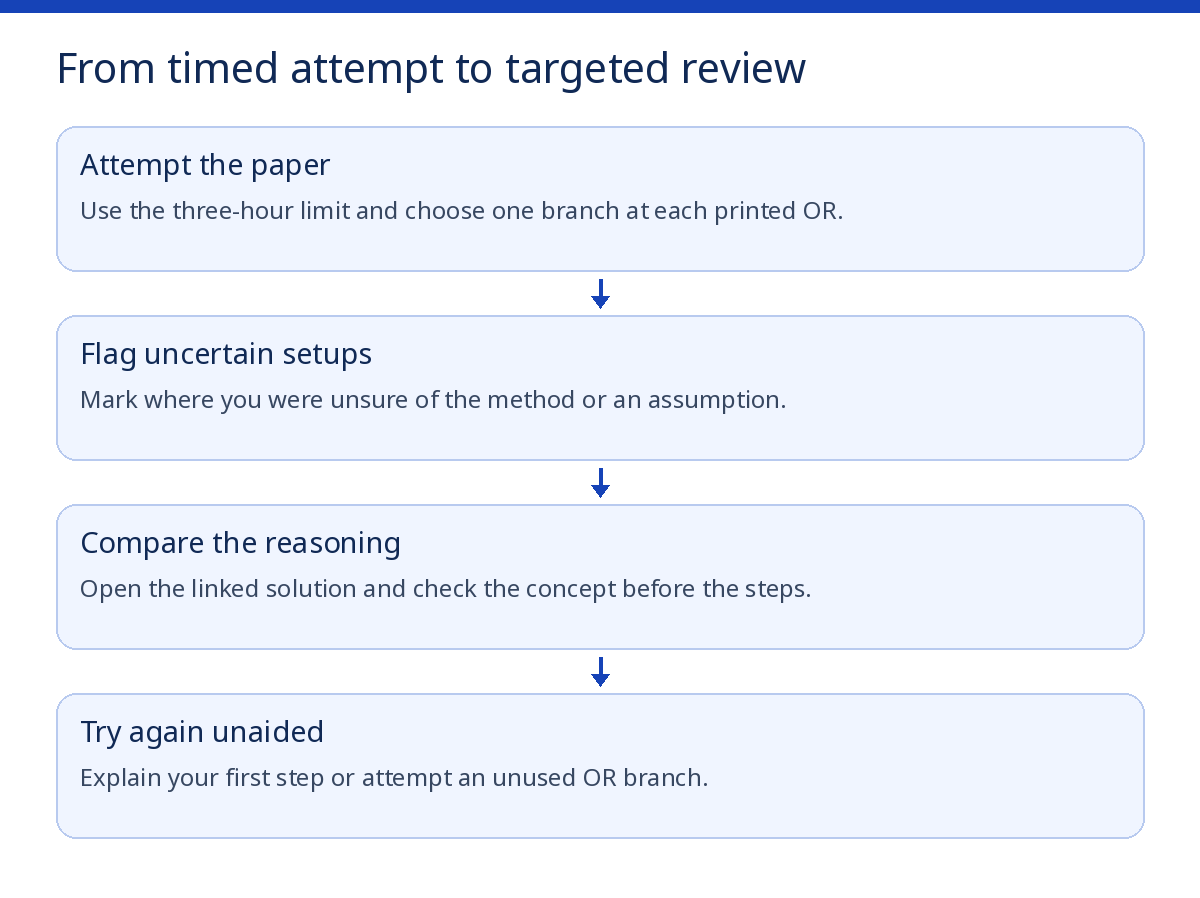
Attempt the paper before opening the solutions. Use only one branch of each printed OR during the timed sitting, and mark questions where you were unsure of the setup as well as those you could not finish. That distinction matters: you may know how to execute a method once it is named but still need practice recognising when it applies.
Use the question-number links to review those attempts. The worked pages separate Formula used, Concept used and Explanation in steps. Compare your setup with the concept first, then find the earliest point where your reasoning diverges. Was the issue a domain restriction, the direction of an inequality, the event being conditioned on, or simply an algebraic slip? Close the solution and try to explain why your revised first step fits the question. An unused OR branch gives you a fresh attempt at applying that review process without seeing its answer first.
Spotted an error? Report a correction. Practise this in the app: notes, formula sheets and mind maps.





























































































































































Loading comments…