CBSE Class 12 Mathematics 2026 Paper: Set 65/2/1
CBSEMathematics2026 Previous Year Paper
Paper code: 65/2/1 · 2026Use the English-language 2026 CBSE Class 12 Mathematics main examination paper for a three-hour, 80-mark practice attempt. Then use the numbered worked solutions to check not just your results, but also the methods and assumptions behind them.
This set is one of the year's papers. See every set from 2026, grouped by series.
Know the five-section paper before you start
This is a full previous year paper for one set, 65/2/1, in a year-wise collection. It contains 38 questions across five sections. Section A has 18 multiple-choice and two assertion–reason questions, each worth one mark. Sections B, C and D contain very short, short and long answers worth two, three and five marks per question, respectively. Section E contains three four-mark case studies with subparts.
There is no overall choice: internal alternatives appear in selected questions outside Section A. For a timed attempt, follow the printed choices, work without a calculator and leave the solution pages closed. If you want to practise the unchosen alternatives, do so afterwards so that your first attempt reflects the paper’s actual instructions.

Mathematics 2026 | Class 12 | Previous Year Paper | Code 65/2/1
In the StudentCurio app
A complete CBSE Class 12 Mathematics paper set 65/2/1 with worked solutions, spanning topics including calculus, matrices, probability, vectors and three-dimensional geometry. It helps students practise the full exam and review solution methods.
Conditions worth checking in functions and matrices
The paper moves from testing properties of a relation to checking whether a function is injective or onto. These are different checks: injectivity asks whether distinct inputs can share an output, while being onto asks whether every element of the stated codomain is reached. Keep the domain and codomain in view while you work. For an inverse-trigonometric composition, check whether the inner expression lies in the inverse function’s domain before applying any angle identity.
The matrix questions move from properties and operations to determinants and a system of equations. A useful check is to preserve factor order when expanding a product: matrix multiplication distributes over addition but need not commute. Before using an inverse-based method, check that the relevant square matrix is invertible.
Choose the calculus method from the form of the problem
The paper includes implicit and parametric differentiation, increasing and decreasing intervals, extrema, definite integrals and differential equations. Start by identifying how the quantities are related. In implicit differentiation, treat as a function of when differentiating expressions that contain . In parametric differentiation, the ratio applies where the derivatives exist and is nonzero.
For an absolute-extremum problem on a closed interval, compare values at the endpoints with those at interior candidates; classifying a local turning point does not settle the absolute comparison. For a bounded-area problem, sketch the region before choosing the variable of integration. A vertical strip measures upper minus lower, while a horizontal strip measures right minus left. In a linear differential equation, put the equation in standard form on an interval where the coefficient you divide by does not vanish.
Translate between equations, vectors and graphs
Vectors and three-dimensional geometry appear in both short items and longer coordinate problems. Distinguish a point on a line from a vector giving its direction. Direction ratios can be scaled by a nonzero factor without changing the line’s direction up to orientation; direction cosines come from normalising a nonzero direction vector. In an intersection problem, the coordinates obtained from the two line equations must agree at the same point, even if the two parameter values differ.
In linear programming, the graphical questions require a different distinction: constraints determine which points are feasible, while the objective function ranks those points. When reviewing a graph, check the side selected by each inequality before checking any objective value. An accurately drawn boundary line is not enough if the wrong side is shaded.
Quick self-check for the case studies
The case studies put conditional probability, integration and piecewise functions into context. For the probability case, ask: Which group am I working within now? Conditioning on a group and conditioning on a test outcome do not generally give the same denominator. In either direction, the event after the conditioning bar must have positive probability.
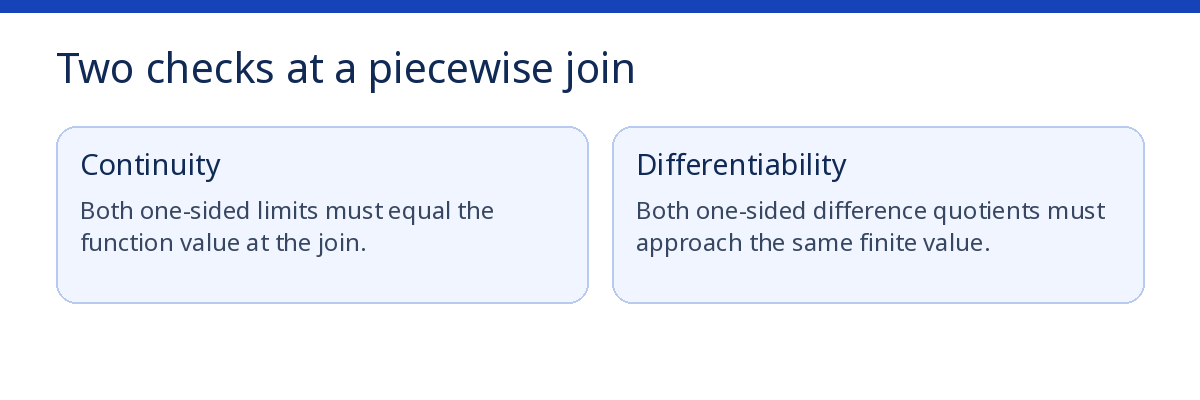
For the area case, ask which boundary the requested region actually uses. The paper distinguishes the enclosed elliptical ground from the surrounding track, so not every feature in the diagram belongs in every calculation. For the piecewise-function case, ask whether the point lies inside one piece or at the join. At a join, continuity requires the one-sided limits to agree with the function value; differentiability requires the one-sided difference quotients to approach the same finite value.
Use the worked solutions to find your first wrong step
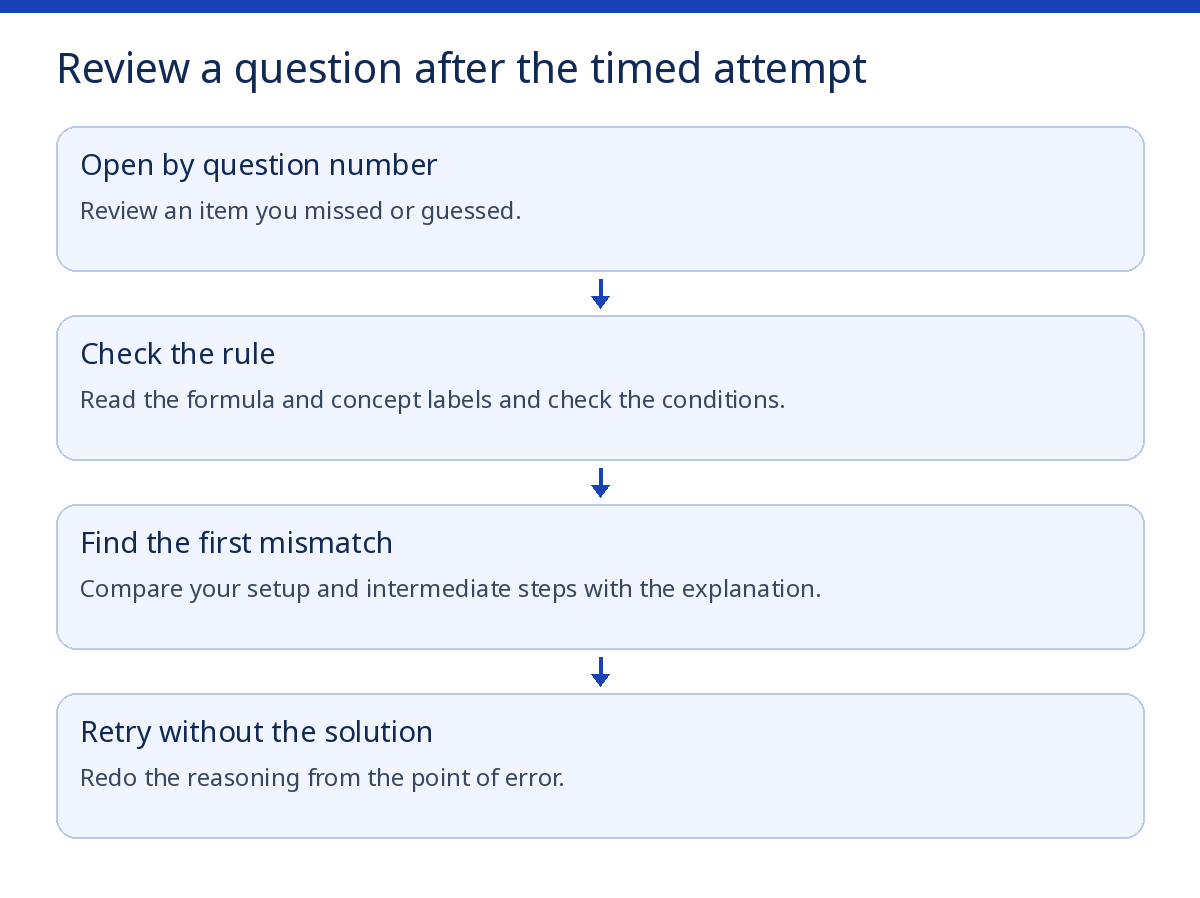
After the timed attempt, open the solution for a question you missed or guessed. The numbered links let you review individual questions without reading the solutions in sequence. Use the Formula Used, Concept Used and Explanation in Steps labels to locate where your approach diverged. Did you choose a rule that did not apply, set up the right method with the wrong bounds or signs, or make an algebraic slip after a correct start?
Then close the solution and redo the question from the point where your reasoning changed. For an assertion–reason item, check the truth of each statement separately before deciding whether the reason explains the assertion. For a longer response, identify the line in your own work that justifies the method, rather than treating a matching final value as a complete check.
This guide leaves out the disputed claim in Q23(b), does not assign a two-trial probability or assume independence in Q31(a), and does not treat Q34’s unspecified nonprincipal branch as unique. It also does not use the worked answers to Q7, Q9 or Q18 as teaching examples.
Spotted an error? Report a correction. Practise this in the app: notes, formula sheets and mind maps.





























































































































































Loading comments…