2025 CBSE Class 12 Mathematics Paper and Worked Solutions
CBSEMathematics2025 Previous Year Paper
Paper code: 65/4/1 · 2025Practise the full English-language 2025 CBSE Class 12 Mathematics main examination paper (65/4/1) under its original three-hour time limit. Then use the worked solutions to check not just your results, but also why each method applies.
This set is one of the year's papers. See every set from 2025, grouped by series.
What this year-wise paper contains
This file presents one full 80-mark board paper from 2025, rather than a chapter-wise collection. It preserves the original English question layout, answer options and diagrams. The cover links to questions by number, and the file provides worked solutions for all 38 questions, including both printed internal choices. The solution pages separate the formula used, the concept behind it and the explanation in steps.
That structure supports two different kinds of practice. In paper order, you have to recognise which topic and method a question calls for without a chapter heading to prompt you. In review, you can return to a single question and locate the step where your reasoning diverged, without reading through the entire solution set.

Mathematics 2025 | Class 12 | Previous Year Paper | Code 65/4/1
In the StudentCurio app
Complete 2025 CBSE Class 12 Mathematics examination paper with worked solutions, covering topics including matrices, calculus, probability, linear programming, vectors and three-dimensional geometry. Useful for practising the board-paper format and reviewing solution methods.
Functions: check the interval, domain and codomain
The inverse trigonometry material illustrates a distinction between finding an angle with a given sine and finding the value returned by inverse sine. The input to lies in , and its output must lie in the principal interval . Periodicity can help evaluate a sine, but it does not change the interval from which the inverse function takes its answer.
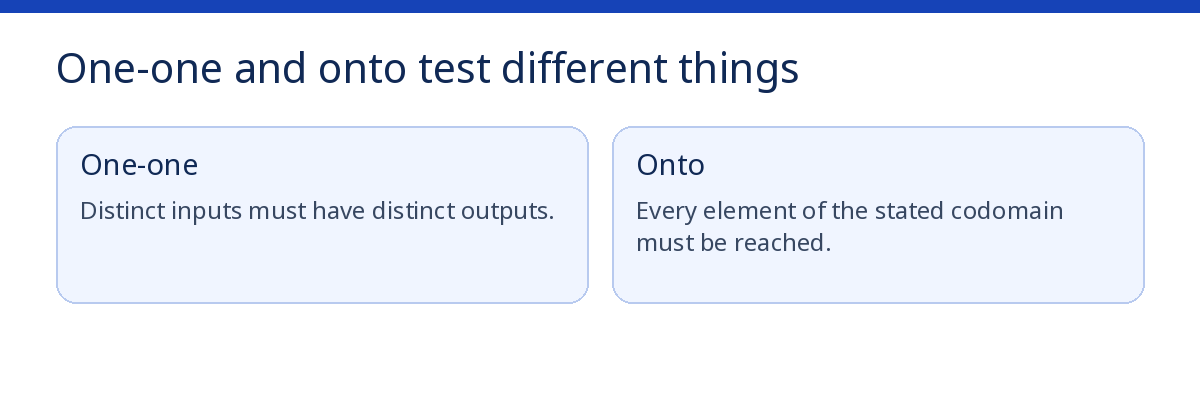
The functions material also separates one-one from onto. To show a function is one-one, check whether distinct inputs can produce the same output. To show it is onto, check whether every element of the stated codomain is attained. Strict monotonicity on an interval can establish the first property; it does not by itself establish the second. For a continuous function on the real line, limits of opposite infinite signs at the two ends can establish that every real output is reached.
Calculus: match the test to the task
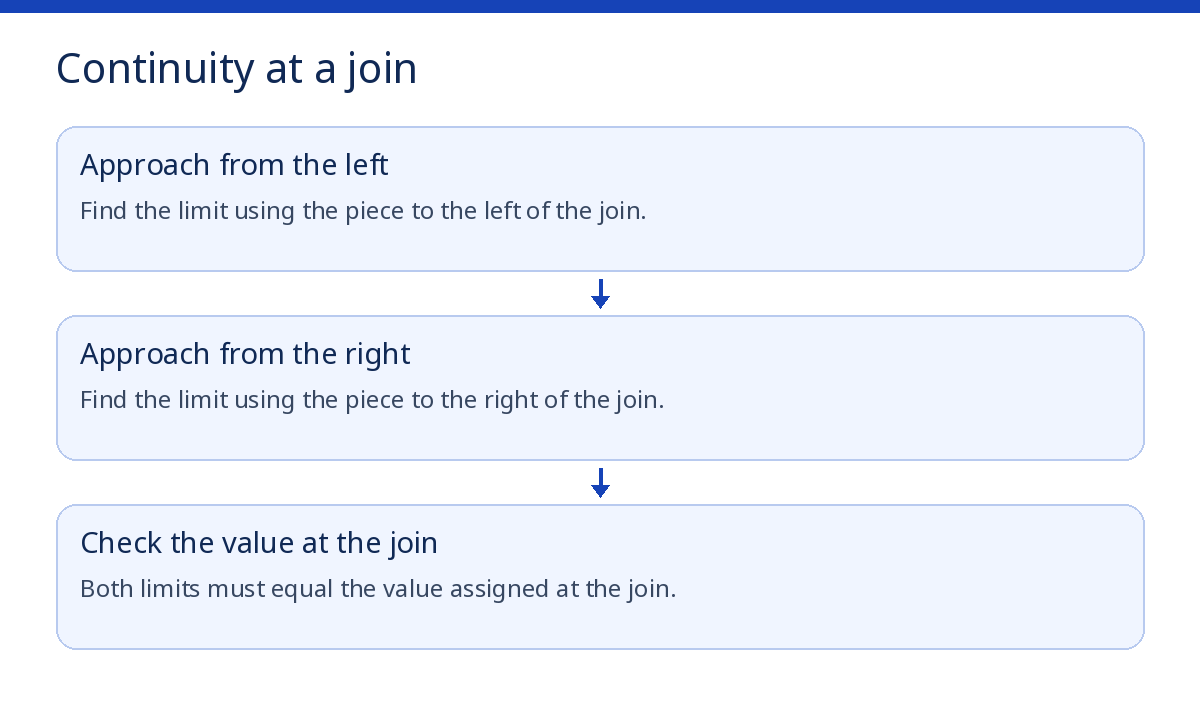
For a piecewise function, continuity within each piece does not settle continuity at the join. At that point, the left-hand limit and the right-hand limit must both exist and equal the function value. When reviewing a continuity argument, check whether it accounts for the value at the join as well as the behaviour on either side.
For monotonicity, the derivative sign must hold across the interval in question, not just at a convenient input. A strictly positive derivative throughout the interior of an interval implies strict increase there, with continuity at any included endpoints. When a derivative contains trigonometric terms, bounding those terms can justify its sign throughout the interval. The differential equations material makes a separate distinction: the highest derivative determines the order, but degree is defined only when the equation can be expressed as a polynomial in its derivatives.
Common mistakes: cancelling without checking
The matrices material gives you two different properties to keep apart. Associativity lets you regroup a product when the dimensions permit, but it does not let you swap the factors. The determinant product rule applies to square matrices of the same size. It remains valid when a determinant is zero; what fails in that case is any later step that divides by that determinant.
A similar distinction matters in integration. Factoring an expression can expose a common term, but cancelling it does not make the original integrand defined where its denominator was zero. Use the simplified expression on intervals where the original denominator is nonzero. For a definite integral, substitution also requires consistent limits: if you evaluate in the new variable, convert both endpoints to that variable first.
What the diagrams and case-study wording tell you
In vectors and three-dimensional geometry, distinguish a point from the vector that joins two points. A point on a line segment can be described with one division parameter, and the same parameter must work in every coordinate. For a triangle median, identify the midpoint first, then distinguish the vector from the vertex to that midpoint from the length of that vector.
In linear programming, equal objective values at two feasible points do not establish a maximum. For a bounded polygonal feasible region, compare objective values at the vertices before drawing that conclusion. In the probability case study, use the wording to identify the event being asked about and any information given as a condition. If a question gives a condition, it changes which outcomes are relevant to the probability calculation.
Before you move on: review the first missed decision
For a timed attempt, keep the worked solutions closed and follow the choices printed in the question paper. After the attempt, use the links to revisit questions you skipped or where your reasoning was uncertain. Start with the concept label, then compare the steps. Locating the first missed decision is more useful than simply seeing that your final result differs: you might have chosen a valid formula but applied it outside its domain, or used the right method and lost a sign later.
Try the alternate route in an internal choice during review, without counting it as extra time in the original attempt. This guide omits the answer statement and option for Q3 and does not reproduce the disputed results in the determinant and linear programming items. Use those items to notice where a conclusion needs an extra assumption or where a stated premise calls for a separate check.
Spotted an error? Report a correction. Practise this in the app: notes, formula sheets and mind maps.





























































































































































Loading comments…