CBSE Class 12 Mathematics 2025 Previous Year Paper (65/2/2)
CBSEMathematics2025 Previous Year Paper
Paper code: 65/2/2 · 2025Use the full 2025 CBSE Class 12 Mathematics main examination paper as a three-hour practice test, then use its worked solutions to check not just your results but the conditions and reasoning behind each method.
This set is one of the year's papers. See every set from 2025, grouped by series.
What’s in the 2025 paper file
This year-wise file contains the English version of the CBSE Class 12 Mathematics 2025 main examination, paper code 65/2/2. The paper allows 3 hours and carries 80 marks. The file preserves the original question layout, options and diagrams and provides worked solutions for all 38 questions, including both printed internal choices. Its question-number index lets you go directly to a solution when you are ready to review it.
This is a full board paper, not a chapter worksheet. The material includes matrices and determinants, inverse trigonometry, calculus, vectors and three-dimensional geometry, probability, and a linear programming objective. Working through the paper in order lets you practise identifying which concept a question calls for, without a chapter heading giving the method away.

Mathematics 2025 | Class 12 | Previous Year Paper | Code 65/2/2
In the StudentCurio app
Complete CBSE Class 12 Mathematics 2025 paper, code 65/2/2, with worked solutions across its questions and internal choices. Helps students practise board-exam questions and review solution methods across the syllabus.
Take the paper first, then open the solutions
For a timed attempt, use the question pages without opening the worked solutions. Follow the printed instructions for internal choices. Save the alternative you did not attempt for later: it gives you another question to try independently rather than another solution to read. Where a question uses a diagram, work from the printed figure and record how it informed your setup.
After the attempt, use the solution’s formula, concept and explanation in steps for different checks. The formula lets you compare setups; the concept helps you check why that setup fits; the steps show where the reasoning or calculation first diverged. Even when your final result agrees, look for a missing justification, such as a restriction on the input or a condition needed before dividing.
Common mistakes: factor order and principal values
In matrix algebra, distributing a product does not give you permission to reverse its factors. For square matrices of the same order, both and exist, but they need not be equal. Keep the order of each product when collecting terms, and check whether commutation is given or can be established before cancelling terms of opposite order. When reviewing transpose questions, distinguish the condition for a symmetric matrix, , from that for a skew-symmetric matrix, .
In inverse trigonometry, simplifying the input and choosing the output are separate steps. Periodicity can help simplify a trigonometric expression inside an inverse function, but the output must still lie in the inverse function’s principal range. For , that range is . An angle with the right sine is not necessarily the principal value.
Calculus: check the setup before the calculation
The calculus material gives you several kinds of setup to review. Differentiability at a point implies continuity there, but continuity alone does not guarantee differentiability: a corner can prevent the one-sided derivatives from agreeing. In a question about increasing behaviour, separate the sign of the derivative on the interior from what happens at an endpoint. A zero derivative at an endpoint does not by itself rule out strict increase on the interval.
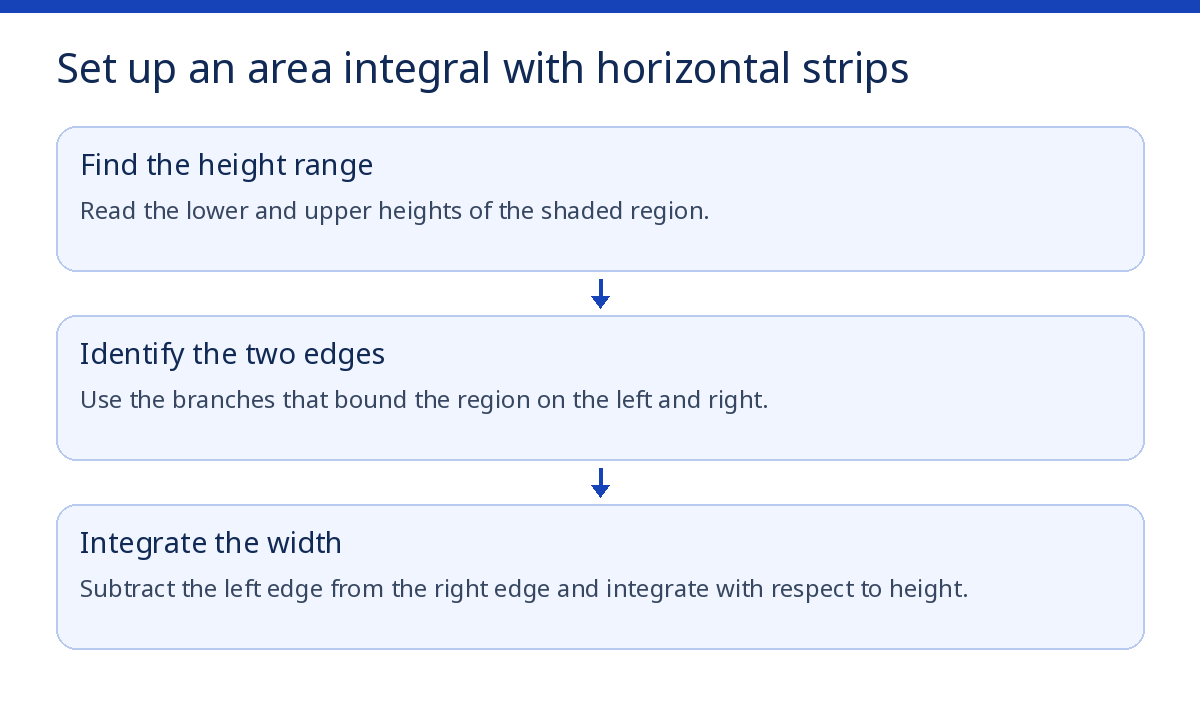
For area by integration, decide which way your strips run before writing the integral. With horizontal strips, express the width as the right-hand boundary minus the left-hand boundary and use bounds in . If a curve has more than one branch, the shaded region determines which branch supplies the boundary. In differential equations, expand a derivative when needed to identify the highest derivative; degree is defined only when the equation can be expressed as a polynomial in its derivatives.
Vectors and 3D geometry: read the representation
The vector material uses the scalar product to interpret an angle and the magnitude of a cross product to interpret area. For two nonzero vectors, a negative scalar product indicates an obtuse angle; the nonzero condition matters because the angle with the zero vector is undefined. For two side vectors from a common vertex, the cross-product magnitude gives the parallelogram area, so the triangle uses half that magnitude.
In a parametric line, distinguish the fixed point from the direction vector. The fixed point anchors the line, while varying the real parameter changes position along the direction. When checking component equations, use the same parameter in all three coordinates. The file flags an ambiguity in an axis-angle item; its disputed option and worked answer are omitted from this guide.
Probability and optimisation: identify each quantity’s role
A probability distribution and a conditional probability use different checks. In a discrete distribution, the probabilities across the outcomes must be nonnegative and sum to one. In a conditional probability, the denominator is the probability of the conditioning event, and it must be positive. When both events appear as complements, identify their intersection before simplifying it: the intersection of the complements is the complement of the union.
In linear programming, distinguish the objective function from the constraints. A profit objective combines quantities with their respective per-unit profits. The constraints specify which combinations are feasible; the objective tells you what to maximise or minimise among those combinations. When reviewing the paper, check that you can explain what the variables and coefficients represent before interpreting the expression.
Spotted an error? Report a correction. Practise this in the app: notes, formula sheets and mind maps.





























































































































































Loading comments…