CBSE Class 12 Mathematics 2023 Paper: Set 65/4/3
CBSEMathematics2023 Previous Year Paper
Paper code: 65/4/3 · 2023Use this complete English-language CBSE Class 12 Mathematics main examination paper for a three-hour practice attempt. Then use the worked solutions to check not just your answers, but why each method applies.
This set is one of the year's papers. See every set from 2023, grouped by series.
Know the format before you start
Set 65/4/3 is a full, year-wise paper from the 2023 main examination, not a chapter worksheet. It carries 80 marks and contains 38 questions across five sections. The paper prohibits calculators, so do your practice attempt without one if you want to match the original conditions.
Section A has 18 multiple-choice and two assertion–reason questions, all worth one mark each. Sections B, C and D have very short, short and long answers worth two, three and five marks per question, respectively. Section E has three case studies worth four marks each. There is no overall choice: attempt every question number, but answer only one alternative where an internal OR is printed. Afterward, you can use the other alternative as extra practice.

Mathematics 2023 | Class 12 | Previous Year Paper | Code 65/4/3
In the StudentCurio app
Complete CBSE Class 12 Mathematics examination paper for 2023, set 65/4/3, with worked solutions. It covers questions across the syllabus and helps students practise the exam and review solution methods.
What the algebra and functions questions test
The matrix questions move from checking whether a product is defined to finding a matrix inverse and using it to solve a system of linear equations. For multiplication, check the inner dimensions before computing entries. For the inverse method, first write the equations in matrix form, keeping the variables in a consistent order. The method requires an invertible coefficient matrix; for a square matrix, that means its determinant is nonzero.
The relations and functions tasks call for different kinds of justification. An equivalence-relation proof must establish reflexivity, symmetry and transitivity. For a function, being one-one means distinct inputs have distinct outputs, while being onto means every element of the stated codomain is reached. Check the domain and codomain before making either claim.
When the calculus rules apply
The paper covers differentiation, integration and differential equations, with tasks ranging from choosing a rule to interpreting a derivative or integral. With a composite function, identify each layer before differentiating: the chain rule includes the derivative of the inner expression, not just that of the outer function. An inverse sine expression has a separate domain check: its input must lie in for the value to be real.
In integration, distinguish a family of antiderivatives from a definite integral with specified limits. For the area task, a sketch helps identify the region enclosed by the parabola and its latus rectum before any integration begins. In a differential equation, note where any divisor is nonzero before rewriting the equation in standard form. Also check whether the question asks for a general solution or a particular one that satisfies a given condition.
Vectors and 3D geometry: identify the object first
The vector and geometry questions cover projection, unit vectors, angles and equations of lines. A direction vector describes the orientation of a line, but it does not tell you where that line is. To write a line equation, distinguish the direction information from the coordinates of a point on the line. To form a unit vector in the same direction as a given vector, the original vector must be nonzero.
Use the wording to decide whether you need a length, a component along a direction or an angle. For example, a point-to-axis distance is a perpendicular length, while the cross-product formula for the sine of an angle uses the magnitudes of two nonzero vectors.
Read the case studies as mathematical models
The three case studies use a construction schedule, a piecewise function and a garden bounded partly by a wall. In the probability case, distinguish a joint probability, which describes two events occurring together, from a conditional probability, which is calculated given that another event has occurred. Keep track of which event is given: reversing the condition changes the question. Elsewhere in the paper, a sampling question specifies replacement, so the probability of drawing a defective bulb stays the same on the next draw.
In the piecewise-function case, differentiability at the join requires both one-sided derivatives to exist and be equal. In the fencing case, the wall changes which sides use wire. Represent that constraint before expressing the area in one variable, and keep the dimensions physically possible when looking for a maximum.
Common graphing mistake: treating every boundary alike
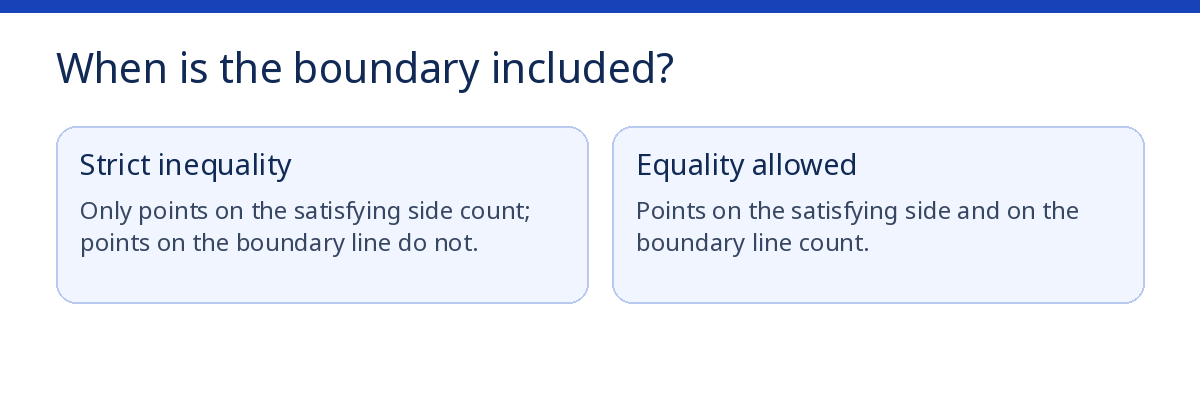
The paper tests linear inequalities directly and also asks for graphical linear programming. Start by drawing the line obtained by replacing an inequality sign with equality. That line separates the two half-planes, but a strict inequality excludes the boundary, whereas an inequality that allows equality includes it.
In the graphical optimisation question, the feasible region comes from satisfying all the constraints at once, including any restrictions on the signs of the variables. A point satisfying just one inequality is not necessarily feasible. Once you have the common region, distinguish the constraints that define it from the objective function you are asked to maximise.
Use the worked solutions to find the first wrong step
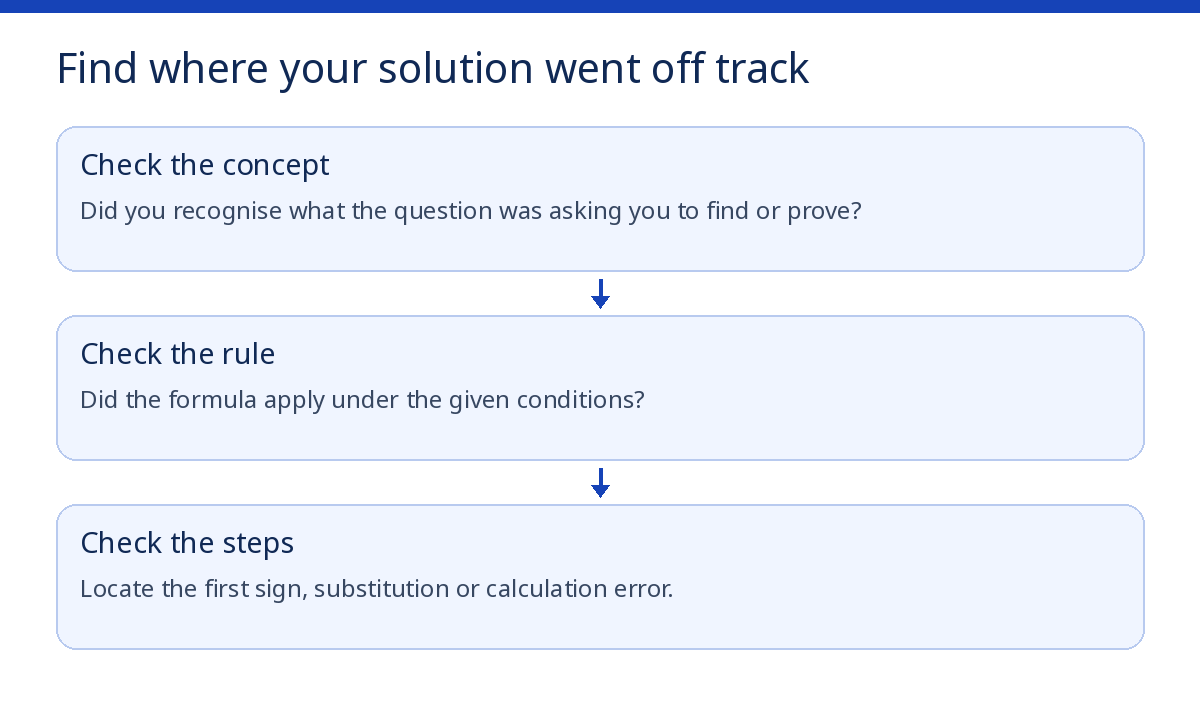
The file includes worked solutions for every question and subpart, including both printed OR choices. The visible solution pages separate the formula used, concept used and explanation in steps. After your timed attempt, use those labels to locate the first point where your reasoning diverged. If you chose the right method but lost a sign, your next step is different from what it would be if you applied a rule outside its domain.
For assertion–reason items, review two decisions separately: whether each statement is true, and whether the reason actually explains the assertion. For longer responses, check that your written reasoning justifies the method before comparing final results.
This guide omits final results and option letters for Q7, Q9, Q10 and Q13, and does not use the wording-sensitive line-division item as an example.
Spotted an error? Report a correction. Practise this in the app: notes, formula sheets and mind maps.





























































































































































Loading comments…