Class 12 CBSE Integrals: A Case-Based Assessment Guide
CBSEMathematicsIntegral Calculus
This CBSE Class 12 Mathematics assessment for Chapter 7, Integrals, contains eight case studies and 31 subquestions. Use it to practise choosing an integration method and checking the conditions that make it valid.
How to use the eight cases
Cases 1–4 use multiple-choice questions, while Cases 5–8 use short-answer questions. All questions come before the step-by-step solutions, which follow the same case order. The clickable index takes you to a case’s questions or solutions, and each subquestion has a link to its solution and a return link. There is no separate topic-practice or chapter-practice section in the file.
For the multiple-choice cases, write down the reason for your method before comparing the options. For the short-answer cases, make the key transformation visible in your working. When you open a solution, compare your first substantive step with the one in the file: did you choose the same variable, split the interval at the same place, or use a different valid method?

Integral Calculus | Class 12 | Case-based Assessment
In the StudentCurio app
Eight case studies practise substitution, integration by parts, definite-integral evaluation, and properties involving symmetry, reflection, even and odd functions, and piecewise integrands. Class 12 CBSE students can use the questions and step-by-step solutions for focused practice.
Substitution: account for the whole integrand
Case 1 covers change of variable in trigonometric and algebraic integrals. Substitution reverses the chain rule: look for an inner expression whose derivative accounts for another factor in the integrand, possibly up to a constant. Changing the expression inside a function is only half the job. The differential must change too, and the rewritten integral should use the new variable consistently. For an indefinite integral, return to the original variable and include the arbitrary constant.
The case’s verification note shows why a convenient rewrite can depend on the domain. Moving a squared denominator out of a square root introduces an absolute value, since . Replacing that absolute value by the variable without checking its sign can change the antiderivative. Differentiate a proposed primitive on the interval where you intend to use it.
Definite integrals: evaluate and subtract in order
Case 2 uses the Fundamental Theorem of Calculus. If the integrand is continuous on the given closed interval and is an antiderivative, the definite integral is . Unlike an indefinite integral, this gives a value rather than a family of functions: the same arbitrary constant at both endpoints cancels. Keep the entire lower-limit evaluation in parentheses so that subtraction applies to every term.
The questions give you practice with polynomial, exponential and rational integrands. In the solutions, means the natural logarithm. The absolute value in the antiderivative for the reciprocal function allows it to be used on negative as well as positive intervals, but it does not make the reciprocal defined at zero or justify evaluating across that point by endpoint subtraction.
Before you integrate, mark where the rule changes
Case 3 covers modulus expressions, the greatest-integer function and an explicitly piecewise function. Additivity lets you split a definite integral into adjacent subintervals and sum their integrals, provided the pieces are integrable. Choose interior split points where the formula changes. For a modulus expression, check the sign of what is inside the modulus on each piece; when the modulus is inside an exponential, the exponential remains in both branches.
For the greatest-integer function, look for jumps at integers rather than sign changes. Between consecutive integers, the function is constant. Its value at a single endpoint does not change the definite integral, so the value assigned at a jump need not be treated as another interval. Check that your pieces collectively cover the original interval without gaps.
Quick self-check: does the whole integrand have parity?
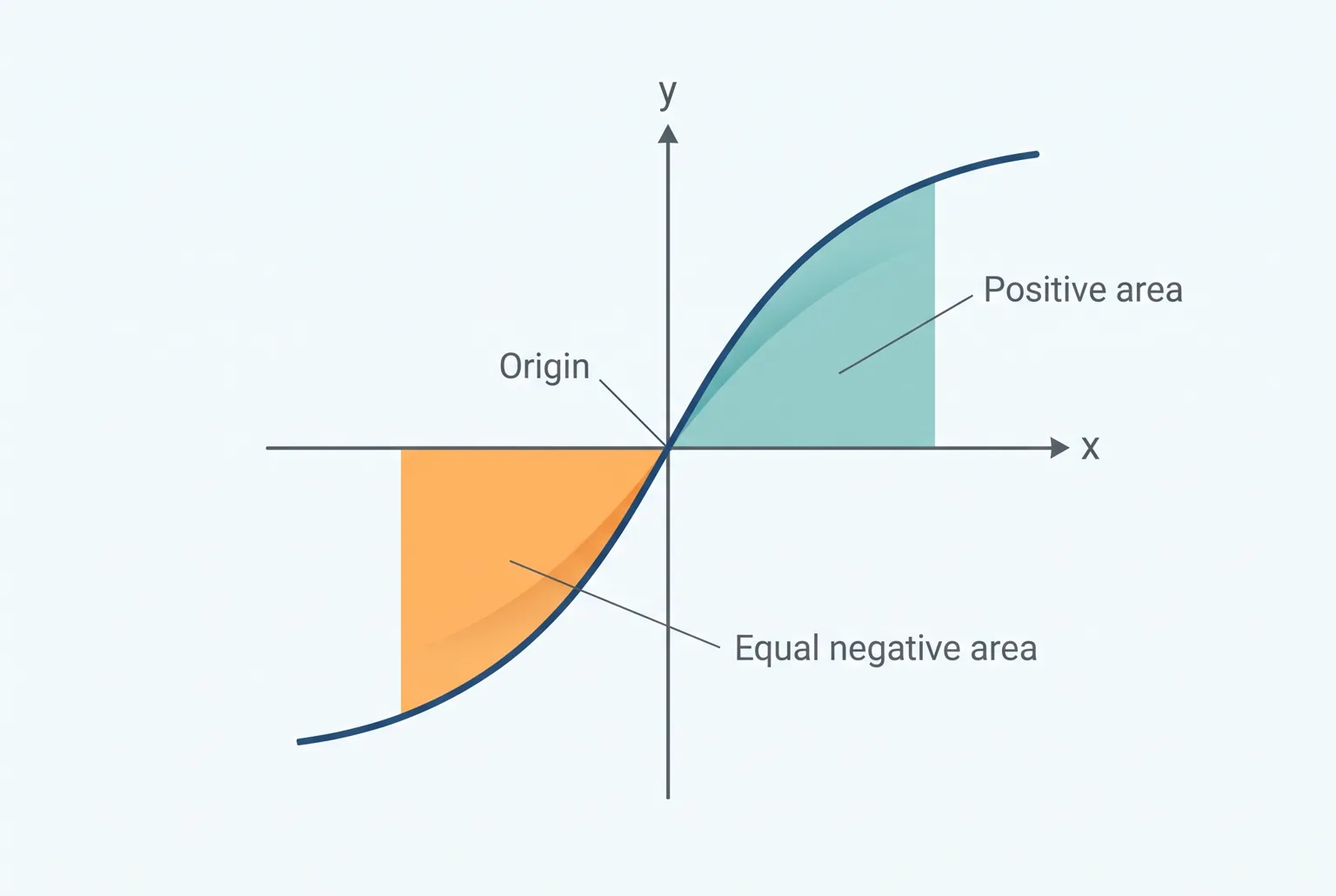
Case 4 uses symmetry on intervals centred at zero. For a continuous integrand on , an even function gives twice the integral over , while an odd function gives zero because opposite points contribute with opposite signs. To use either rule, substitute into the whole integrand and simplify. Symmetric limits alone do not establish parity, and one odd factor does not make a product odd: two odd factors give an even product.
Before opening a solution, ask whether you have shown that the reflected expression is identical to the original, its negative, or neither. The distinction matters because symmetry can eliminate an integral or reduce it to a shorter interval, but reducing the interval may still leave an integration step, such as integration by parts.
Recognising a product derivative or using parts
Case 5 works backwards from the product rule: . An exponential factor is not enough to apply this pattern. The remaining factor must be expressible as a function plus its derivative with respect to the current variable. The case shows that substitution or algebraic rewriting can make that relationship visible even when the original expression does not display it directly.
Case 6 uses integration by parts, which transfers a derivative from one factor to another. Choose a factor to differentiate and one whose antiderivative you can find. The worked steps show why it helps to keep track of terms from the original integral: an integral left over after applying parts can cancel another term. Read for that cancellation rather than assuming every integral that appears must be evaluated separately.
When midpoint reflection applies
Cases 7 and 8 move from reflection on to reflection on a general interval . On the general interval, the map exchanges the endpoints and pairs points equally far from the midpoint. A well-defined, integrable function and its reflected version have the same definite integral. Unlike the parity test, this comparison does not require an interval centred at zero.
The reflection cases ask you to compare the original expression with its reflected form before looking for an antiderivative. For a quotient, check that its denominator does not vanish and that the resulting integrand is integrable; continuity of the functions used to build the quotient is not enough. The verification notes also flag the need to check that any fractional powers are real and defined throughout the interval.
Spotted an error? Report a correction. Practise this in the app: notes, formula sheets and mind maps.





























































































































































Loading comments…