2026 CBSE Class 12 Mathematics Supplementary Paper
CBSEMathematics2026 Previous Year Paper
Paper code: 65/7/3 · 2026Use the complete English-language CBSE Class 12 Mathematics supplementary paper (2026, code 65/7/3) for a three-hour practice attempt. Then use the worked solutions to check which concept justified each method, not just whether your final answer matched.
This set is one of the year's papers. See every set from 2026, grouped by series.
What the five sections ask you to do
The paper carries 80 marks, contains 38 questions, and does not allow a calculator. It is organised by exam year, not by chapter, so a full attempt involves switching between topics as well as between answer formats.
Section A has 18 multiple-choice questions and two assertion–reason questions, each worth one mark. In assertion–reason questions, decide whether each statement is true before deciding whether the reason explains the assertion. Sections B, C and D contain very short, short and long answers worth two, three and five marks per question, respectively. Section E contains three case studies worth four marks each.
There is no overall choice. Where an internal choice is printed, attempt one alternative in that slot during your timed sitting. Save the other for review: it gives you a fresh task without turning the first attempt into a longer paper than the one prescribed.

Mathematics Supplementary 2026 | Class 12 | Previous Year Paper | Code 65/7/3
In the StudentCurio app
The complete 2026 CBSE Class 12 Mathematics supplementary examination paper (code 65/7/3), with worked solutions. It supports full-paper practice and review of solution methods, including questions involving three-dimensional geometry.
Good to remember: Check the domain before the rule
The paper tests continuity, inverse trigonometric functions and bijectivity. For a piecewise function, check each point where the defining rule changes. Continuity there requires the left- and right-hand limits to exist, agree with each other and equal the function value. Substituting into the branch that defines the value at the join checks only one part of that condition.
For an inverse trigonometric expression, an angle that gives the right trigonometric value is not enough: it must also lie in the inverse function’s principal range. For example, inverse sine returns values in . When reviewing a bijectivity question, keep the declared domain and codomain in view. Distinct inputs must have distinct images, and every element of the codomain must be reached.
Calculus: Link the calculation to what it represents
The differentiation questions include implicit differentiation, motion and extrema. In the motion setting, the first derivative of displacement is velocity and the second is acceleration. Finding when acceleration is zero identifies a time to examine; it does not tell you the velocity without a separate evaluation. For an extrema problem on a closed interval, compare values at the endpoints with those at eligible interior points rather than stopping at the first stationary point.
The integration material includes definite integrals and areas bounded by curves or lines. The worked area solutions include shaded graphs. Compare the shaded region with the bounds in your setup: for a vertical slice, its height is the upper boundary minus the lower boundary. If the order of those boundaries changes, split the integral where it changes. The paper also includes a differential equation, where the unknown is a function rather than a single numerical value.
Matrices and linear programming: Read the setup carefully
Matrix questions move between equality, multiplication, transpose properties, determinants and solving simultaneous equations. Matching corresponding entries is the test for matrix equality when the orders agree. In a product, by contrast, an entry comes from pairing a row of the first matrix with a column of the second, and the inner dimensions must match. When reviewing a determinant calculation, distinguish scaling a matrix from scaling its determinant: the effect on the determinant depends on the order of the square matrix.
In the graphical linear programming tasks, finding the feasible region and minimising the objective are distinct steps. A corner is a candidate only if it satisfies every constraint, including non-negativity. Read the command carefully: one task asks for shading and corner coordinates, while another asks for graphical minimisation.
Three-dimensional geometry: Separate position from direction
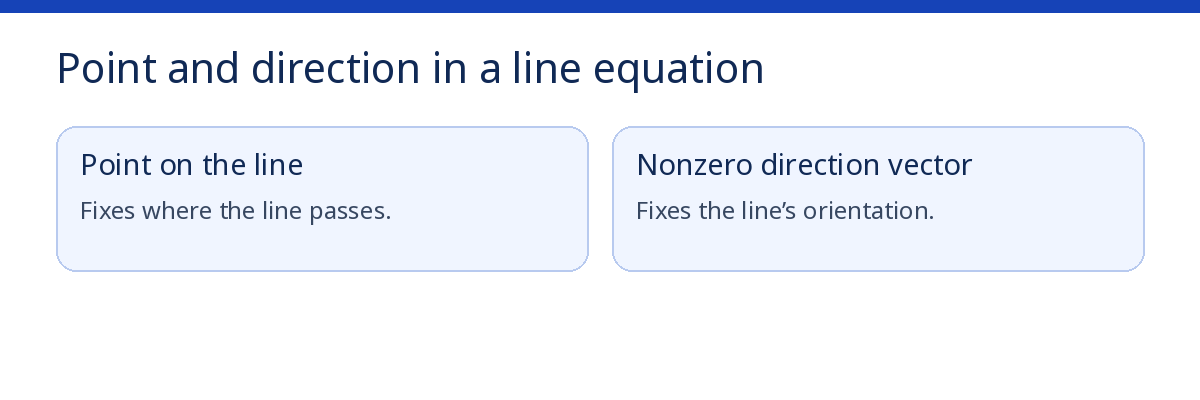
The paper uses line equations in both short-answer work and a swimming-pool case study. When representing a line, a point fixes its position and a nonzero direction vector fixes its orientation. A parallel line through a specified point can use the same direction, but its equation must use a point on that new line. A zero dot product between two nonzero direction vectors shows that the directions are perpendicular; it does not establish that the lines meet.
The foot of a perpendicular is a point on a line; the shortest distance is a length. Before choosing a distance formula, check whether the lines are parallel. A formula that divides by the magnitude of the cross product of their directions cannot apply when that cross product is zero.
Quick self-check: What are you conditioning on?
Probability appears in short questions and in the construction-company case study. For conditional probability, name the event after “given” before calculating: that event defines the restricted sample space and must have positive probability. In the case study, distinguish the probability of a construction outcome given a company from the probability of a company having been selected given an observed outcome. Those are different questions.
Also check whether the task involves independence or mutual exclusivity. Independence concerns whether one event changes the probability of the other; mutual exclusivity means they cannot occur together. In a draw without replacement, do not assume the probabilities for successive draws are unchanged.
Use the worked solutions to find your first wrong step
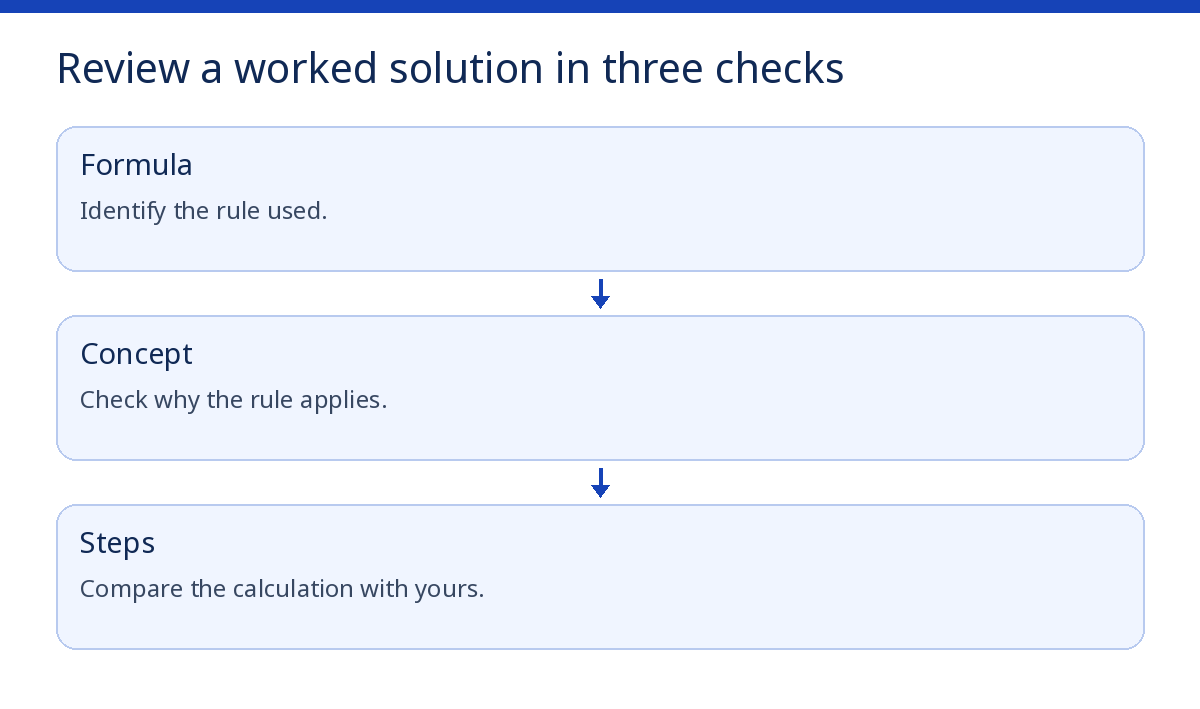
Attempt the question paper before opening the linked solutions. Each worked solution separates the formula, the concept and the explanation in steps. Compare them in that order: did you choose a valid rule, recognise why it applied, and carry out the calculation correctly? In a case study, also check whether your setup used the relationships stated in the prompt before you started calculating.
This guide leaves out Q19’s verdict because the worked solution qualifies it based on the library’s collection. It also leaves out Q27’s differentiation example because the printed expression has no real interval on which the stated differentiation applies.
Spotted an error? Report a correction. Practise this in the app: notes, formula sheets and mind maps.





























































































































































Loading comments…