Class 12 CBSE Differential Equations Assessment Guide
CBSEMathematicsDifferential Equations
This CBSE Class 12 Mathematics assessment has 222 questions with worked solutions. Use the topic sets to practise classification, separation of variables, homogeneous equations and integrating factors, then use Chapter Practice to test whether you can choose a method without a topic label.
How the assessment is organised
The file is divided into three topic practices and one mixed Chapter Practice. The first set has 25 questions on order, degree and solutions. The second has 77 on methods for first-order and first-degree equations, and the third has 45 on linear differential equations. The 75-question Chapter Practice brings these skills together and includes case-based questions alongside objective, very short-answer, short-answer and long-answer questions.
The chapter index lists printed page numbers for the questions and their worked solutions. You can select a question type to find its practice block or select an individual question number to open its solution. Because numbering restarts in each practice, note the set as well as the number when marking a question to revisit.

Differential Equations | Class 12 | CBSE Assessment
In the StudentCurio app
A Class 12 assessment covering differential-equation basics, separation of variables, and homogeneous and first-order linear equations, including integrating-factor methods and worked solutions. Objective, short-answer, long-answer and case-based questions help students practise CBSE-style problems and applications such as Newton’s law of cooling.
Order, degree and what it means to verify a solution
Order identifies the highest derivative present. Degree is the power of that highest-order derivative once the equation is expressed as a polynomial in its derivatives. It is not the largest power that appears anywhere in the equation. If the equation cannot be put in polynomial form in its derivatives, its degree is undefined. When clearing a denominator or removing a radical, keep track of the restrictions in the original equation.
The first topic set also asks you to verify proposed solutions. Here you are not being asked to derive a solution from scratch. Differentiate the supplied relation, implicitly if necessary, and substitute into the original equation. A verification is complete only where the required derivatives and expressions are defined. If the question gives an initial condition, check it separately: satisfying the equation does not by itself show that the proposed solution passes through the specified point.
Common mistake: dividing before checking what can vanish
Separation of variables applies when the equation can be rearranged so that the factor accompanying depends only on and the factor accompanying depends only on . Some expressions in Topic Practice 2 need to be factored before this structure becomes visible. Look for that structure before integrating; an expression containing both variables is not necessarily inseparable.
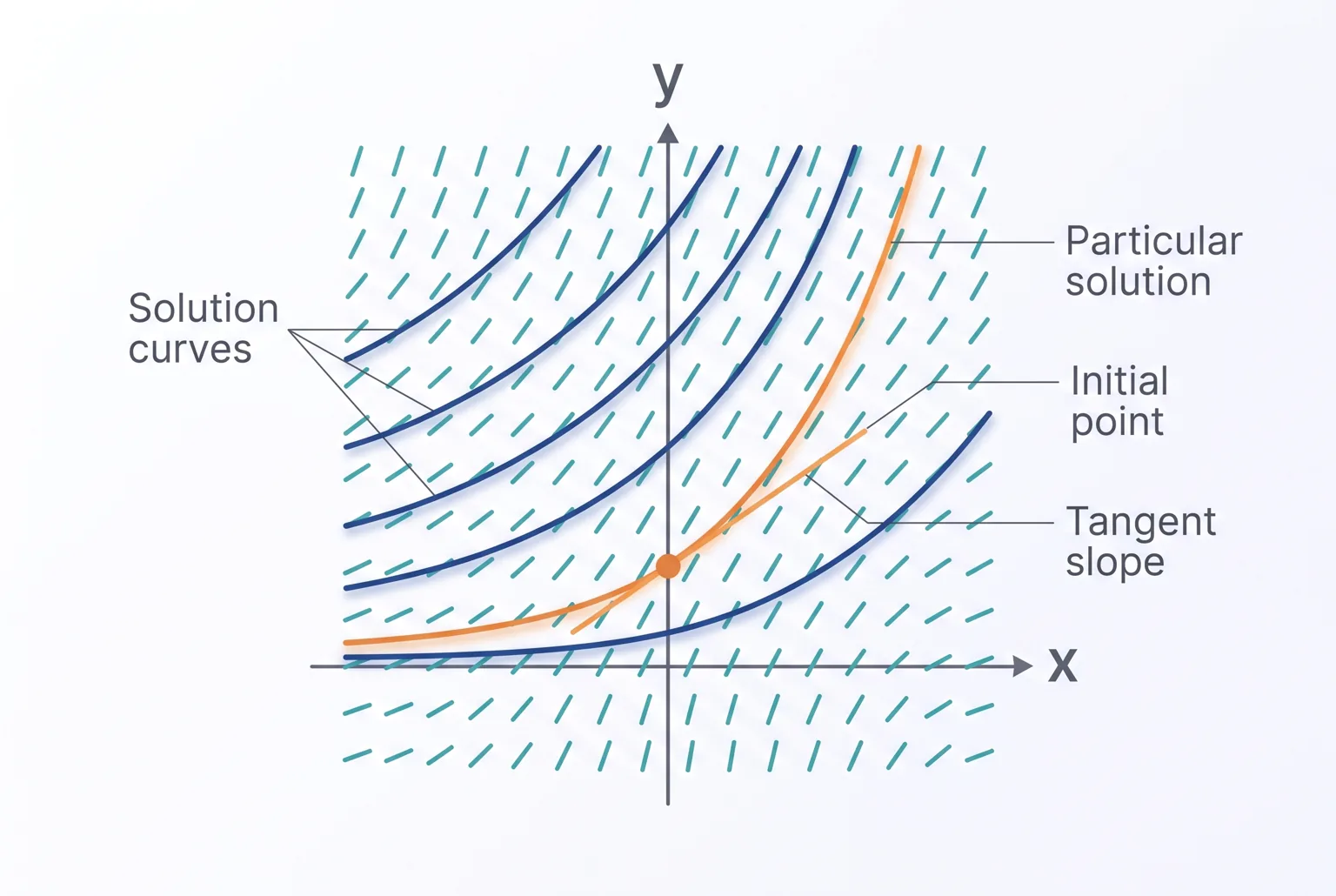
If you divide by a factor involving , check separately whether a value that makes it zero gives a constant solution of the original equation. Division can remove such solutions from the calculation. Also distinguish a general solution containing an arbitrary constant from a particular solution selected by a condition. The assessment includes both, as well as questions where a condition is used before evaluating the solution at another point.
When a homogeneous substitution applies
In the first-order homogeneous method, look for a slope that can be written entirely as a function of the ratio . On an interval where and the slope is defined, set . The product rule gives , which is the step that lets the transformed equation be approached by separation. Some questions instead use expressions in , so it can be useful to work with as a function of , where that formulation is valid.
The assessment tests recognition as well as substitution. Before choosing this method, try rewriting the entire slope in terms of one ratio. Seeing a single ratio in the question is not enough if other terms still depend on the variables separately.
The integrating factor comes after standard form
For a first-order linear equation in , first write . If the derivative initially has a coefficient, divide by it only on an interval where it is nonzero. Read from the resulting equation, including its sign. The integrating factor is on an interval where the coefficients are continuous. Its purpose is to turn the left side, after multiplication, into the single product derivative .
Topic Practice 3 includes questions that ask only for the factor and others that ask for a general or particular solution. It also includes equations linear in when is the independent variable. In that form, use the coefficient of after normalising , and integrate with respect to .
Read the rate statement before choosing a method
The applications connect an equation to the quantity that actually changes. Topic Practice 2 includes continuous population and bank-balance growth, as well as a balloon problem that specifies a constant rate of change of volume, not radius. Those are different models: a constant rate is not the same as a rate proportional to the current amount. In tangent-slope questions, the description instead tells you what represents at a point on the curve.
The assessment also lists Newton’s law of cooling among its applications. In that model, with constant surroundings temperature, the rate depends on the difference between the object’s temperature and its surroundings. Identifying that difference is part of setting up the equation, not a step to leave until after integration.
Quick self-check before opening a worked solution
Use Chapter Practice to check decisions that the topic headings make for you in the earlier sets. Before calculating, ask: Is this question asking me to classify, verify or solve? If it asks me to solve, can I justify my first rearrangement, and does it exclude any values? If there is an initial condition, does the point lie where the original equation is defined?
Then use the indexed worked solution to compare the first step where your approaches differ. A wrong method choice, a sign error when putting a linear equation in standard form and a missed condition call for different kinds of revision, even if all three produce an incorrect final expression.
Spotted an error? Report a correction. Practise this in the app: notes, formula sheets and mind maps.





























































































































































Loading comments…