Vector Algebra: CBSE Class 12 NCERT Textbook Guide
CBSEMathematicsVector Algebra
This NCERT chapter for CBSE Class 12 Mathematics connects directed line segments with coordinate calculations. Its worked examples and exercises cover vector addition, components and points in space, while the chapter also introduces dot and cross products and their uses in projections and areas.
Read a vector as a directed displacement
The chapter begins with a distinction that matters throughout: a scalar gives a numerical value, while a vector has magnitude and direction. Speed is a scalar; velocity is a vector. On a diagram, the length of a directed segment gives the magnitude, and the arrow points from the initial point to the terminal point. Magnitude cannot be negative, and the zero vector has no definite direction.
NCERT works with free vectors, so an arrow can be moved parallel to itself without changing the vector it represents. That is why equal vectors need not start at the same point. Coinitial vectors, by contrast, share a starting point but need not be equal. Collinear vectors are parallel to the same line and may point in opposite directions.

Vector Algebra | Class 12 | NCERT Textbook
In the StudentCurio app
This textbook chapter covers vector basics, addition and components, followed by scalar and vector products, their properties and applications to projections and areas. It includes worked examples and exercises to help Class 12 students learn and practise vector algebra.
See why the two addition laws agree
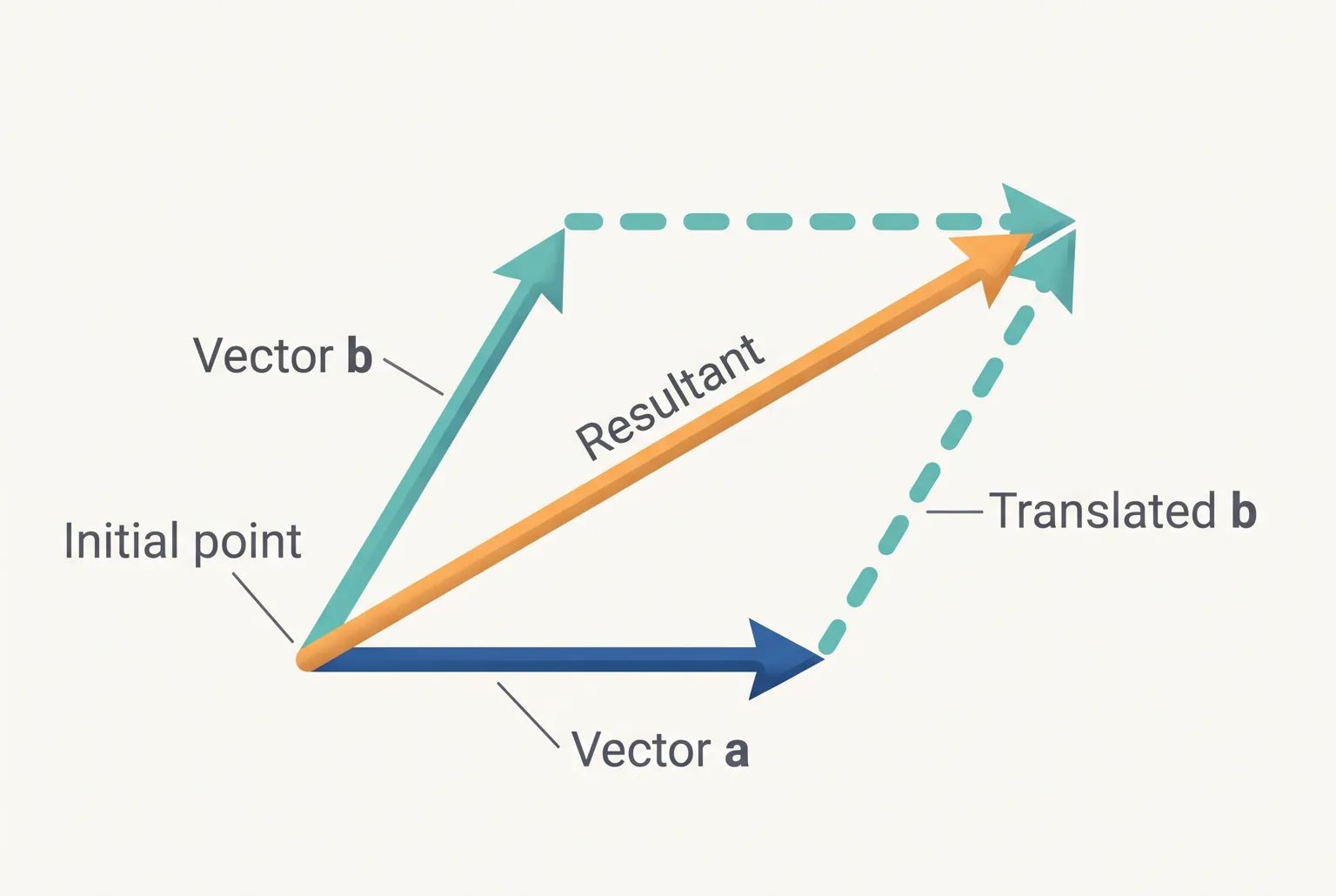
The triangle law treats addition as successive displacement. Place the second arrow with its tail at the head of the first. The resultant runs from the starting point of the first arrow to the endpoint of the second. If a chain of displacements returns to its starting point, its resultant is the zero vector, even though the individual displacements need not be zero.
The parallelogram law starts with the two arrows at a common point and takes the diagonal from that point. An opposite side of the parallelogram supplies the translated arrow used in the triangle law, so both constructions give the same sum. For subtraction, reverse the vector being subtracted and then use addition. Reversing the arrow changes its direction, not its length.
Translate the diagram into components
The position vector of a point runs from the origin to that point. In the rectangular coordinate system, it can be written as . NCERT distinguishes the three numerical scalar components from the three vector components, which include the corresponding axis unit vectors. Applying Pythagoras twice gives the magnitude as .
The component form turns addition and subtraction into operations on corresponding coordinates. Likewise, two vectors written in the same coordinate system are equal exactly when all corresponding components agree. For two nonzero vectors, collinearity requires a single nonzero multiplier that works for every component. Checking the component equations directly is safer than comparing quotients when a component in a denominator is zero.
When normalisation applies
Multiplying a nonzero vector by a positive scalar keeps its direction, while a negative scalar reverses it. In both cases the magnitude is multiplied by the absolute value of the scalar. A zero multiplier gives the zero vector. To keep the direction but obtain length one, divide the vector by its magnitude. This is normalisation, and it applies only to a nonzero vector.
The same operation explains direction cosines. For a nonzero vector, these are the cosines of its angles with the positive coordinate axes, and they are the components of the unit vector in its direction. Their squares sum to one. The original components can serve as direction ratios, but their squares need not sum to one. Keeping these terms separate helps distinguish information about direction from information about length.
Keep endpoint order and division type visible
A vector joining two points is not generally a position vector from the origin. To find the vector directed from one point to another, subtract the initial point’s position vector from the terminal point’s position vector. Reversing the order reverses the vector, although the distance between the points stays the same. Marking the initial and terminal points before calculating makes the subtraction order clear.
The section formula asks a different question: it finds the position vector of a point that divides the line joining two given points in a specified ratio. Internal division places the point between the endpoints, while external division places it outside the segment. The midpoint is the equal-ratio case of internal division. For external division of a segment with distinct endpoints, the two terms of the ratio cannot be equal.
Choose the product by what it returns
Multiplication by a scalar takes a number and a vector as inputs. The dot product and cross product each take two vectors, but the dot product returns a scalar and the cross product returns a vector. The chapter connects the dot product with angles and projections, and the cross product with area calculations.
For two nonzero vectors, the dot product multiplies their magnitudes by the cosine of the angle between them. This is why it is zero for perpendicular directions and negative when the angle is obtuse. If either vector is zero, the dot product is defined to be zero even though the angle is undefined. So a zero dot product establishes perpendicularity only after checking that both vectors are nonzero.
Quick self-check after the NCERT examples
Use Exercise 10.1 alongside the opening diagrams to practise reading the arrows before classifying the vectors. Can you tell which feature of the drawing determines whether two vectors are coinitial, and which features you need to compare for equality? In Exercise 10.2, the focus shifts to calculations involving components, directed segments, direction cosines and division of a segment.
Before computing, name the kind of result the question calls for: a length, a directed vector or the position vector of a point. When reviewing a worked example, use its diagram or wording to explain your choice of operation before comparing the algebra. This helps you locate whether a mistake came from interpreting the question or from carrying out the calculation.
Spotted an error? Report a correction. Practise this in the app: notes, formula sheets and mind maps.





























































































































































Loading comments…