CBSE Class 12 Mathematics 2023 Supplementary Paper
CBSEMathematics2023 Previous Year Paper
Paper code: 65/C/1 · 2023Use the full 2023 CBSE Class 12 Mathematics supplementary paper (65/C/1) for timed board-exam practice. Then use the worked solutions to check not just what you got, but why your method did or did not apply.
This set is one of the year's papers. See every set from 2023, grouped by series.
How the 2023 supplementary paper is organised
This year-wise resource contains the English version of the full supplementary paper. It has 38 questions, carries 80 marks and allows three hours, with no calculator. Section A contains 18 multiple-choice questions and two assertion–reason questions, each worth one mark. Sections B, C and D contain very short, short and long answers worth two, three and five marks per question, respectively. Section E contains three four-mark case studies.
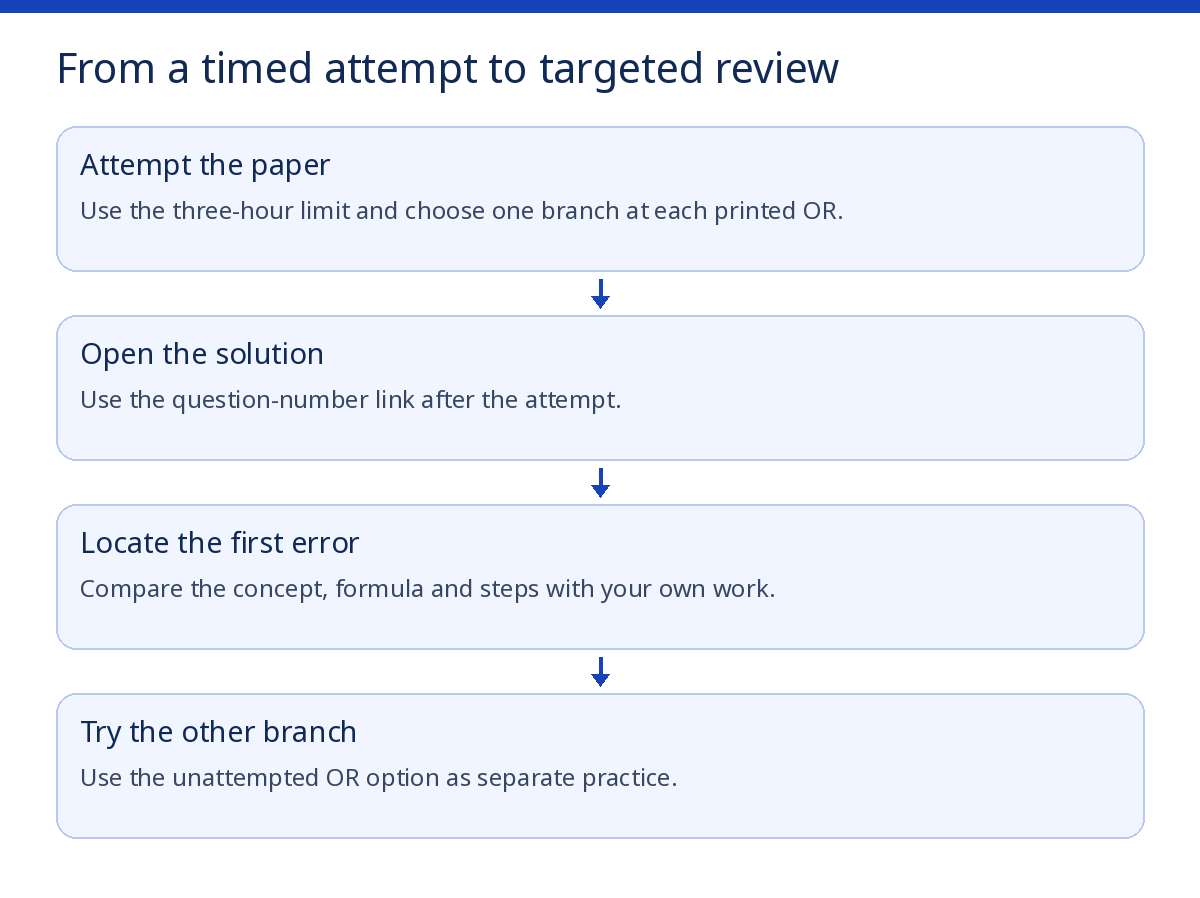
There is no overall choice: all question numbers are compulsory, but some questions in Sections B through E offer an internal OR. For a timed attempt, answer only one branch where an OR is printed. Save the other branch for review. In the assertion–reason questions, decide whether each statement is true before deciding whether the reason actually explains the assertion. Two true statements do not automatically form a valid explanation.

Mathematics Supplementary 2023 | Class 12 | Previous Year Paper | Code 65/C/1
In the StudentCurio app
A complete 2023 CBSE Class 12 Mathematics supplementary paper with worked solutions, covering questions across the syllabus, including applications of derivatives. It helps students practise board-exam questions and review solution methods.
Matrices and relations: check what the notation tells you
The paper tests matrices and determinants through shorter tasks on multiplication, cofactors and the adjugate, then asks you to use a matrix inverse in a five-mark system of equations. These tasks make different demands. A cofactor is a minor with a position-dependent sign; using an inverse requires an invertible coefficient matrix. When reviewing a matrix equation, check which side the inverse must multiply on. Matrix multiplication is not generally commutative, so changing that order can invalidate an otherwise correct calculation.
The questions on functions and relations call for a different kind of check. Whether a function is onto depends on its stated codomain, not just its formula. To establish an equivalence relation, verify reflexivity, symmetry and transitivity separately. To disprove one of those properties, a counterexample must violate that particular property on the stated set.
When a calculus method applies
The calculus questions range from continuity and increasing intervals to definite integration, differential equations and area by integration. At a point where a piecewise rule changes, checking continuity means comparing the two one-sided limits and the value of the function there. In a differential-equation question that asks for a particular solution, the given condition must be used; a family of solutions with an undetermined constant does not complete the task.
Integration also tests whether you can set up the problem before choosing an antiderivative. With absolute values, check where the expressions inside the modulus signs change sign within the interval. For an area bounded by lines, identify which line gives the upper boundary on each part of the interval if integrating with respect to . If that boundary changes, the integral needs to be split rather than treated as one unchanged difference.
Vectors, three-dimensional lines and feasible regions
Vector questions distinguish operations that can look similar on the page. A dot product gives a scalar; the signed scalar projection onto a nonzero vector divides the dot product by the length of that vector. In a line equation, the point locates the line and the direction vector determines its orientation. Parallel direction vectors need not have identical components. For an intersection, the two line equations must give the same point at the respective parameter values; matching direction information alone does not establish that.
Linear programming also separates two jobs: the inequalities determine which points are feasible, while the objective function assigns a value to those points. When reviewing a graphical solution, first check that the shaded region satisfies all the constraints. Only then check how the objective is evaluated. An objective value calculated at an infeasible point cannot establish an optimum.
Case-study self-check: what changes after you model it?
The probability case study selects a student and records the student's age. Ask yourself what is equally likely: the students or the distinct ages? Repeated ages matter when assigning probabilities to values of the random variable. If the question supplies information about the selected student's age, the conditional probability must use that information to restrict the outcomes under consideration.
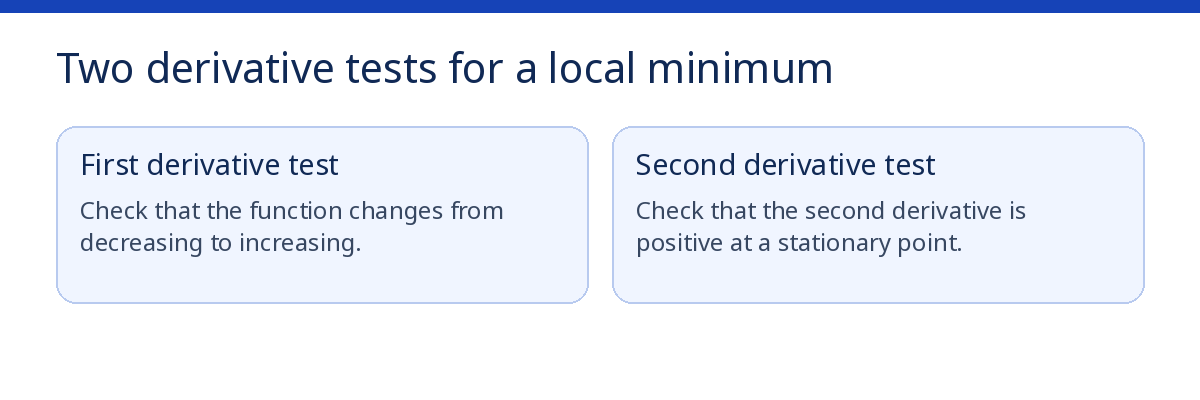
The swimming-pool case study uses a fixed capacity to express cost in terms of depth, then offers branches using the first or second derivative test. Ask why a critical point is only a candidate for a minimum. The first derivative test uses a change from decreasing to increasing; at a stationary point, a positive second derivative establishes a local minimum. If the task asks for an absolute minimum on a closed interval, endpoints must also be considered.
Use the worked solutions to diagnose errors
After attempting the paper, use the question-number links to open the relevant solutions. The file separates Formula used, Concept used and Explanation in steps. Compare your concept choice first, then look for the earliest step where your reasoning diverged. For example, distinguish choosing the wrong test for a minimum from choosing the right test but differentiating incorrectly. Those errors call for different kinds of revision.
Return to an unattempted OR branch to see whether you can choose a method without having the solution in view. On longer questions, review the setup and justification as well as the calculation: a matrix inverse, a graph or an integral is an intermediate step unless it answers what the question asks. This guide omits Q2’s endpoint evaluations, final numerical answer and answer-choice letter.
Spotted an error? Report a correction. Practise this in the app: notes, formula sheets and mind maps.





























































































































































Loading comments…