CBSE Class 12 Mathematics 2024 Paper, Set 65/2/3
CBSEMathematics2024 Previous Year Paper
Paper code: 65/2/3 · 2024Practise the full English-language 2024 CBSE Class 12 Mathematics Main Board Examination paper, set 65/2/3, under its original three-hour, 80-mark conditions. Then use the worked solutions to check not only your results but also the rules and assumptions behind your methods.
This set is one of the year's papers. See every set from 2024, grouped by series.
How the 2024 board paper is organised
This is a year-wise previous year paper, not a chapter-wise worksheet. Its 38 questions are arranged in five sections. Section A contains 18 multiple-choice questions followed by two assertion–reason questions, all worth one mark each. Sections B, C and D contain very short, short and long answers worth two, three and five marks per question, respectively. Section E contains three case studies worth four marks each.
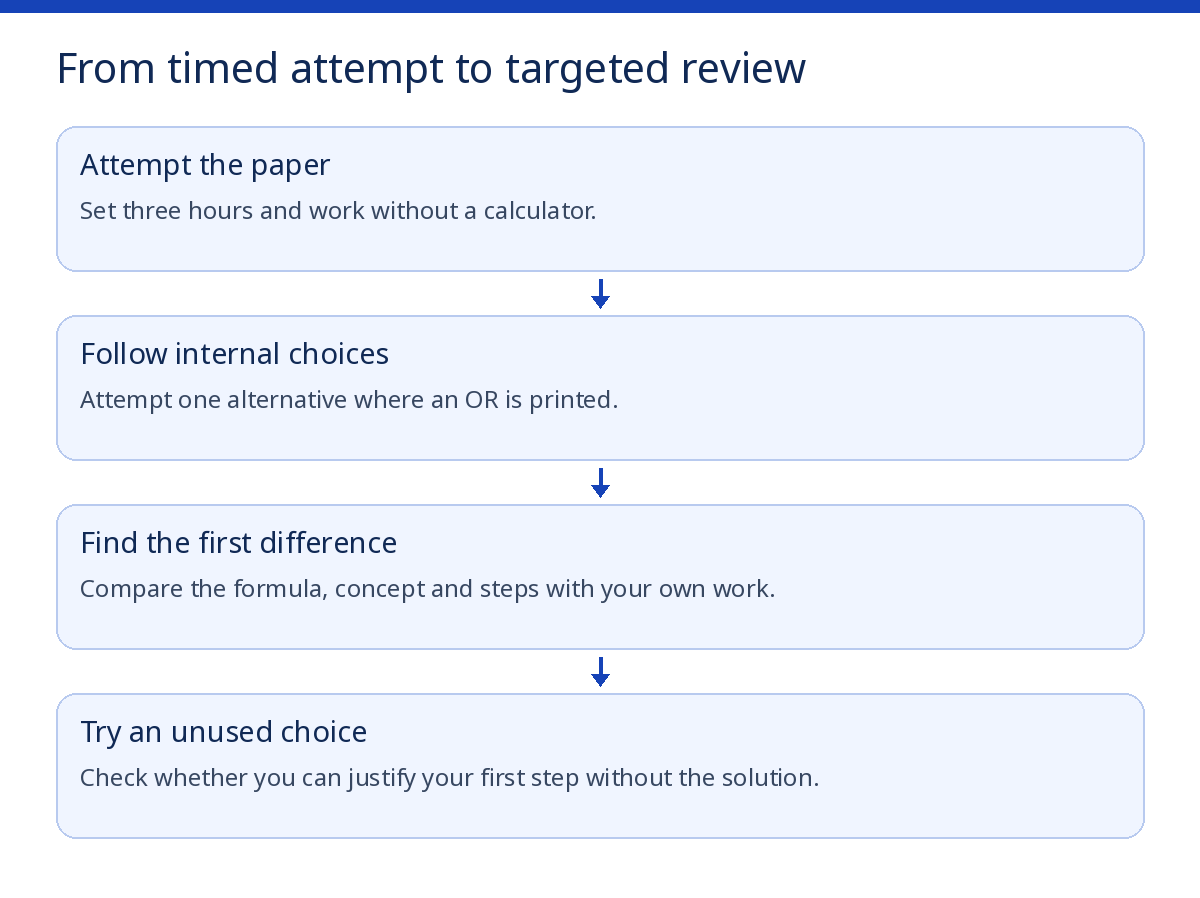
There is no overall choice. The printed instructions provide internal choices in two questions in Section B, three in Section C, two in Section D and two in Section E. For a timed attempt, follow those choices as printed and work without a calculator. Save the unused alternatives for review rather than treating them as extra questions to complete within the three hours.

Mathematics 2024 | Class 12 | Previous Year Paper | Code 65/2/3
In the StudentCurio app
The complete 2024 CBSE Class 12 Mathematics paper, set 65/2/3, with worked solutions covering topics across the syllabus, including calculus, matrices, vectors, probability and linear programming. Useful for practising the board-exam format and reviewing solution methods.
Functions and calculus: let the domain guide the method
The paper asks you to classify functions, examine continuity and use derivatives to study increasing or decreasing behaviour and local extrema. These tasks use related ideas but ask for different conclusions. To establish that a function is onto, compare its range with the stated codomain. To apply a derivative sign test for monotonicity, check the sign throughout the relevant interval, not just at one convenient input. For a piecewise function, continuity at a join requires the two one-sided limits to agree with the function value there.
Calculus also appears in antiderivatives, differential equations and area problems. For an area question, identify the actual bounding curves and lines before choosing limits. For a differential equation, distinguish a general solution from a particular solution obtained using the given condition.
When this rule applies: inverse cosine and square roots
The paper uses inverse trigonometric functions in evaluation, domain and range, and differentiation questions. A principal value is the value selected by the inverse function’s prescribed output range, not just any angle with the right trigonometric value. In differentiation, the real inverse cosine is defined for inputs in , but its standard derivative formula applies only for inputs in . For a composite function, check that condition on the inner expression before using the chain rule. The first worked solution explicitly separates the derivative’s valid interval from the algebra; its final expression and option letter are omitted here.
A sign check matters in integration too: for real . Remove the absolute value only after checking the sign on the interval given.
Matrices, vectors and three-dimensional lines
The matrix questions move between reading indexed entries, applying transpose properties, working with determinants and using matrices to solve simultaneous equations. As you review, identify what each operation acts on. An entry calculation uses a row and column index; a transpose interchanges them; and a determinant is a scalar associated with a square matrix. That distinction helps you choose a method before carrying out arithmetic.
In the geometry questions, vectors describe directions and help connect coordinates to angles and lines. The dot product gives a scalar, while a cross product of nonparallel vectors gives a vector perpendicular to both. If a unit perpendicular vector is required, the direction alone is not enough: a nonzero normal vector must be scaled to length one.
Case studies: distinguish the model from the calculation
Section E uses contexts involving air travel, fuel consumption and diet cost. In the probability case, keep track of which event is given: reversing the order of events in conditional probability changes what is being asked. The conditioning event must have positive probability. Elsewhere, the dice question asks for a probability distribution, so the focus is on assigning probabilities to the possible values of a random variable rather than finding the probability of just one event.
In the fuel case, distinguish the consumption rate, measured in litres per 100 kilometres, from the total fuel required for a journey. In the diet case, the feasible region describes choices that satisfy all constraints; the objective function measures the cost of those choices. An unbounded feasible region does not by itself settle whether a minimum exists.
Quick self-check before opening the worked solutions
Do one uninterrupted attempt before using the file’s question-number links. On an assertion–reason item, decide whether each statement is true before asking whether the reason explains the assertion. On a longer question, write down the method you chose and any condition it needs, even if you cannot finish. That gives you a specific decision to revisit when you open the solution.
The worked pages distinguish Formula used, Concept used and Explanation in steps. Use those labels to locate the first point where your reasoning diverged: did you choose a different rule, overlook a restriction or make an algebraic slip after a correct start? Then try an unused internal choice without looking at its solution. Before comparing methods, ask yourself: can I explain why my first step applies to this version of the question?
Spotted an error? Report a correction. Practise this in the app: notes, formula sheets and mind maps.





























































































































































Loading comments…