Matrices: NCERT Textbook Guide for CBSE Class 12
CBSEMathematicsMatrices
This guide to Chapter 3 of the NCERT Class 12 Mathematics textbook explains how to read matrices, decide which operations are defined, and use the worked examples and exercises to practise matrix algebra.
Read the array before calculating
The chapter opens with a familiar kind of table: the numbers of notebooks and pens owned by three students. You can put the students in rows and the items in columns, or swap those roles. Both arrangements record the same information, but they organise it differently. That distinction matters because a matrix is an ordered rectangular array: the position of an entry is part of what it represents. The chapter works with real numbers and real-valued functions as entries.
The order gives the number of rows first and the number of columns second. The entry lies in row and column , and the matrix has entries. When you know only the total number of entries, look for ordered pairs of positive integers whose product is that total. Reversing an unequal pair gives a different order, even though the entry count stays the same.

Matrices | Class 12 | NCERT Textbook
In the StudentCurio app
This textbook chapter covers matrix notation and types, matrix operations and multiplication, transpose, symmetric and skew-symmetric matrices, and invertible matrices, with worked examples and exercises. It helps Class 12 students build and practise core matrix algebra skills.
Classify matrices by shape and entries
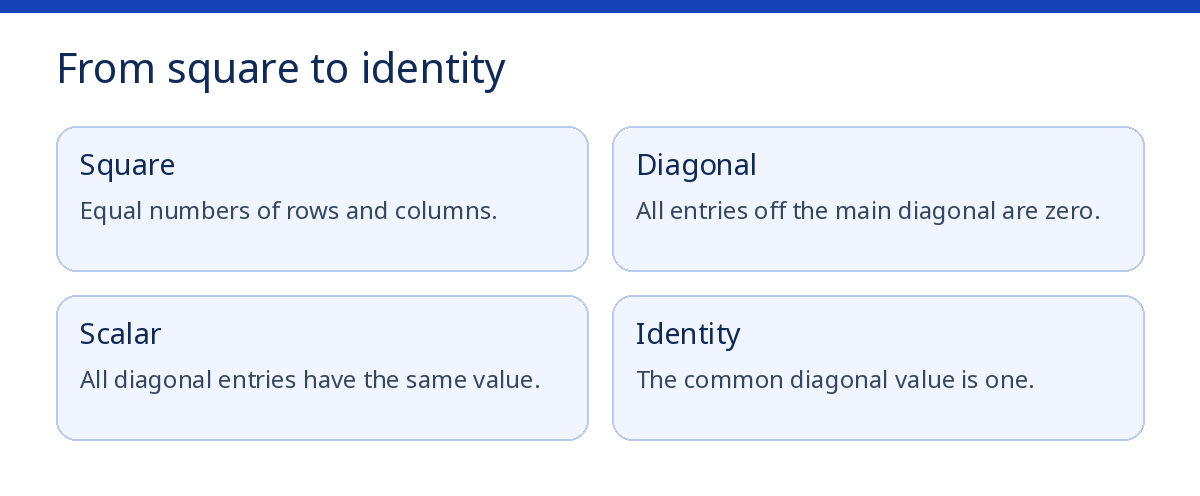
A row matrix has just one row, a column matrix has just one column, and a square matrix has as many rows as columns. Within a square matrix, the main diagonal consists of entries whose row and column indices match. A diagonal matrix must have zeros off that diagonal. A scalar matrix is a diagonal matrix whose diagonal entries are all equal; it is an identity matrix when that common value is one.
A zero matrix, by contrast, can be rectangular: the requirement is that every entry be zero. These labels are not always exclusive. An identity matrix, for example, is also scalar, diagonal and square. When classifying a matrix, separate what you can tell from its shape from what you need to check in its entries.
Common mistake: checking values but not positions
Two matrices are equal only when they have the same order and every pair of corresponding entries agrees. Having the same numbers somewhere in both arrays is not enough. This is why a matrix equation with unknown entries can be read as a set of ordinary equations: once the orders match, compare each position with that same position on the other side.
Exercise 3.1 gives you several ways to practise this attention to position. In an entry-reading task, locate the row before moving to the column. In a construction task, use the indices of each position in the given rule. In an equality task, write each comparison separately so you can see which entries supplied the equation.
Connect addition, subtraction and scaling
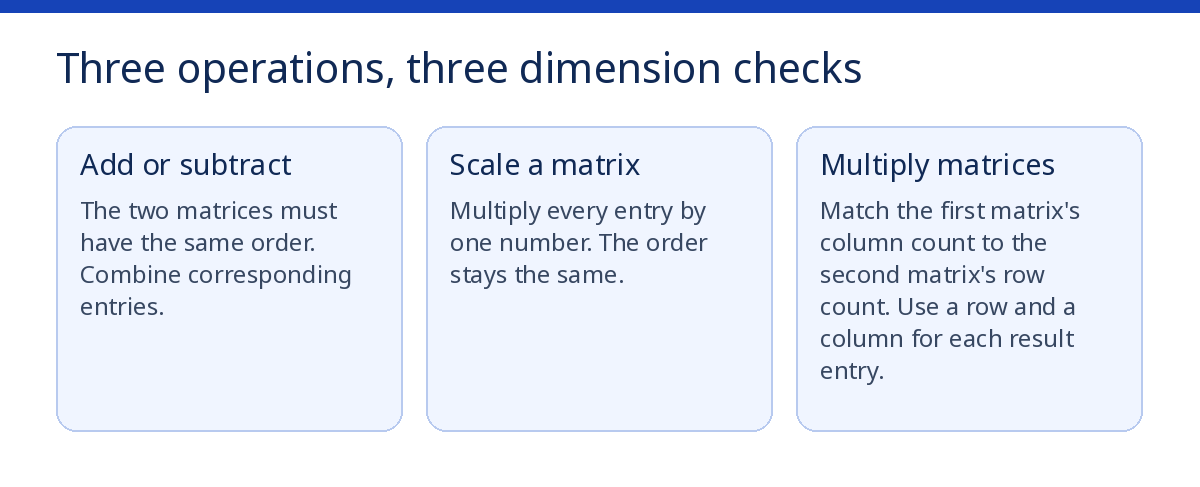
The shoe production example shows why matrix addition is entrywise. To combine production from two factories, you add quantities for the same category, not quantities that merely happen to be adjacent. In algebraic terms, addition and subtraction require matrices of the same order, and the result has that order too. In a data problem, also check that corresponding positions describe the same categories.
Scalar multiplication uses one number rather than a second matrix. It multiplies every entry without changing the order. Multiplying by gives the additive inverse , so subtraction can be written as . The chapter states both distributive rules, for matrices of the same order and for scalars and . The second rule is valid; the erroneous printed derivation labelled (iii) in Section 3.4.4 is omitted here.
Before multiplying, check the inner dimensions
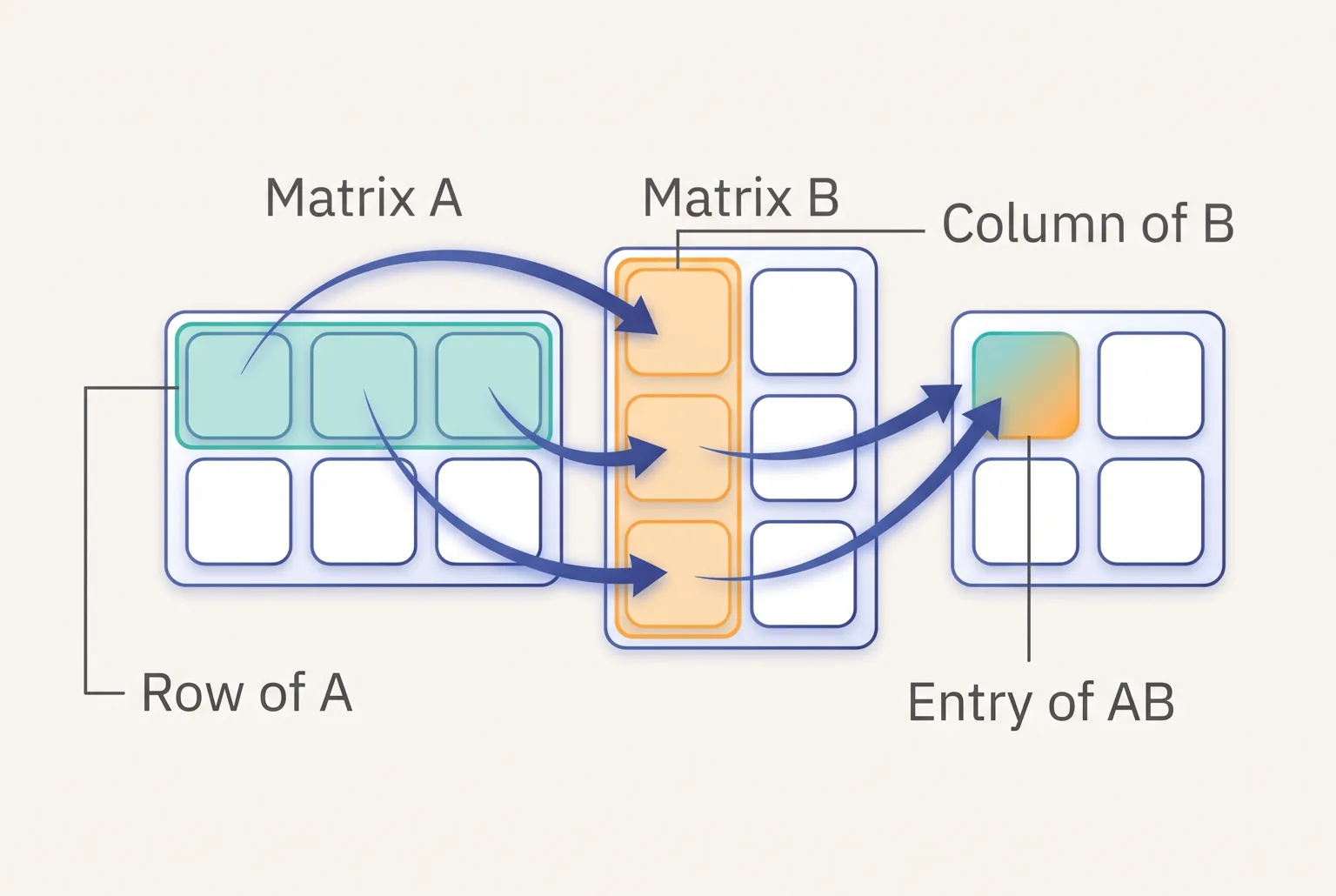
The shopping example introduces a different operation. A row of quantities is paired with a column of unit prices. Multiply the quantity of each item by its matching price, then add those products to get one total. The general rule follows the same pattern: an entry of comes from a row of and a column of , not from two entries occupying the same position.
If has order and has order , the product is defined and has order . The matching inner dimensions tell you how many pairs contribute to each sum. The outer dimensions tell you how many rows and columns to write in the result. Check separately: the reverse product may be undefined, and even when both products exist, they need not be equal.
Use transpose to recognise structure
Taking the transpose interchanges rows and columns, so a matrix of order becomes one of order . For square matrices, this operation makes it easy to compare entries on opposite sides of the main diagonal. A matrix is symmetric if , so those paired entries agree. It is skew-symmetric if , so those paired entries are negatives of each other. Over the real numbers, each diagonal entry of a skew-symmetric matrix must be zero because it equals its own negative.
The chapter also covers invertible matrices. Keep the two meanings of inverse distinct: adding to gives the zero matrix, but a multiplicative inverse, when it exists, gives the identity matrix on either side of the original square matrix. When following the textbook examples, look first at the operation and the required result. That tells you which definition to use before you start manipulating entries.
Spotted an error? Report a correction. Practise this in the app: notes, formula sheets and mind maps.





























































































































































Loading comments…