CBSE Class 12 Mathematics Supplementary 2022 Paper
CBSEMathematics2022 Previous Year Paper
Paper code: 65/6/3 · 2022Practise with the full English-language 2022 CBSE Class 12 Mathematics supplementary paper and use its worked solutions to review how you chose each method, set up the problem and checked your reasoning.
This set is one of the year's papers. See every set from 2022, grouped by series.
What this year-wise paper contains
This file contains the complete 2022 CBSE Class 12 Mathematics supplementary examination paper, set 65/6/3. The printed duration is 2 hours and the maximum is 40 marks. It is a year-wise resource: vector algebra, three-dimensional geometry, integration, differential equations and probability appear together in the order of the original paper rather than in separate chapter sets.
All three sections are compulsory. Section A has six 2-mark short-answer questions, Section B has four 3-mark short-answer questions, and Section C has four 4-mark long-answer questions. Some questions offer an internal choice, so a compulsory section does not mean you must attempt both alternatives. Question 14 is a probability case study with two 2-mark subparts. The file includes worked solutions for the subparts and both alternatives where an OR choice is printed.

Mathematics Supplementary 2022 | Class 12 | Previous Year Paper | Code 65/6/3
In the StudentCurio app
A complete CBSE Class 12 Mathematics supplementary examination paper from 2022 with worked solutions. It includes questions across topics such as vector algebra, three-dimensional geometry, integrals, differential equations and probability, helping students practise the board-paper format and review solution methods.
Vector algebra and 3D geometry: name the quantity first
The vector questions distinguish between a dot product, which gives a scalar, and a cross product, which gives a vector. Expanding the squared magnitude of a vector sum brings in pairwise dot products; if the vectors are unit vectors, their individual squared magnitudes are known. A cross product serves a different purpose: when it is nonzero, it gives a direction perpendicular to both input vectors. A zero cross product does not provide such a direction.
In three-dimensional geometry, finding where a line meets a plane is not the same task as finding a distance. An intersection point must satisfy both the line and the plane equations. The paper also distinguishes the distance between two specified points from the shortest separation of parallel lines, which is measured perpendicular to their common direction.
Integration: choose a method that simplifies the integrand
The integration questions reward noticing structure before starting a calculation. A product of sines can be rewritten as a sum or difference of cosines so that the terms can be integrated separately. In other questions, substitution is only the first step: the resulting integral can call for integration by parts or partial fractions. When reviewing the worked pages, ask what form the substitution created and why the next method fits that form.
Good to remember: In a definite integral, a change of variable changes the limits as well as the integrand. If the substitution reverses the direction of the interval, account for that reversal when writing the new limits. For real logarithms, check that the arguments are positive before splitting a logarithm into separate terms.
Area by integration: establish the region before the limits
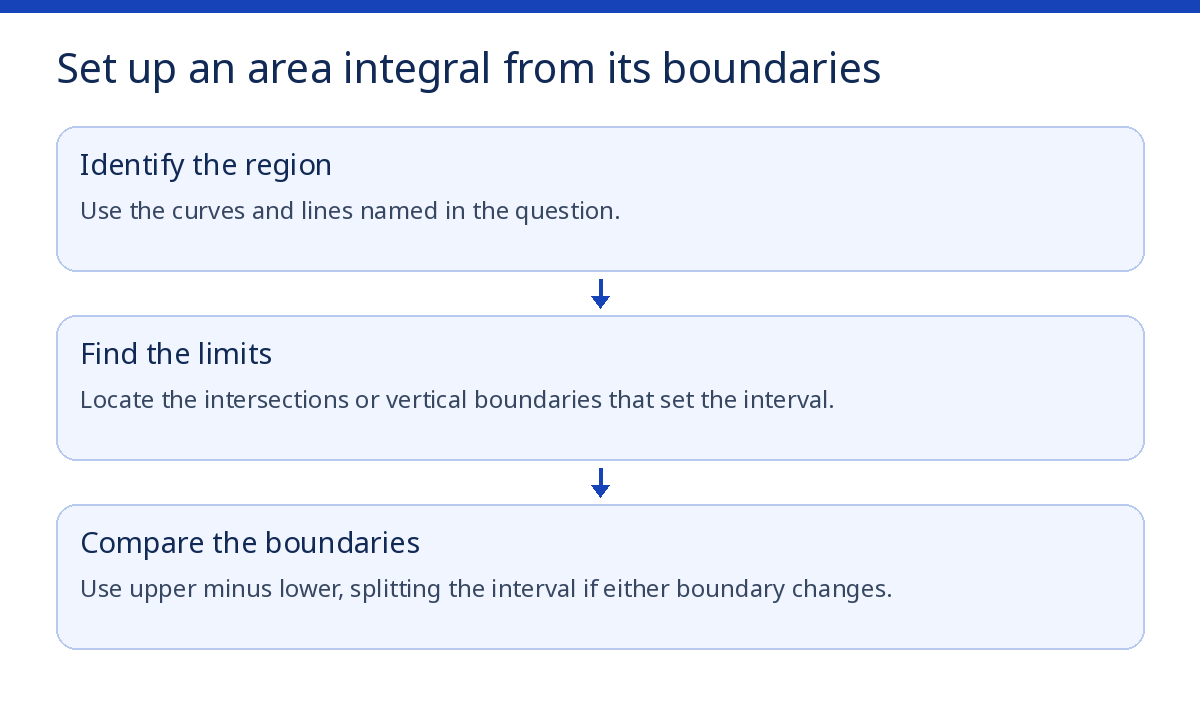
The area questions ask you to turn a geometric description into an integral. Start by identifying which curves or lines bound the required region and where those boundaries meet. With vertical slices, integrate upper boundary minus lower boundary over the relevant interval, provided those expressions describe the same region throughout that interval. If the upper or lower boundary changes, the setup must reflect the change rather than use one expression across the whole range.
Common mistake: Do not assume that naming the x-axis as a boundary automatically selects the upper branch of a sideways parabola. The guide omits the worked setup for the printed parabola alternative because the explanation does not establish why the upper branch alone is selected.
Differential equations: distinguish method, condition and domain
The paper asks for both a general solution and a particular solution. A general solution retains an arbitrary constant; an initial condition is used to determine that constant for a particular solution. Another question asks for order and degree rather than a solution. The order is the order of the highest derivative present. The degree, when the equation is polynomial in its derivatives, is the power of that highest-order derivative.
The worked pages illustrate two useful recognition skills: separating variables where the equation permits it and spotting when several terms form a product derivative. Keep domain checks alongside those algebraic steps. A real logarithm can restrict where the original equation is defined, while an initial value must lie in an interval on which the differential equation is defined.
Probability: track what changes the next draw
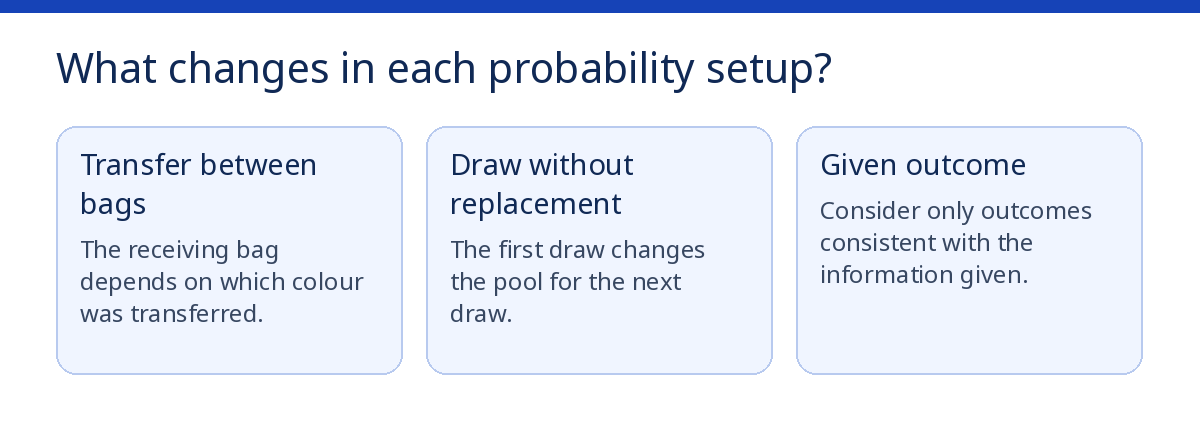
The probability questions use three different ways of narrowing or changing the outcomes. In the transfer between bags, the colour transferred determines the composition of the second bag. Treat the possible transfers as separate cases, then weight the probability of the desired draw in each case by the probability of that transfer. For the cards drawn without replacement, the first draw changes the pool for the second draw; the original counts do not apply unchanged.
In the biased-die case study, the face probabilities must sum to one, but the faces need not be equally likely. Quick self-check: When a question tells you that an even face has already occurred, which outcomes remain possible, and why must the denominator reflect only those outcomes?
Use the worked solutions to diagnose your first error
For a timed attempt, work from the question pages for the printed two hours and make one selection for each internal choice you encounter. Save the unchosen alternatives for later: because the file provides worked solutions for both options, they give you a second task at the same place in the paper without changing the conditions of your first attempt.
Afterwards, use the question-number links to find the corresponding Formula used, Concept used and Explanation in steps entries. Compare your work at the first point where the methods differ, not just at the final line. For example, separate a wrong boundary or conditioning event from an arithmetic slip after a correct setup. Then retry the question from that point without looking at the worked steps.
Spotted an error? Report a correction. Practise this in the app: notes, formula sheets and mind maps.





























































































































































Loading comments…