CBSE Class 12 Limits, Continuity and Differentiability
CBSEMathematicsLimit, Continuity and Differentiability
This CBSE Class 12 Mathematics case-based assessment connects limits and piecewise functions with the chain rule and other differentiation methods. Use its linked questions and worked solutions to check not only your calculations, but also where each rule applies.
What the assessment covers
The PDF is organised around Chapter 5, Continuity and Differentiability. Its 14 cases include multiple-choice and short-answer questions, with OR alternatives in Cases 3 and 4. All questions appear before the worked solutions, and the clickable index lets you open either section for a particular case. Individual questions also link to their solutions, with links back to the questions.
The index is useful when you want to practise a specific decision rather than work through the file in order. Case 2 pairs continuity of a sum with a piecewise continuity check. Cases 3 and 5 focus on one-sided derivatives, while Case 11 adds interval continuity and parameter restrictions. Cases 1 and 6 use parametric reasoning; Cases 12 and 14 focus on logarithmic and implicit differentiation, respectively.

Limit, Continuity and Differentiability | Class 12 | Case-based Assessment
In the StudentCurio app
Case-based questions and worked solutions cover limits, continuity, differentiability, piecewise functions, one-sided derivatives and standard differentiation rules, including chain-rule and implicit differentiation. Useful for Class 12 students practising CBSE-style case-study assessments.
At a piecewise join, compare three quantities
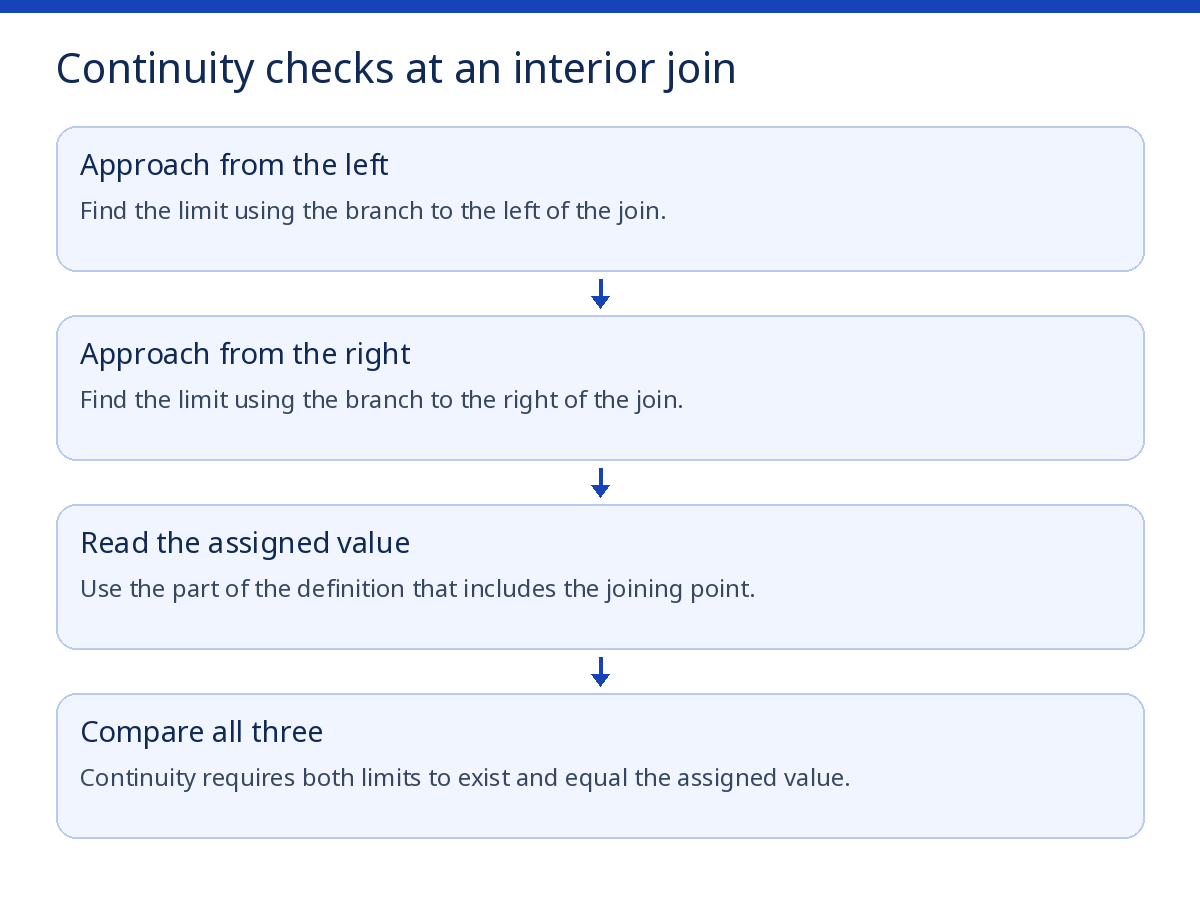
To test continuity at an interior joining point, find the left-hand limit, the right-hand limit and the actual function value. In a piecewise definition, the inequalities tell you which expression to use for each approach and which expression supplies the value at the point. Continuity requires the two limits to exist and both equal the function value. This is a different task from showing that a sum is continuous: there, the limit law for sums applies once both summands are known to be continuous at the point.
Case 8 practises distinguishing a removable discontinuity from a jump. If the two sides approach the same finite value but the assigned value differs, changing that single value can restore continuity. If the sides approach different finite values, changing the value at the join cannot make the limits agree. For continuity on a closed interval, as in Case 11, check each endpoint from inside the interval, not from both sides.
Common mistake: treating a branch derivative as a join derivative
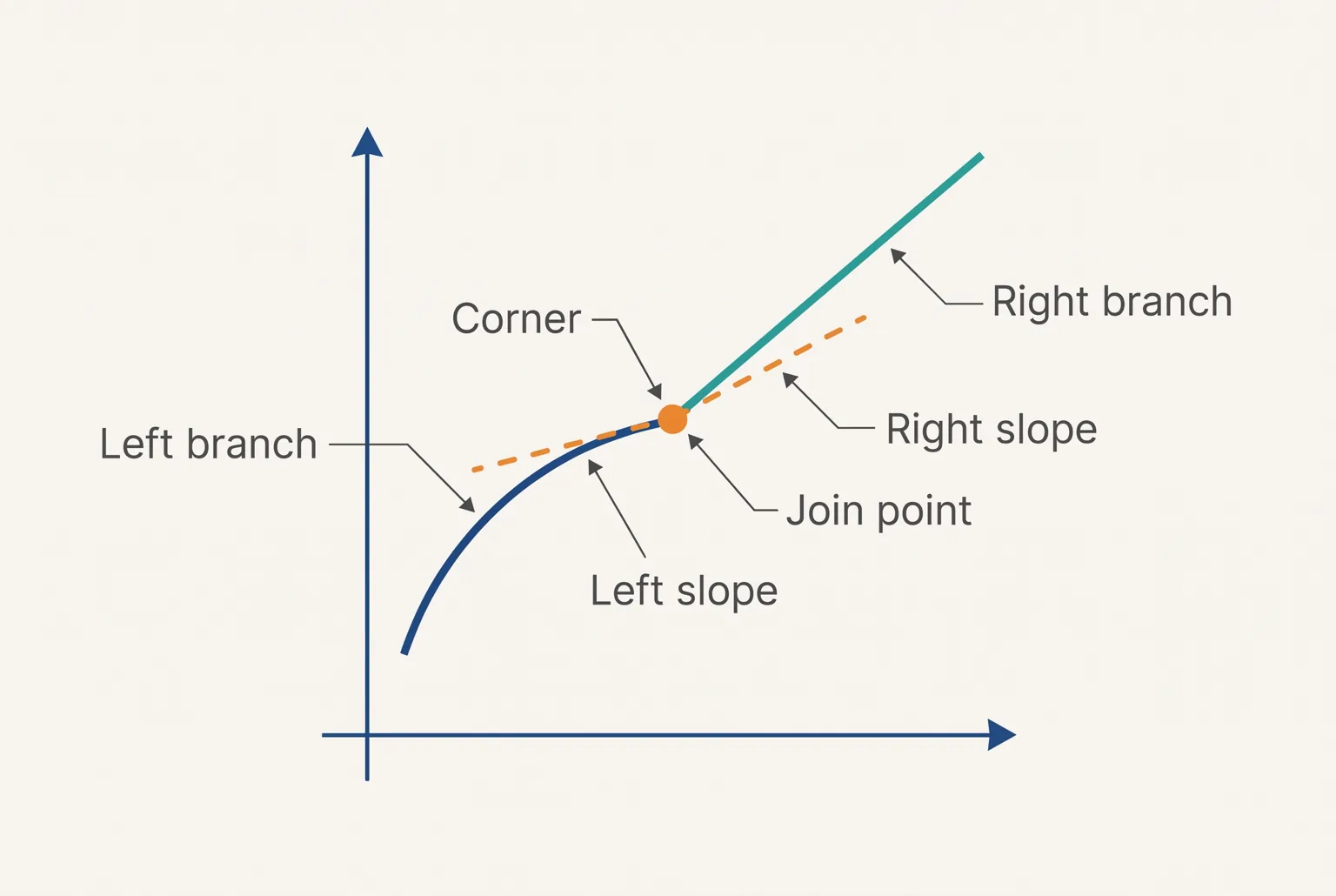
A derivative formula obtained on one side of a piecewise join does not by itself give the derivative at the join. Form each one-sided difference quotient using the actual value at the point. With a positive step size approaching zero, the left-hand quotient uses a negative increment in the denominator, while the right-hand quotient uses a positive one. At an interior point, a finite derivative exists only if both one-sided derivatives exist as finite numbers and agree.
This explains why continuity is a useful first check but not a complete test. Finite differentiability implies continuity, so a discontinuity rules out a finite derivative there. A continuous graph can still have a corner where its one-sided slopes disagree. The join cases let you practise separating the question about function values from the question about slopes.
One chain rule, two ways of using it
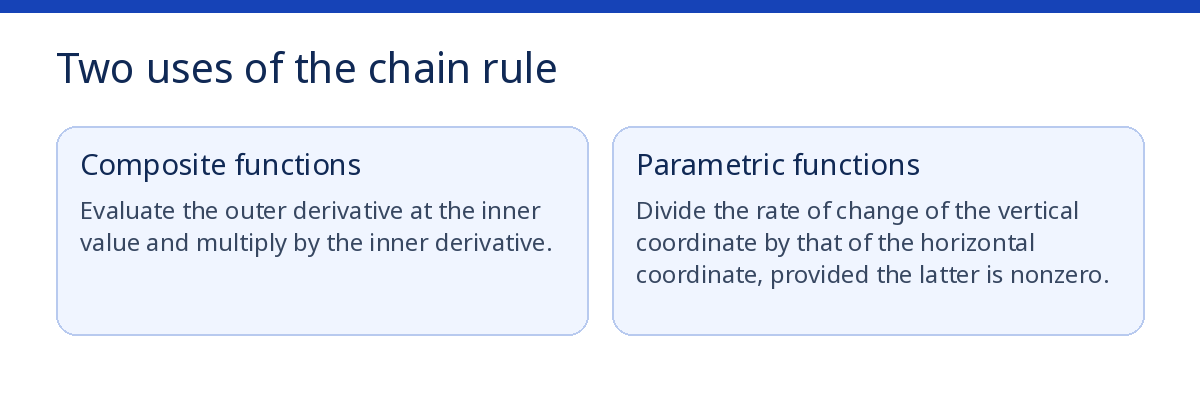
In the composite-function cases, identify the inner expression and the outer function before differentiating. The chain rule multiplies the derivative of the outer function, evaluated at the inner expression, by the derivative of the inner expression. The usual rule applies where the inner function is differentiable and the outer function is differentiable at the corresponding input. Writing down the inner expression first helps you see which factor must accompany the outer derivative.
In the parametric cases, both coordinates depend on a shared parameter. Differentiate both with respect to that parameter, then use where . The same reasoning applies when taking a derivative with respect to another function of a shared variable. If the denominator is zero, the ratio rule does not decide whether the derivative exists; it cannot be used at that point.
Before simplifying, check the domain and branch
The radical and inverse-trigonometric cases make domain checks part of the calculation. A real square root is nonnegative, so for real . Dropping the absolute value without checking the sign can give the wrong expression to differentiate. Likewise, an inverse trigonometric function returns values in its principal range; check that range before using an identity to simplify a composition.
Keep the domain of the function separate from the domain of its derivative. A function may be continuous at an included endpoint even when it has no finite one-sided derivative there. For higher derivatives, featured in Case 10, each new derivative comes from differentiating the previous one, where that further differentiation is defined.
Choose between logarithmic and implicit differentiation
Logarithmic differentiation is useful when both the base and exponent vary. For the real-valued variable-power method used in Case 12, work where the base and the resulting function are positive so that taking natural logarithms is valid. This turns the exponent into a factor before differentiation. Check the original domain before using a simplified derivative formula.
Implicit differentiation is useful when a relation contains both variables and you want the derivative without first isolating the dependent variable. Differentiate the relation with respect to the independent variable, treating the dependent variable as a function of it. The chain rule introduces its derivative when you differentiate a term through that variable. If isolating the derivative requires division, check that the divisor is nonzero before using the resulting formula.
Use the solutions to check your reasoning
Try a case in the questions section first. For a short answer, write down the condition that justifies your conclusion; for a multiple-choice question, identify the rule and its restrictions before looking at the options. Then follow the solution link and compare the first step where your reasoning differs, rather than checking only the final line.
For review, use the PDF’s verification notes alongside the worked solutions. This guide leaves out the printed derivative choices in Case 7(ii) and the blanket inverse-trigonometric claim and endpoint item in Case 9. It also states the one-sided tests without copying the undirected limit notation printed in some cases.
Spotted an error? Report a correction. Practise this in the app: notes, formula sheets and mind maps.





























































































































































Loading comments…