Determinants: CBSE Class 12 PYQs and Solutions (2023–2026)
CBSEMathematicsMatrices and Determinants
This guide to the CBSE Class 12 Determinants previous-year collection explains the ideas that its 90 board questions from 2023–2026 test again and again. It covers the scaling and product rules, cofactors and adjoints, singular matrices and inverses, triangle area and collinearity, and the matrix method for solving linear systems.
How the 90 Determinants questions are grouped
The collection gathers 90 CBSE Class 12 board questions on Chapter 4, Determinants, from 2023 to 2026. They come from main, compartment, Delhi and Outside Delhi papers. Each question keeps its set label, such as 65/3/1, and its original serial order. Q1–Q66 are single-correct MCQs. The subjective questions begin at Q67, and numbered worked solutions follow.
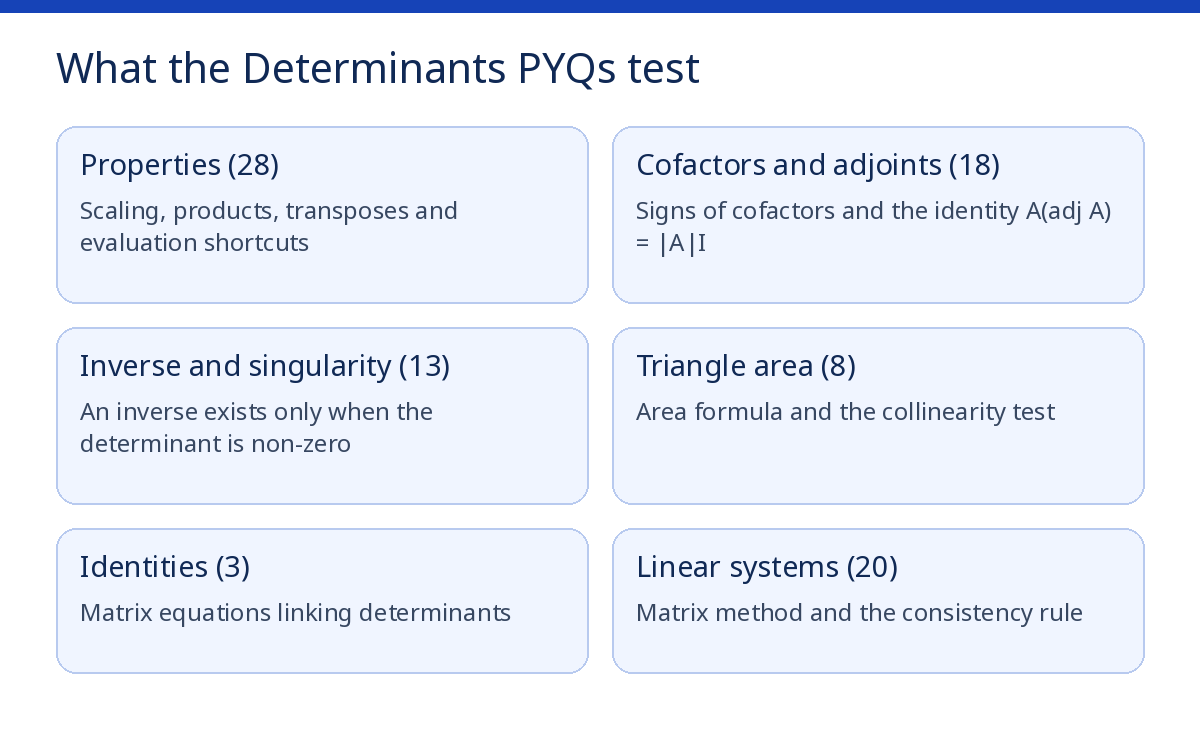
The topic index groups the questions as follows:
- Evaluation and properties of determinants: 28
- Linear systems and applications: 20
- Minors, cofactors and adjugates: 18
- Inverse and singularity of matrices: 13
- Area of triangles and collinearity: 8
- Matrix equations and determinant identities: 3
Properties and linear systems together account for more than half of the collection. The MCQ block also includes an assertion-reason item. Some subjective questions, such as Q67 and Q68, offer an internal choice marked "OR".

Determinants | Class 12 | Previous Year Paper
In the StudentCurio app
A collection of solved CBSE Class 12 previous-year questions on determinants, including evaluation, properties, and area applications, alongside related matrix methods such as adjoints, inverses, and solving linear systems. Useful for exam practice and reviewing worked solutions.
Scaling, products and transposes: why the order n matters
Many MCQs give you and and ask for the determinant of a combination, such as , , or . For square matrices of order , each of these reduces to a short chain of standard results:
- . Multiplying a matrix by multiplies every row by , so comes out once per row.
- and .
- when is non-singular.
Read the order before you calculate. The same scalar contributes for a matrix but for a matrix. A negative scalar raised to an odd power also changes the sign.
Other questions test properties directly:
- The determinant of a diagonal matrix is the product of its diagonal entries.
- Interchanging two rows changes the sign of the determinant.
- A determinant with two identical or proportional rows is zero.
- A skew-symmetric matrix of odd order has determinant zero.
Several evaluation items involve variables, trigonometric entries or a column of 1s. These reward a row or column operation before you expand.
Cofactors, adjoints and the identity A(adj A) = |A|I
The minor is the determinant left after you delete row and column . The cofactor is . Questions ask for a single cofactor, for example of , so the sign factor is the usual trap.
One recurring pattern combines the elements of one row with the cofactors of a different row. Multiplying the elements of a row by their own cofactors and adding gives . Using the cofactors of another row gives zero.
The adjoint is the transpose of the cofactor matrix. For a matrix, adj swaps the diagonal entries and changes the signs of the off-diagonal entries. The central identity is
.
When a question shows as a scalar matrix, you can read from its diagonal. From that identity it follows that .
A typical stem gives for a matrix and asks for . Working backwards involves an even power. Before choosing an option, check whether the sign of is actually fixed.
Singular or non-singular: when an inverse exists
A square matrix is singular when . Only a non-singular matrix has an inverse, given by .
Two question types follow from this:
- Make it singular. Set the determinant equal to zero and solve. The result is often a quadratic, so a question may ask for the sum or product of all possible values.
- Keep it invertible. Require . The answer is then a set such as , not a single number.
Q68(b) adds a domain restriction: you accept only solutions with .
Keep the algebra of inverses straight. The reversal law is . There is no comparable rule that splits into and .
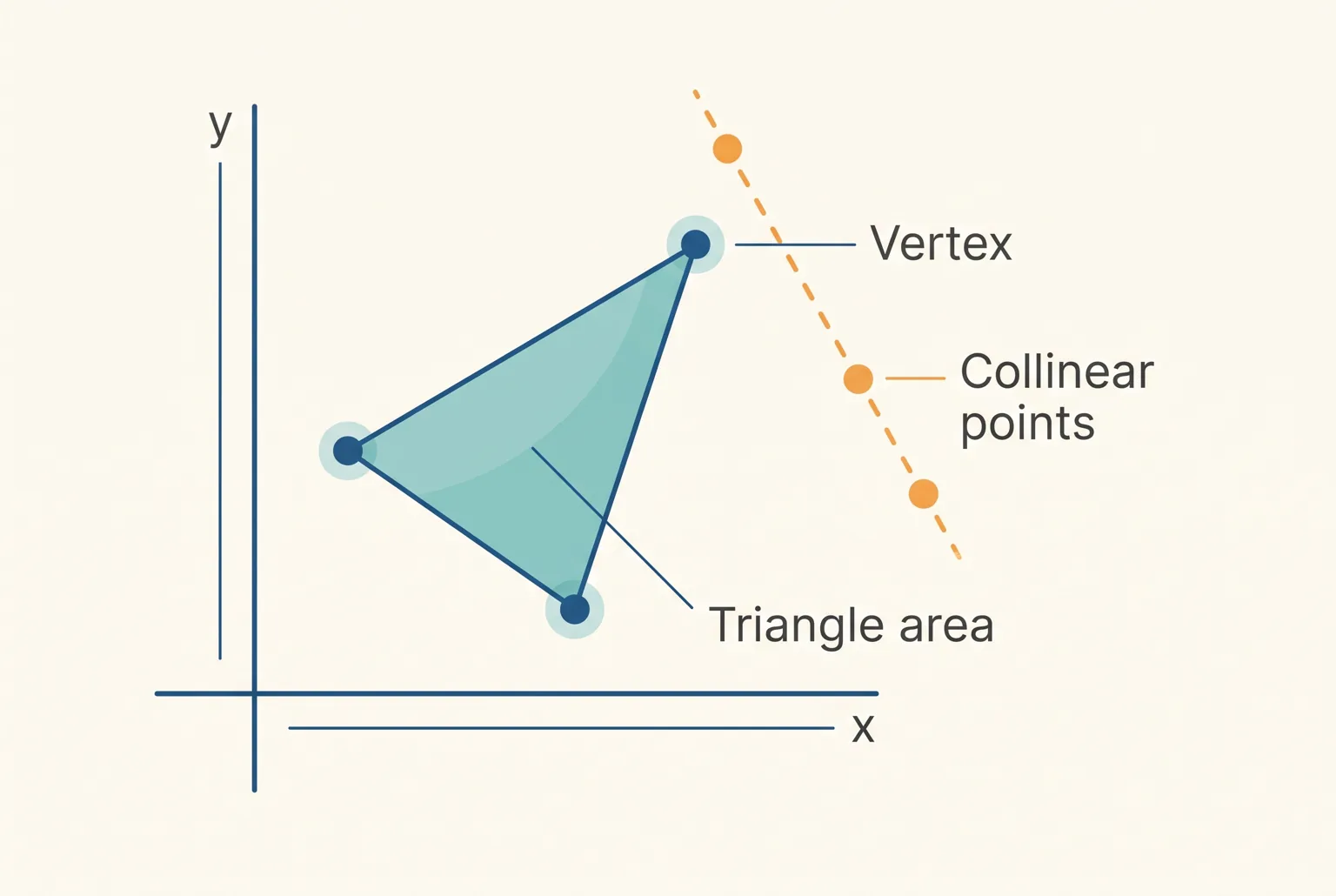
Triangle area and the collinearity test
For vertices , and , the area is
,
with the absolute value taken. Area questions usually give the area and leave one vertex coordinate unknown. Set the determinant equal to plus or minus twice the given area. This can produce two candidate values, so do not stop at the first one.
The same determinant also tests collinearity. Three points lie on one line exactly when the determinant is zero, because the "triangle" they form has no area. Other MCQs ask how the determinant, or its square, relates to . Questions like these reward knowing where the and the sign come from.
Writing AX = B for matrix-method word problems
The 20 linear-systems questions are mostly word problems: vouchers, fruit prices, runners' speeds, investments and furniture output. A paraphrased example: a showroom hands out 60 vouchers of two values, and a second condition links their numbers. You must set up the equations and solve them by the matrix method.
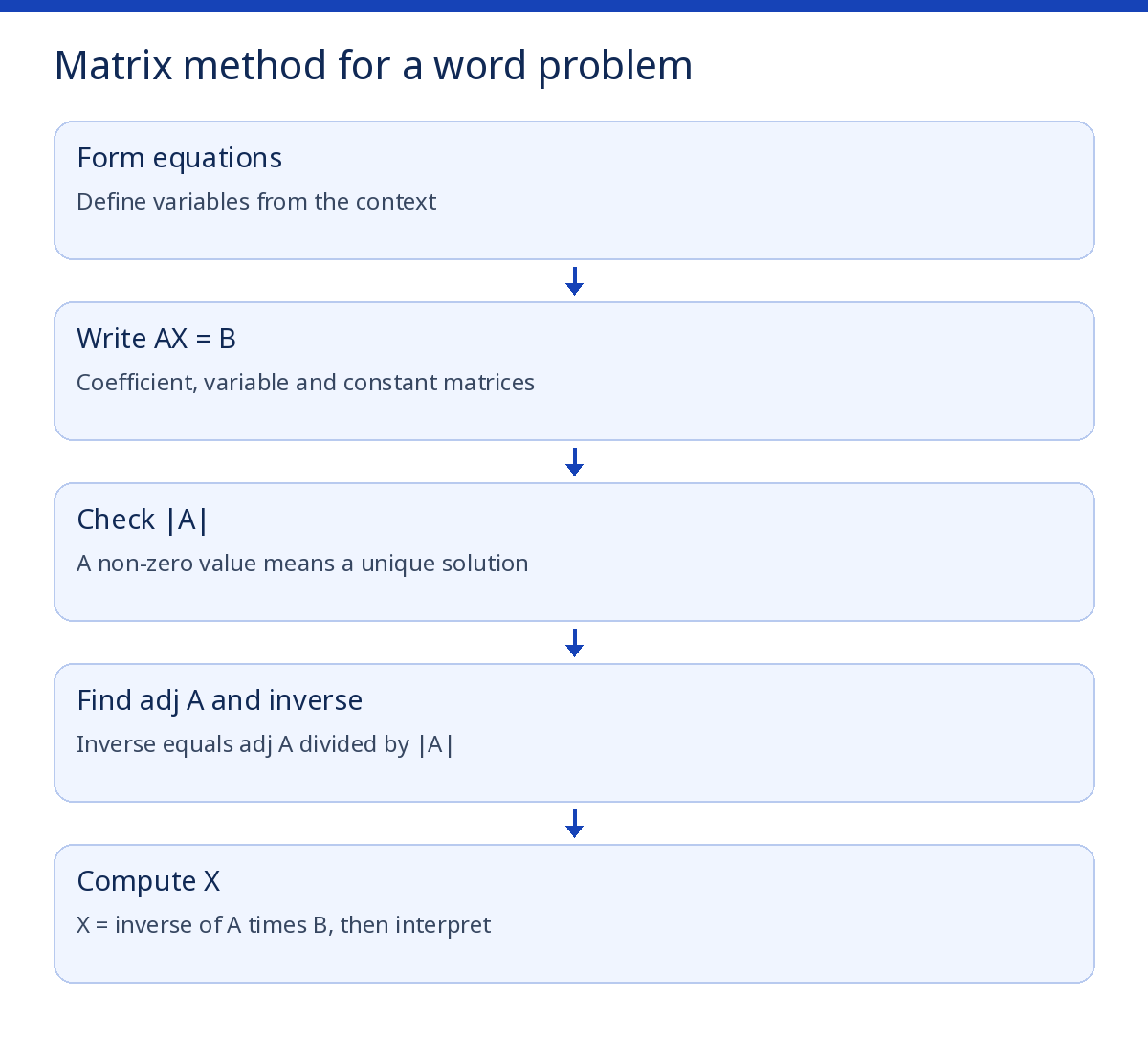
The expected steps are:
- Define the variables and write the equations.
- Form the coefficient matrix , the variable matrix and the constant matrix .
- Show that .
- Find the cofactors and adj , then .
- Compute . Note the order: comes first.
- State the answer in the context of the problem.
The NCERT consistency rule decides what happens next:
- If , the system has a unique solution.
- If and , the system is inconsistent.
- If and , the system may have infinitely many solutions or none.
Some questions instead ask for the parameter values that give a unique solution. That condition is again .
Practice order for this collection
Use the topic index rather than working straight from Q1.
- Start with properties and cofactor MCQs, because they build the rules that later questions depend on.
- Move on to the inverse and area questions.
- Finish with the subjective matrix-method problems, writing every step before you open the solution.
Quick self-check before moving on:
- Can you explain why depends on the order of ?
- Can you explain why an area condition can give two values of an unknown coordinate?
- Can you explain why is not enough to call a system inconsistent?
Frequently asked questions
Which years and question types does this Determinants collection include?
It has 90 CBSE Class 12 questions from 2023–2026. Q1–Q66 are single-correct MCQs, including one assertion-reason item, and the subjective questions begin at Q67. Worked solutions follow the questions.
Which topic has the most questions?
Evaluation and properties of determinants has the most, with 28 questions. Linear systems and applications follows with 20.
Spotted an error? Report a correction. Practise this in the app: notes, formula sheets and mind maps.





























































































































































Loading comments…