Class 12 Three-Dimensional Geometry: NCERT Revision Notes
CBSEMathematicsThree-Dimensional Geometry
These CBSE Class 12 Mathematics notes connect coordinates and direction ratios to equations of lines in space. Use the worked examples to practise switching between vector and Cartesian forms and deciding whether two lines intersect, are parallel, or are skew.
Start with coordinates and projections
The notes begin with three mutually perpendicular coordinate axes meeting at the origin. Each pair of axes determines a coordinate plane, and the three planes divide space into eight octants. A point on the plane has ; on the plane it has ; and on the plane it has . For a point anywhere in space, the perpendicular distance to a coordinate plane is the absolute value of the coordinate that vanishes on that plane. The coordinate can be negative; the distance cannot.
The notes review the distance, midpoint and section formulas alongside the centroids of a triangle and a tetrahedron. The worked example on distance from a point to an axis makes a useful distinction: the perpendicular foot on an axis keeps the coordinate along that axis and sets the other two to zero. Finding distance to a plane, by contrast, requires changing only one coordinate.

Three-Dimensional Geometry | Class 12 | NCERT Notes
In the StudentCurio app
Reviews coordinates and direction ratios in space, equations of lines, and methods for analysing skew lines and finding shortest distances, with worked examples. These notes help Class 12 students revise key concepts and problem-solving techniques in Three-Dimensional Geometry.
Direction ratios and direction cosines do different jobs
Direction ratios form a nonzero triple that specifies a line’s direction up to a common scale. For two distinct points, subtract the coordinates of the starting point from those of the endpoint to obtain one such triple. Direction cosines are the cosines of the angles a directed line makes with the positive coordinate axes. To obtain the cosines for the orientation of a direction vector, divide its components by its length. This explains the identity : the resulting vector has unit length.
Reversing orientation negates the entire triple, not just one component. The notes use proportional direction ratios to test whether three distinct points are collinear. In that test, the two displacement vectors already come from segments that share a point. Proportionality therefore puts the segments on the same line, rather than merely showing that their directions are parallel.
Common mistake: dividing by a zero direction component
A point and a nonzero direction vector determine a line. In the vector form , the position vector fixes a point on the line, while the real parameter lets you move along the direction . When two distinct points are given instead, their displacement supplies the direction vector, and either point can serve as the starting point.
The conversion examples in the notes show why it helps to write the three coordinate equations before eliminating the parameter. The same parameter must describe all three coordinates. If a direction component is zero, that coordinate stays constant: a zero first component gives , not a fraction with zero in the denominator. The vector and parametric forms still work without modification.
Separate angle from intersection
The smaller angle between two lines depends only on their direction vectors. The notes use the absolute value of their dot product, divided by the product of their lengths, to find its cosine. The absolute value keeps the angle unchanged if one vector is reversed. A zero dot product tells you that the directions are at right angles; it does not establish that the lines meet.
An intersection requires a common point, so both lines’ locations matter. Give each line its own parameter and equate the three coordinates of their general points. For nonparallel directions, solve two independent component equations and check the third. Failing that check means the candidate point is not common to both lines. If the equations describe the same line, every point on it is common.
When each shortest-distance formula applies
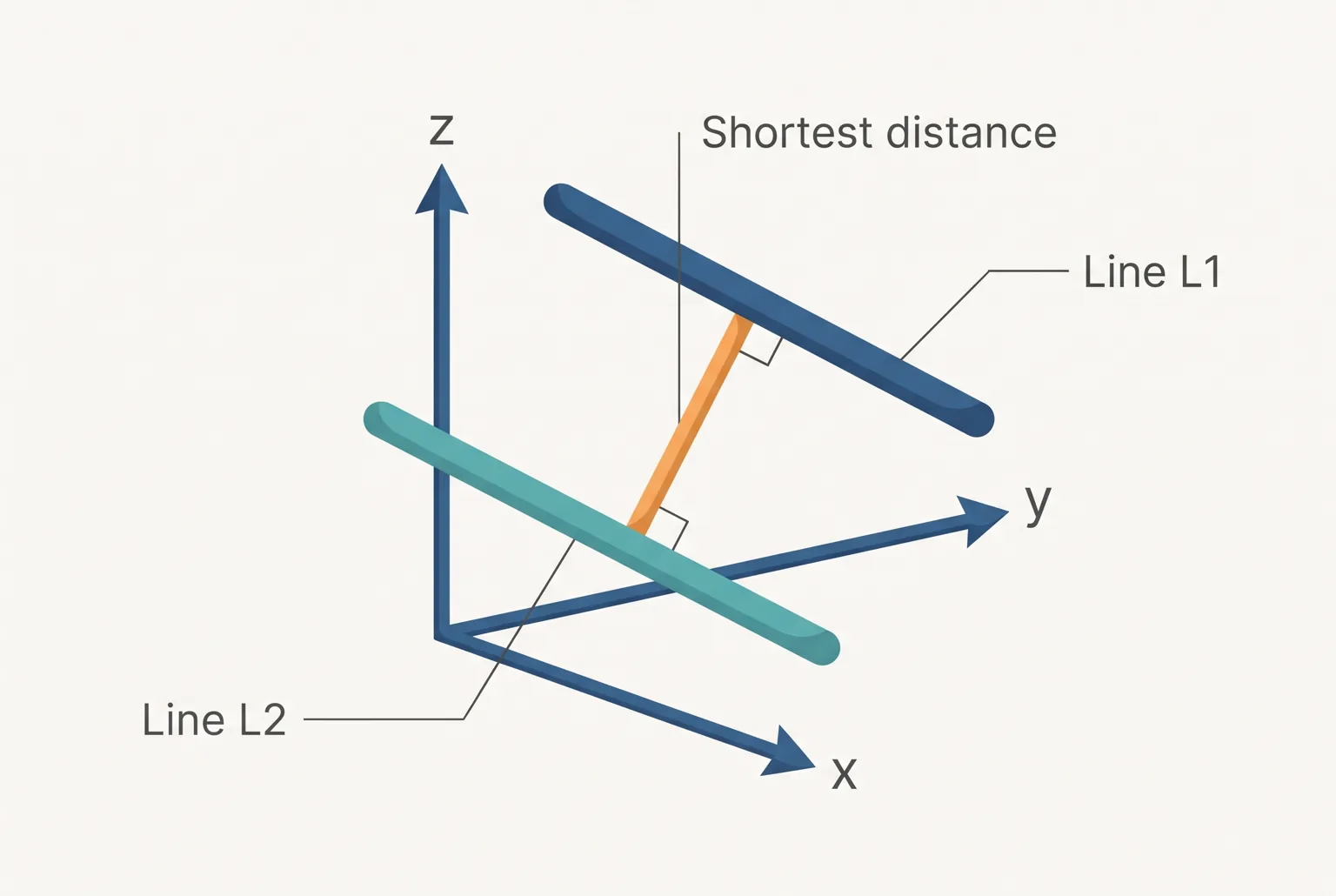
Check the directions before choosing a distance formula. With nonparallel directions, their cross product gives a vector perpendicular to both. The shortest-distance formula takes the absolute magnitude of the component of a joining displacement along this perpendicular direction. In the notes’ Cartesian version, the numerator is the absolute value of a determinant, and the denominator is the length of the cross product. These are two ways of computing the same quantity.
For nonparallel lines, zero shortest distance means the lines intersect. A nonzero distance means they are skew: they neither meet nor lie in a common plane. For parallel directions, the cross product of the two direction vectors vanishes, so the nonparallel formula would divide by zero. The notes instead cross a common direction vector with a displacement joining the lines and divide the resulting magnitude by the length of that direction vector. This gives the perpendicular separation.
Use the worked examples to check your setup
The chapter index separates direction cosines and ratios from lines in space, so you can return to the step that caused trouble. If you misread a Cartesian equation, revisit the conversion examples and identify a point and a direction triple before looking at the algebra. When reviewing the intersection examples, pause once you have candidate parameters and identify which component equation still needs checking.
For the distance examples, write down first whether the directions are proportional and which quantity will go in the denominator. Then compare your setup with the notes before checking the arithmetic. That comparison helps you distinguish a sign error in a cross product from a more fundamental error: applying a formula to the wrong pair of lines.
Spotted an error? Report a correction. Practise this in the app: notes, formula sheets and mind maps.





























































































































































Loading comments…