CBSE Class 12 Mathematics 2023 Paper with Worked Solutions
CBSEMathematics2023 Previous Year Paper
Paper code: 65/1/1 · 2023Practise the complete 2023 CBSE Class 12 Mathematics main examination paper (65/1/1) in its original English layout. Use the worked solutions after your attempt to check the method, the conditions that make it valid and the steps you need to show.
This set is one of the year's papers. See every set from 2023, grouped by series.
Know the paper format before you start
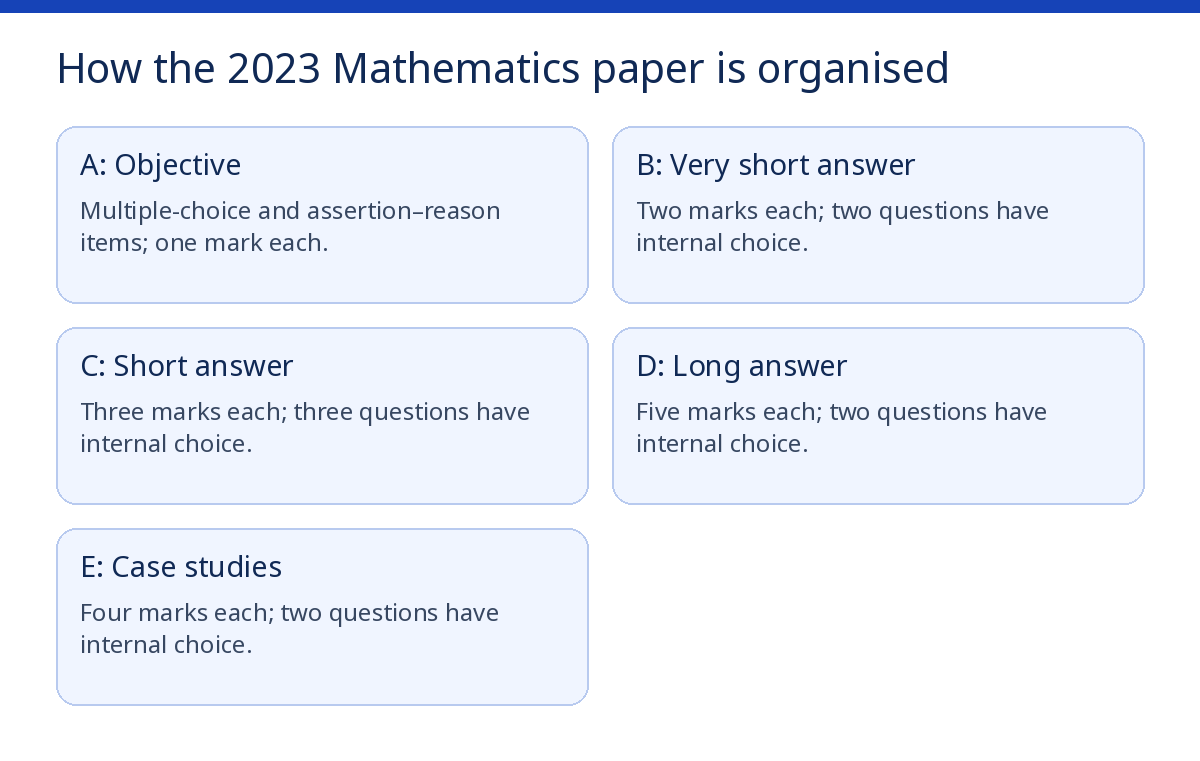
This is a year-wise previous paper, not a chapter worksheet. It gives you three hours for 80 marks and contains 38 questions across five sections. Calculators are not allowed. The original options and diagrams are preserved in the PDF, so use the page itself when a sign, interval or diagram label matters.
- Section A: Questions 1–18 are multiple choice; Questions 19–20 are assertion–reason. Each carries one mark.
- Section B: Questions 21–25 are very short answers worth two marks each.
- Section C: Questions 26–31 are short answers worth three marks each.
- Section D: Questions 32–35 are long answers worth five marks each.
- Section E: Questions 36–38 are case studies worth four marks each.
There is no overall choice. All question numbers are compulsory, but there are internal choices in two questions in B, three in C, two in D and two in E. In a timed attempt, answer one alternative where the paper offers an OR. Save the other for review.

Mathematics 2023 | Class 12 | Previous Year Paper | Code 65/1/1
In the StudentCurio app
Complete CBSE Class 12 Mathematics board paper for 2023 (code 65/1/1), with worked solutions covering topics across the syllabus. Helps students practise the board-paper format and review solution methods.
Distinguish the object from the operation in algebra
The paper tests matrices and determinants in short objective items and revisits matrix methods in a long-answer choice. During review, identify what each operation produces: a matrix inverse is a matrix, whereas its determinant is a scalar. An inverse exists only for a square matrix with nonzero determinant. If a scalar multiplies an entire square matrix, its effect on the determinant depends on the matrix order; it is not the same as multiplying an already evaluated determinant by that scalar.
The questions on relations and functions call for a different kind of reasoning. For a relation, test reflexivity, symmetry and transitivity separately on the stated set. A single counterexample can disprove one property, but a few examples that satisfy it cannot establish it. For a function, keep the image distinct from the codomain: being onto means the two coincide.
Check intervals before using a calculus rule
The calculus questions include continuity, differentiation, integration, differential equations and area. At a join in a piecewise function, continuity requires the left-hand limit, right-hand limit and function value to agree. When using a derivative to justify monotonicity, examine its sign over the stated interval rather than at just one point. An isolated zero of the derivative does not, by itself, rule out strict monotonicity.
- Before dividing by the variable: Check where it is nonzero. If separating or rearranging a differential equation leads to division by , the resulting formula must be considered on intervals that avoid zero.
- Before setting up an area integral: Identify the region and check which curve forms the upper boundary on each interval. If that boundary changes, split the integral rather than using one difference throughout.
The parameter-based monotonicity item is not discussed individually here because the extracted stem and option intervals are incomplete.
Separate direction from position in geometry and graphs
Vectors and three-dimensional geometry appear in both brief items and longer problems. A point fixes a position on a line; a nonzero direction vector tells you how the coordinates change along it. The dot-product test for perpendicular directions uses the direction vectors, not the coordinates of points on the lines. If one direction component is zero, the corresponding coordinate stays constant. A parametric equation expresses that directly without introducing division by zero in a symmetric form.
The linear programming questions also reward a distinction: the constraints determine the feasible region, while the objective function assigns a value to each feasible point. Comparing corner values is useful, but first check whether the region is bounded. An unbounded region can have finitely many corners, so the presence of corners alone does not establish that both extrema exist.
Quick self-check: What does the case study give you?
The three case studies use a yoga Venn diagram, a draining tank and a polynomial model of a roller-coaster path. They call for different starting points: read the event regions in the diagram, identify the changing dimensions of the water in the conical part of the tank, and translate a point on the polynomial graph into a condition on the function.
- For a conditional probability, can you name the event that restricts the sample space? Its probability must be positive. Reversing the events generally changes the denominator.
- In the tank problem, can you identify the quantity whose rate is given and distinguish it from the rate the subpart asks for? Outflow means the volume of water remaining is decreasing. Keep the sign and units when moving from a volume rate to a length or surface-area rate.
Use the worked solutions to diagnose your first error
The PDF links question numbers to worked solutions and returns you to the corresponding question. The solutions separate the formula, concept and explanation, and cover subparts and both printed OR choices. After a timed attempt, compare your reasoning before checking the final answer. For an assertion–reason item, decide whether each statement is true before asking whether the reason explains the assertion. Those are separate judgments.
For longer responses, mark the first point where your reasoning diverged. A missed domain restriction needs a different fix from an arithmetic slip or an incomplete justification. If your method differs from the one shown, compare the assumptions and the mathematical steps rather than copying the layout. Then try the unused OR alternative without looking at its solution to see whether you can select and justify a method independently.
Spotted an error? Report a correction. Practise this in the app: notes, formula sheets and mind maps.





























































































































































Loading comments…