Three Dimensional Geometry: CBSE Class 12 PYQs and Solutions
CBSEMathematicsThree-Dimensional Geometry
This guide covers Three Dimensional Geometry (Class 12, Chapter 11) through a collection of CBSE previous-year questions labelled 2022–2026. It explains direction cosines and ratios, reading line equations, angle and perpendicularity conditions, perpendicular feet and shortest distance, and how the MCQ, assertion-reason and case-based items are framed.
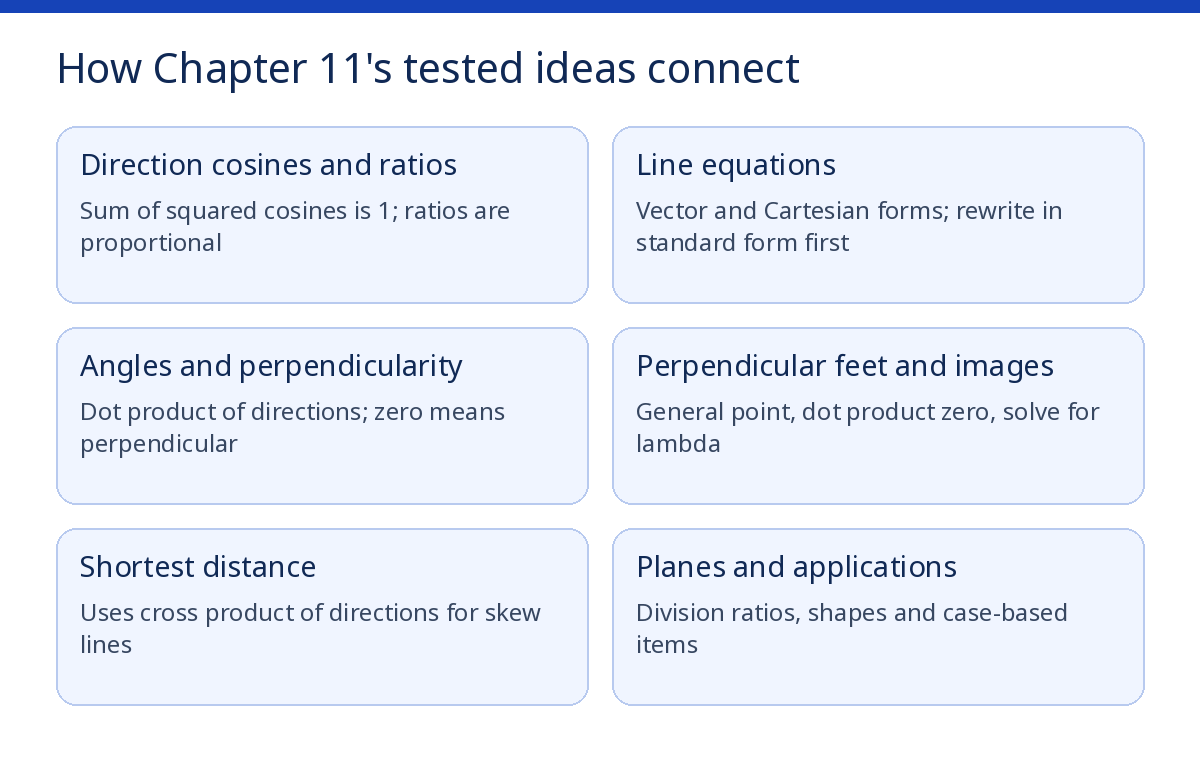
Six sub-topics behind 154 board questions
The collection gathers 154 previous-year questions on Chapter 11, with exam-year labels from 2022 to 2026. It keeps the original question numbers and paper labels, such as Delhi, Outside Delhi, Compartment and set codes like 65/1/1. A topic index sorts every question into one of six groups:
- Direction cosines and direction ratios: 29
- Vector and Cartesian equations of lines: 31
- Angles and perpendicular lines: 30
- Shortest distance between lines: 10
- Perpendicular feet, images and distances: 32
- Planes, intersections and applications: 22
The first three groups hold 90 questions. These ideas also drive the distance problems, so they are the core of the chapter. The planes group includes coordinate applications, such as finding the ratio in which the xy-plane divides a segment and testing whether four points form a rhombus.

Three-Dimensional Geometry | Class 12 | Previous Year Paper
In the StudentCurio app
A collection of solved CBSE Class 12 previous-year questions on three-dimensional geometry, covering direction ratios and cosines, equations and intersections of lines, and shortest distances between skew lines. Helps students practise exam-style problems and review worked solutions.
Direction cosines versus direction ratios
Suppose a line makes angles with the positive x, y and z axes. Its direction cosines are , and , and they always satisfy . This identity appears in several reasons in the collection.
Direction ratios are any numbers proportional to . To turn ratios into cosines, divide each by . The overall sign can be or , because a line can be traversed in either direction.
Questions in this group follow a few repeating patterns:
- Find the third angle when two are given.
- Find a parameter or that appears inside the direction cosines.
- Decide whether a given triple can be direction cosines at all.
- Derive related identities in or .
A typical stem gives the angles a line makes with the x- and y-axes and asks for its angle with the z-axis. Use the identity to find . Then decide which sign is admissible, remembering that each angle must lie in .
Reading direction and point from a line's equation
A line through a point with position vector , parallel to , is . Its Cartesian form is . For a line through two points, the direction ratios are .
Many board items deliberately give an equation that is not in standard form. Examples in the collection include , , and . Before reading direction ratios, make the coefficient of each variable :
- becomes .
- becomes .
- Symmetric forms like can be divided through by a common number so that each variable stands alone.
A zero denominator is a convention, not division by zero. It means that coordinate stays constant, so the direction has no component along that axis. This is how lines parallel to an axis appear.
In parametric form, such as , setting gives a point on the line. The coefficients of give its direction.
Parallel, perpendicular and angle conditions
Take two lines with direction vectors and .
- Parallel: the ratios are proportional, so .
- Perpendicular: , that is, .
- Angle: it comes from the dot product, . Read carefully whether the question asks specifically for the acute angle, because that changes how you handle the sign.
- Perpendicular to two lines: a third line perpendicular to both has direction .
A recurring stem gives two lines with an unknown in one denominator and asks for the value of that makes them parallel or perpendicular. Usually the hard part is rewriting both equations in standard form first. A slip there, such as a sign lost from , carries straight into the final answer.
Feet of perpendiculars, images and shortest distance
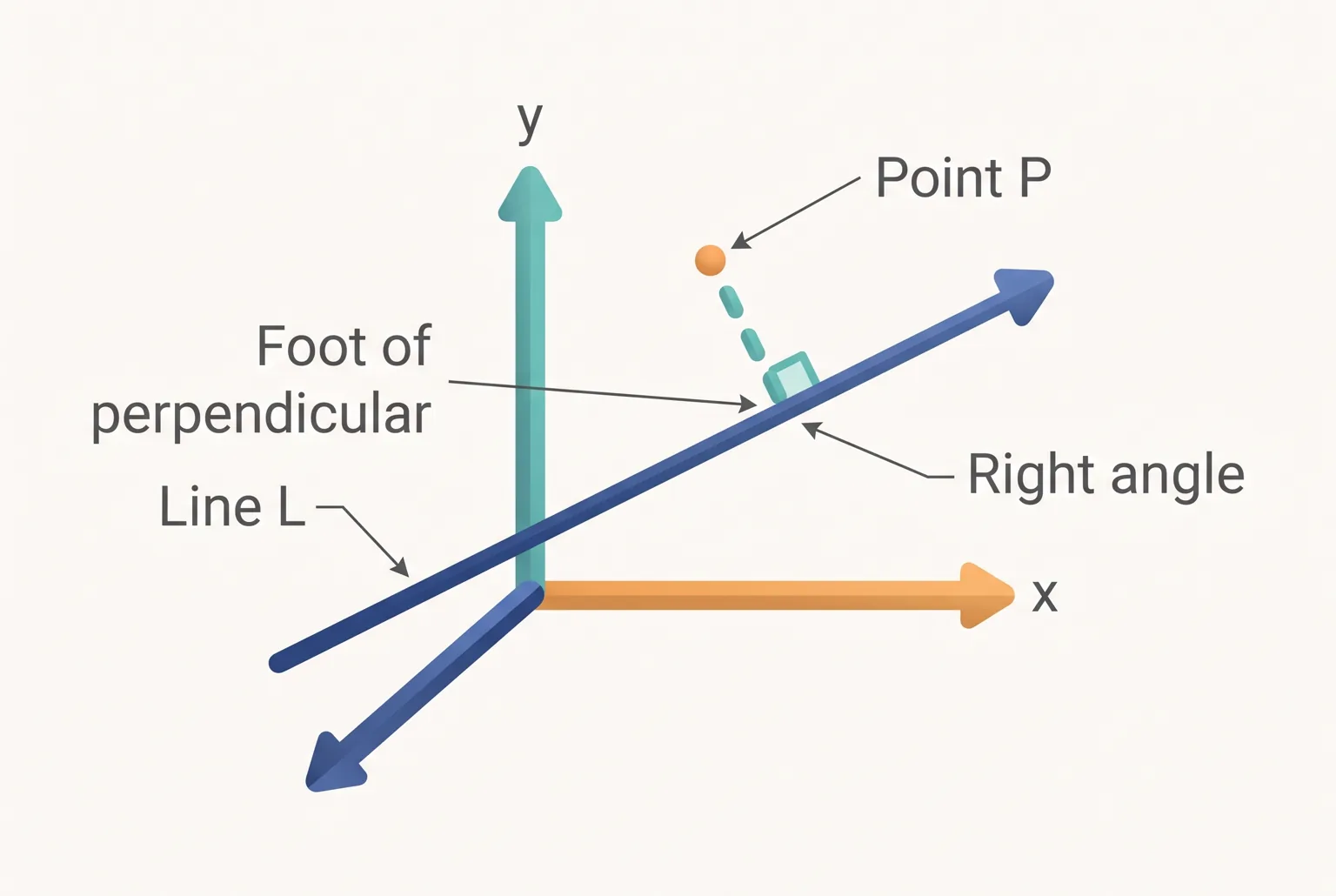
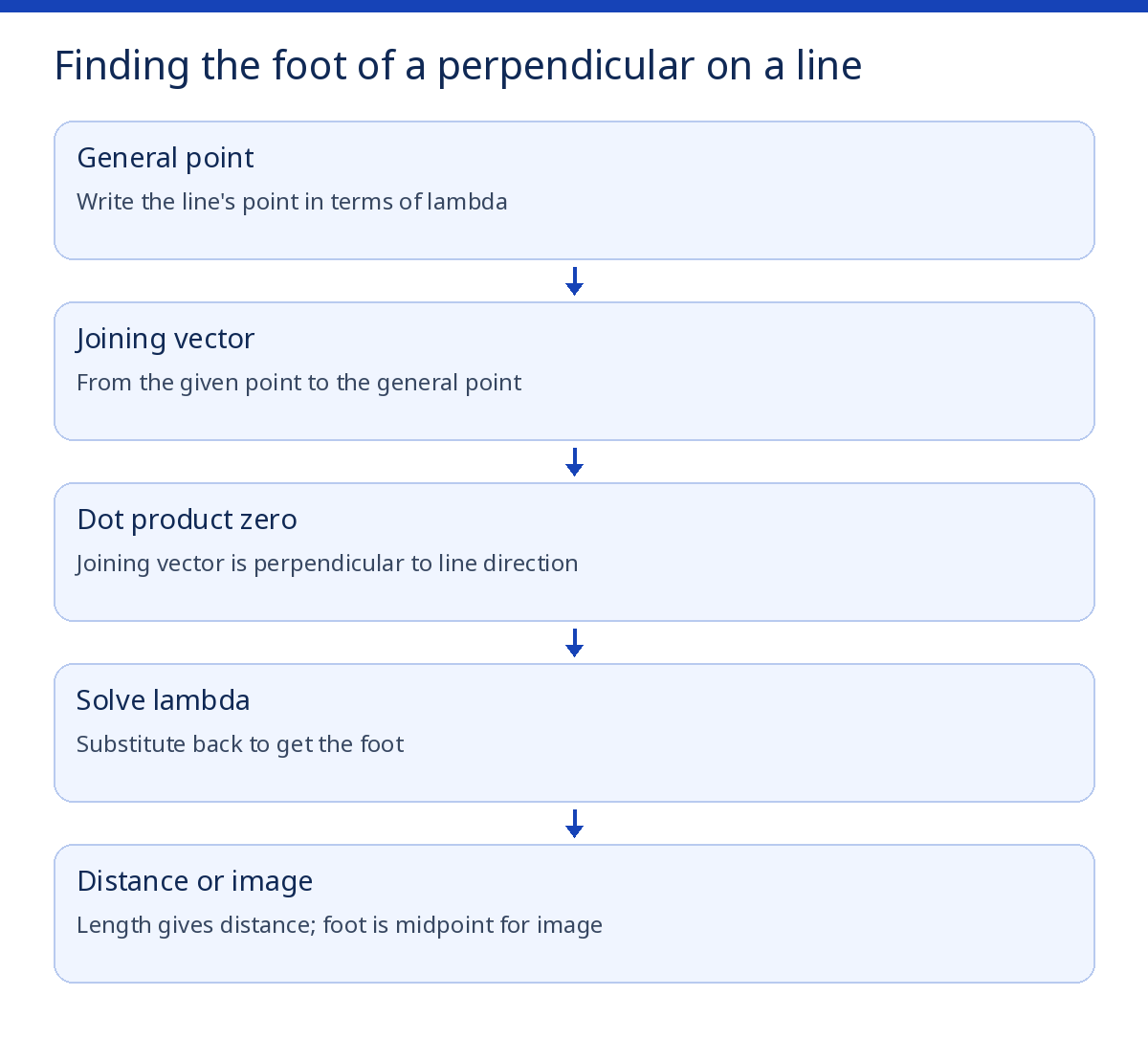
The 32 questions on perpendicular feet share one method:
- Write a general point of the line in terms of .
- Form the vector from the given point to that general point.
- Set its dot product with the line's direction to zero and solve for .
That value of gives the foot. The length of the vector gives the perpendicular distance. For an image of a point in a line, the foot is the midpoint of the point and its image.
When the line is a coordinate axis, the foot must lie on that axis, so two of its coordinates are zero. Several MCQs test exactly this shortcut.
For skew lines and , the NCERT shortest distance is:
This formula needs . For parallel lines with common direction , use instead. A distance of zero for non-parallel lines means they intersect.
How MCQ, assertion-reason and case-based items test Chapter 11
The questions are arranged in four formats: MCQ (single correct answer), Assertion and Reason, Subjective, and Case-based. Questions stay in the original serial order.
The index flags assertion-reason items as Q1, Q5, Q9, Q27, Q42, Q44, Q51, Q54 and Q59. Each uses the standard four options. The reasons are usually general rules, for example:
- the identity
- the two-point form of a line
- the condition
- a condition for collinearity
- a condition for a rhombus
Judge each part separately. First ask whether the rule is true in general, not just in the case shown. Then ask whether it actually explains the assertion. For instance, a correct two-point formula can sit beside an assertion whose equation uses a point that does not lie on the line.
The case-based items are Q63, Q82, Q139 and Q151. Each sits under a topic group, two of them under planes and applications.
Working through the collection topic by topic
Use the topic index rather than the serial order. A sensible sequence is:
- Direction cosines and ratios
- Line equations
- Angles
- Perpendicular feet
- Shortest distance
- Planes
Each later group reuses the earlier skills. Every question links to a complete, numbered worked solution, and the solutions section begins at page 42. Attempt a full topic group before opening the solutions. Then compare how the worked solution wrote the line in standard form and set up the perpendicularity condition. The file also ends with source review notes on page 128, so check those before relying on any flagged item.
Common mistakes
- Reading direction ratios from or without first rewriting them in standard form.
- Treating a zero denominator as undefined instead of as a fixed coordinate.
- Forgetting that direction cosines carry a sign choice.
Quick self-check: Can you explain why a line's direction ratios are not unique, while its direction cosines are unique up to sign?
Frequently asked questions
Which years and papers does this collection cover?
It prints exam-year coverage of 2022–2026 and keeps labels such as Delhi, Outside Delhi, Compartment and set codes like 65/2/1.
Does every question have a solution?
Yes. The contents state that all questions link to complete, numbered worked solutions, which start at page 42.
Spotted an error? Report a correction. Practise this in the app: notes, formula sheets and mind maps.





























































































































































Loading comments…