Integral Calculus: CBSE Class 12 2022 Term 2 Paper Solutions Guide
CBSEMathematicsIntegral Calculus
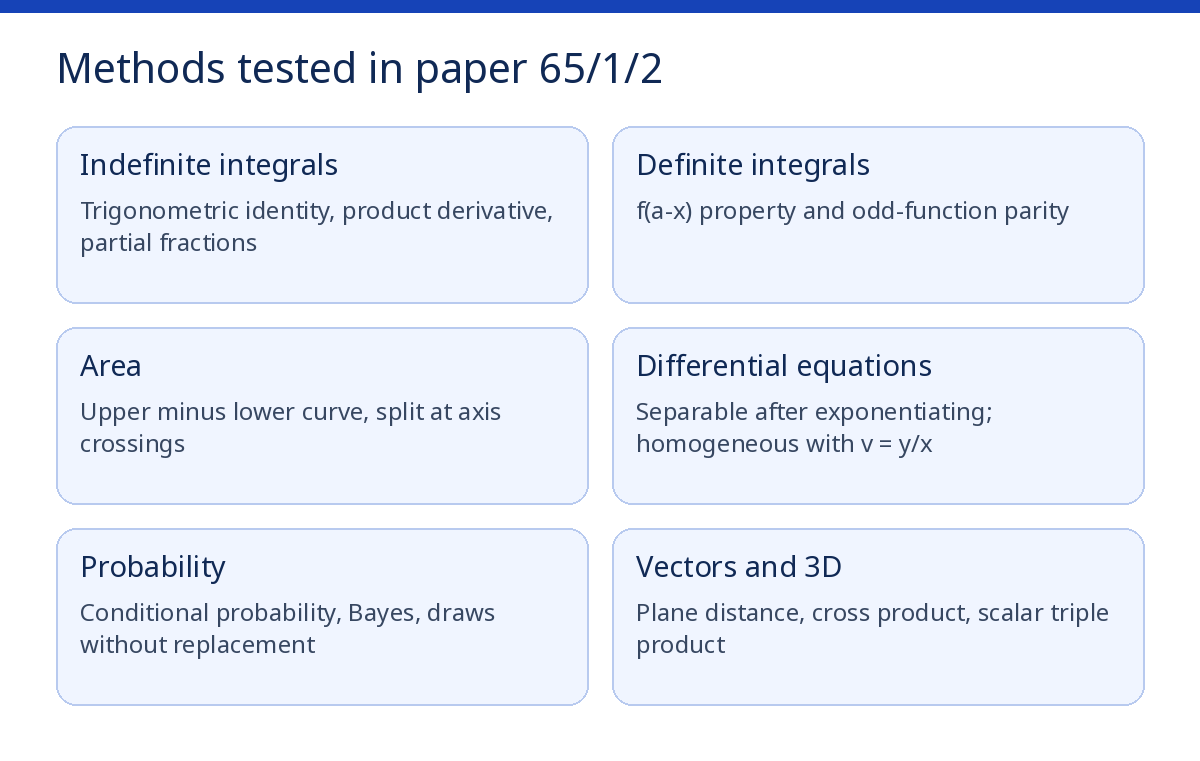
Paper code: 65/1/2 · 2022This guide covers the worked solutions to the CBSE Class 12 Mathematics 2022 Term 2 paper 65/1/2, where integrals and areas between curves sit alongside differential equations, probability, vectors and 3D geometry. It explains how each method is chosen, which step decides it, and which domain and sign checks the solutions insist on.
Paper 65/1/2: a Term 2 board paper, not NCERT exercises
Although the file is labelled NCERT Solutions, it is a previous-year CBSE question paper. It is the 2021-22 session Term 2 examination, code 65/1/2, with a time of 2 hours and a maximum of 40 marks. It has 14 questions, and both printed OR choices are solved.
Integral calculus appears in Q1, Q9, Q11 and Q13. The rest of the paper covers differential equations, probability, vectors and three-dimensional geometry.
Every solution follows the same three blocks: Formula used, Concept used and Explanation in steps. Domain assumptions and source ambiguities are noted where they matter.
To practise, attempt a question first and write down only the formula and concept you would use. Compare these with the first two blocks before you read the steps.

Integral Calculus | Class 12 | NCERT Solutions | 2022 | Code 65/1/2
In the StudentCurio app
Worked solutions to CBSE Class 12 Mathematics exam questions, with emphasis on definite integrals and areas between curves. The material also covers probability, vectors, differential equations and three-dimensional geometry, helping students practise past-paper methods.
Choosing between an identity, a product derivative and partial fractions
In the indefinite-integral questions, the form of the integrand decides the method.
In Q1(a), the given derivative simplifies to . The deciding step is the identity . The first piece integrates directly because is the derivative of . The second piece is handled with . A given value of then fixes the constant, so an answer that stops at is incomplete.
The OR part avoids substitution altogether. The integrand matches the derivative of under the product rule . The solution is stated only on intervals where and .
In Q9(a), the substitution turns the integrand into a rational function of . Partial fractions over complete the integration. The final answer is written back in terms of , with .
Symmetry properties that simplify definite integrals
Two definite integrals depend on symmetry rather than on direct antiderivatives.
Q11 asks for . The property helps here because replacing by leaves unchanged. Adding the original and the transformed integral removes from the numerator. What remains is times , which is then handled with .
The general result behind this step is , valid when .
In Q9(b), squaring produces a term in . Over , that odd term integrates to zero, so only the even terms need work. Check parity before integrating over any symmetric interval.
Area between curves: the region first, then the integral
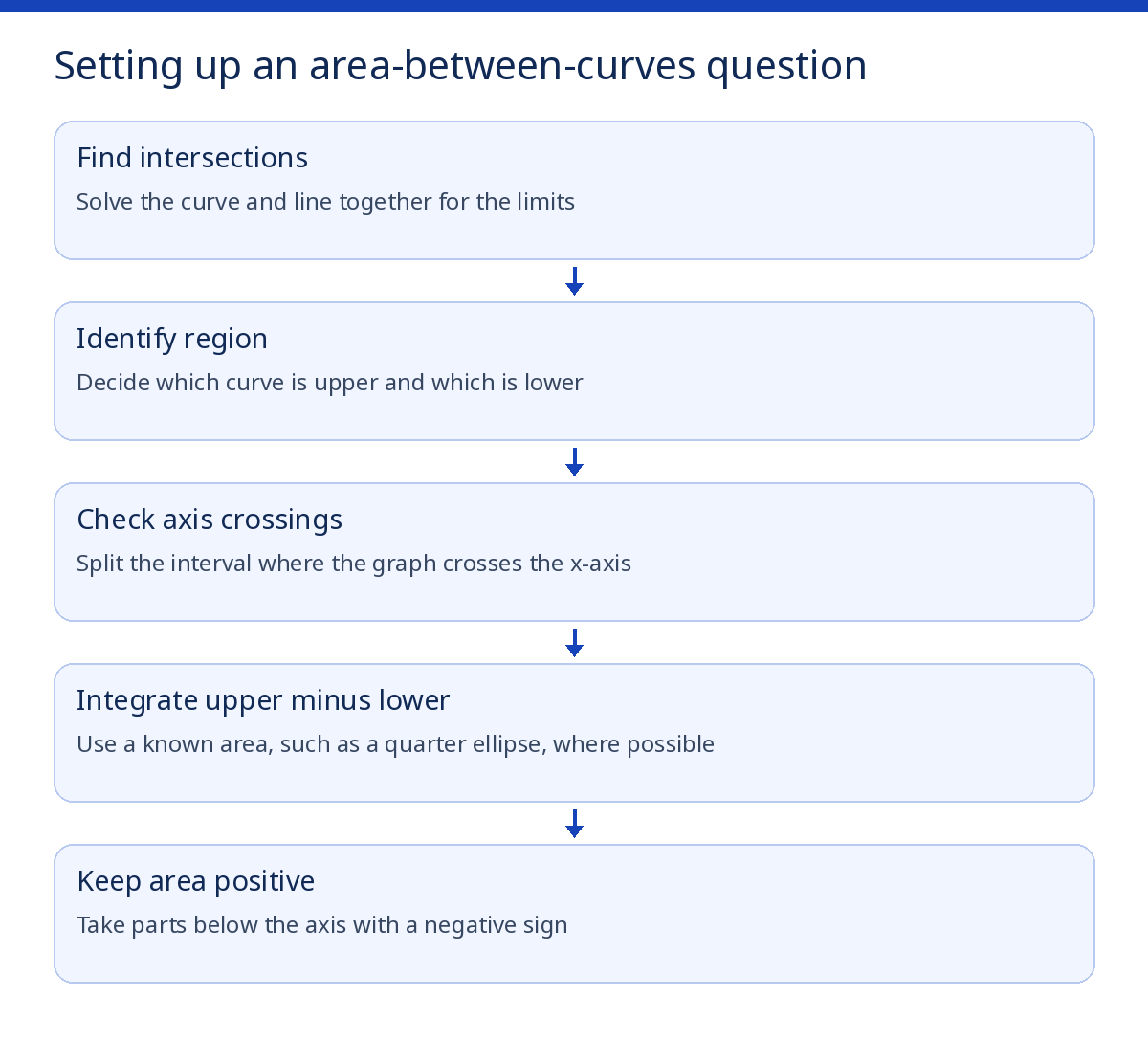
The area formula used is . The solutions identify the bounded region before writing any integral.
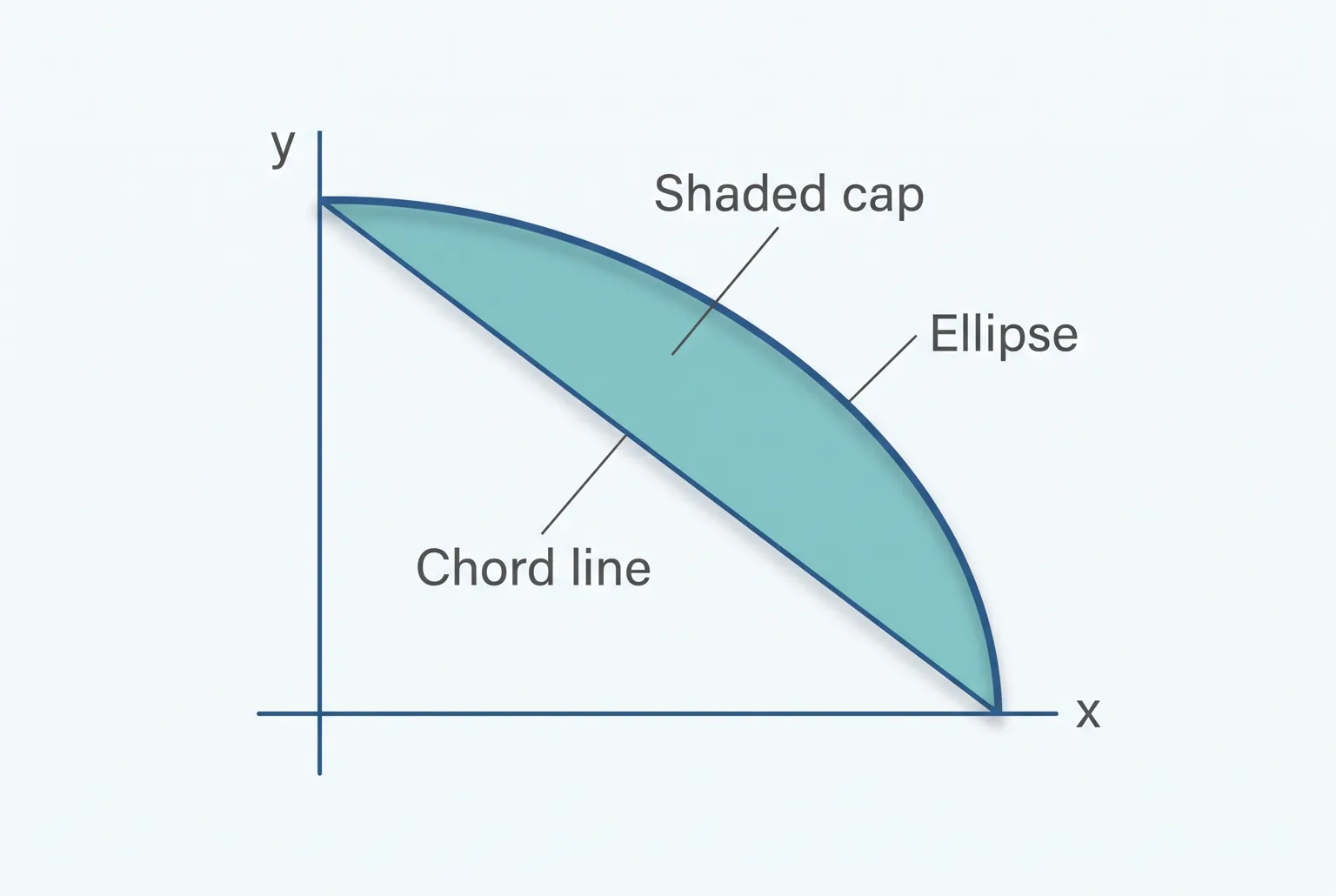
In Q13(a), the ellipse and the line meet on the two axes. The required cap lies above the line and below the upper half of the ellipse, , for . The ellipse part equals a quarter of the ellipse's area, with and . It can also be found with the substitution .
In the OR part, the line crosses the -axis at , which lies inside the interval. The integral is split at that point, and the part below the axis is taken with a negative sign. Without the split, the signed integral would subtract the piece below the axis from the piece above it and give less than the true area.
Separable versus homogeneous differential equations
In Q5, the logarithm of a derivative equals . The solution first notes that the logarithm requires . It then exponentiates to get and separates the variables as .
Written explicitly, the solution holds only where . The solution also confirms that the derivative is positive there. In other words, the answer is checked against the condition the question itself imposed.
In Q7, the equation contains the ratio , which signals a homogeneous equation. The substitution is with . This reduces the equation to the separable form . The initial condition fixes the constant, and the solution is written on the branch with through the initial point.
Conditional probability, Bayes' theorem and a distribution from draws
Q2 uses one conditional probability to find . It then divides by to get the reverse conditional probability.
Q3 involves two draws without replacement, which gives a hypergeometric distribution. takes the values 0, 1 and 2, with . The solution checks that the three probabilities sum to 1.
Q12 applies Bayes' theorem to a reported doublet on two fair dice. The prior comes from 36 equally likely outcomes. The denominator is the total probability of a report, . It therefore counts both routes: a doublet that is reported, and no doublet but a report anyway.
The solution states its interpretation openly. Truth and falsehood are read as correct or incorrect reporting of this binary event, and the result is given under that interpretation.
Distance, diagonals and coplanarity in vectors and 3D geometry
Several vector and 3D questions rely on standard set-ups:
- Point-to-plane distance: the formula contains an absolute value, so an unknown coordinate can take two values.
- Parallelogram diagonals: these are the sum and difference of adjacent side vectors. The area is .
- Unit vectors along diagonals: either direction, or its negative, is a valid choice.
- Parallel vectors: show that the cross product is zero, and confirm that both vectors are nonzero.
- Points at a given distance on a line: parametrize the line, and the squared distance gives a quadratic in .
- Coplanar lines (for nonparallel lines): show that . To find the intersection, solve two coordinate equations and verify the third.
Domain and sign checks the solutions insist on
Common mistakes the steps correct:
- Leaving in the answer when a given value of the function fixes it.
- Dropping restrictions such as , or .
- Integrating across an axis crossing without splitting, which lets negative and positive parts cancel.
- Accepting an intersection point without checking the third coordinate equation.
Quick self-check: Why does the substitution help in Q11, and why would it not help if the integrand contained ? What condition on makes the logarithm in Q5 meaningful?
Frequently asked questions
Is this file NCERT textbook exercise solutions?
No. It contains worked solutions to the CBSE Class 12 Mathematics 2022 Term 2 board paper, code 65/1/2. That paper has 14 questions, a time of 2 hours and a maximum of 40 marks.
Are the OR alternatives solved?
Yes. The source states that every question, subpart and both printed OR choices have worked solutions.
Which integration topics appear?
The paper includes indefinite integrals that use identities, product derivatives and partial fractions. It also includes definite integrals that use symmetry and parity, and areas bounded by an ellipse and a line or by a line and the x-axis.
Spotted an error? Report a correction. Practise this in the app: notes, formula sheets and mind maps.





























































































































































Loading comments…