CBSE Class 12 Determinants Assessment: A Practice Guide
CBSEMathematicsMatrices and Determinants
This Class 12 CBSE Mathematics assessment pairs topic practice with worked solutions. Use it to connect determinant evaluation with coordinate geometry, matrix inverses, and the question of whether a system of linear equations has a solution.
What the assessment covers
The file contains 140 questions across five topic practice sets and a mixed Chapter Practice set. The topic sets cover determinant evaluation, coordinate geometry, minors and cofactors, adjoint and inverse matrices, and applications to simultaneous equations. The chapter set combines objective, written-answer, and case-based questions, so it lets you practise choosing a method without relying on a topic heading to tell you which one to use.
The two-page index links to question ranges and individual worked solutions. Numbering restarts in each set, so use the set name as well as the question number when returning to an attempt. If you already know which step causes trouble, start with that topic; if you can execute the methods separately, use the mixed set to check whether you can recognise when each one applies.

Determinants | Class 12 | CBSE Assessment
In the StudentCurio app
CBSE assessment questions with worked solutions cover determinant evaluation, cofactors, adjoints and inverse matrices, and solving or checking the consistency of simultaneous linear equations. Includes applied case-study practice for Class 12 students.
From a square matrix to a single value
The opening set moves between direct evaluation and equations in which an unknown appears inside a determinant. In an evaluation question, the determinant is a scalar, not a matrix. In an equation, evaluating it produces a scalar expression that you then use to find the unknown. Keeping those stages separate makes it easier to see whether an error came from evaluating the determinant or from the algebra that followed.
Before simplifying a determinant with trigonometric entries, check where the original entries are defined. If an entry contains a secant or tangent, the cosine of its argument must be nonzero. Even if the determinant simplifies to an expression that is defined at more values, those extra values are not in the domain of the original expression.
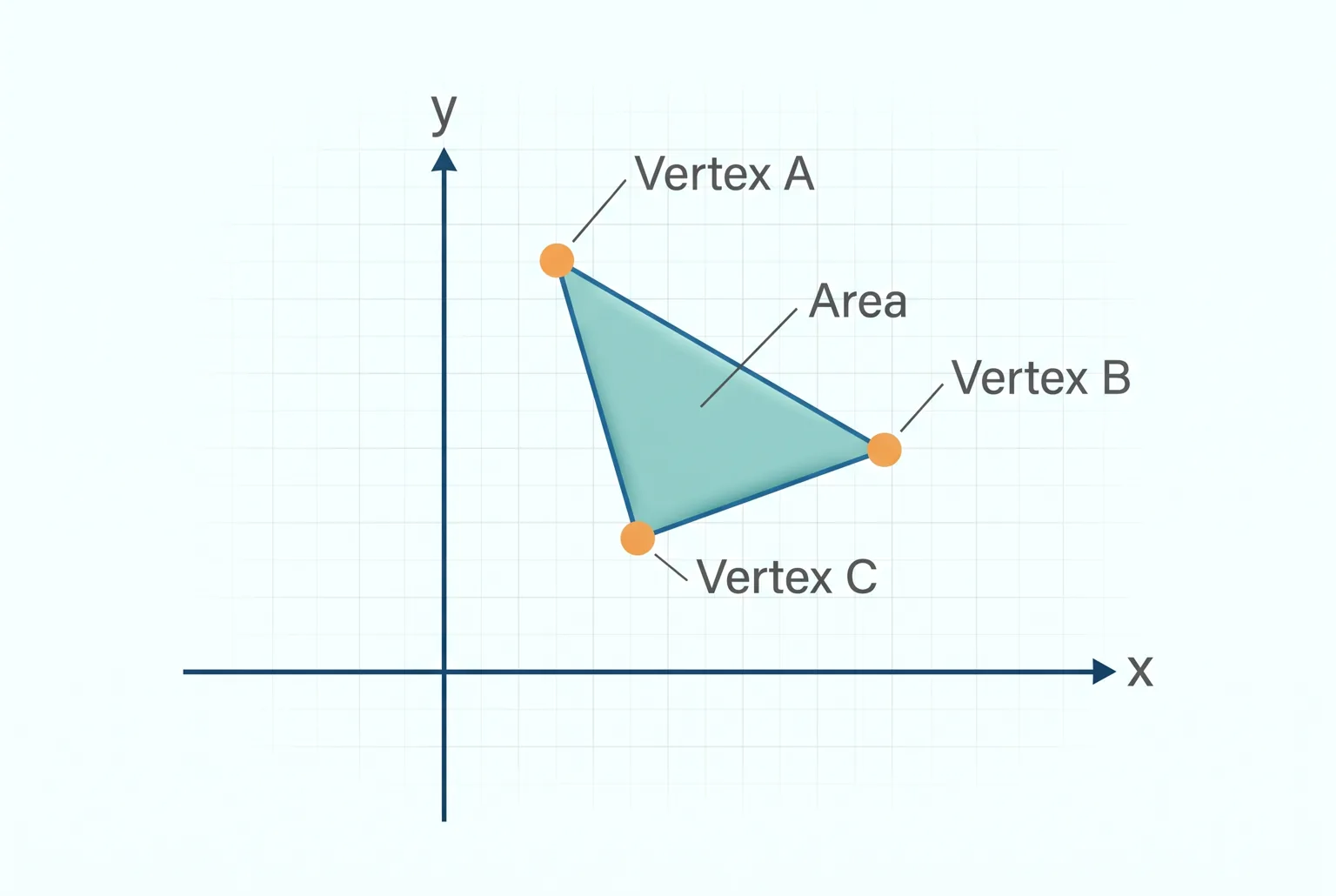
Area is unsigned; collinearity is a zero test
In the coordinate geometry set, write one row per vertex, with its two coordinates followed by a 1. The triangle’s area is half the absolute value of the resulting determinant, in square units. Reversing the order of two vertices reverses the determinant’s sign, but it cannot change the area. When the area is given and a coordinate is unknown, retain the absolute value until you account for both possible signs of the determinant.
For collinearity, the question is whether that same determinant vanishes. This is also the basis of the line-equation exercises: use two distinct fixed points and a variable third point, then impose the zero-determinant condition. The resulting equation describes the points on the line through the two fixed points.
Common mistake: treating a minor as a cofactor
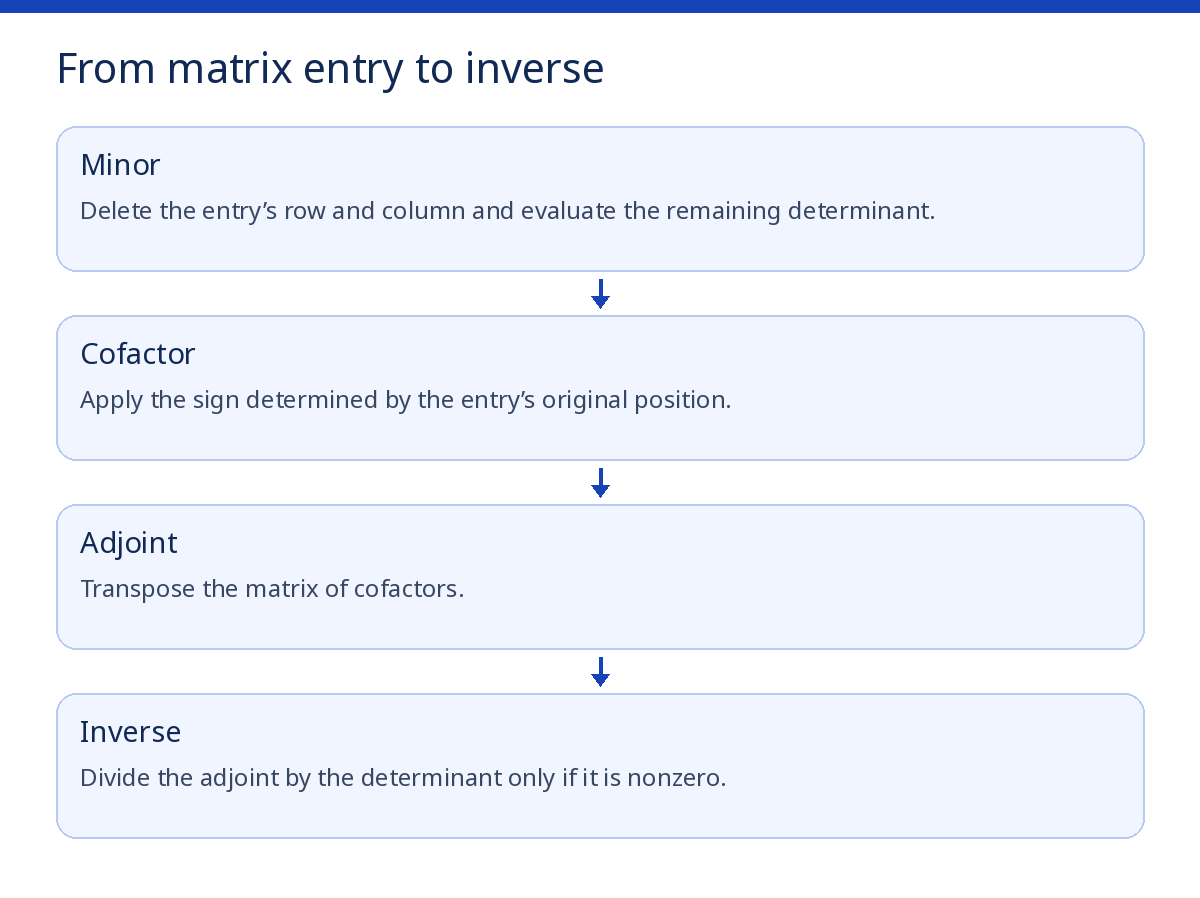
To find the minor of an entry, delete its row and column and take the determinant of what remains. The cofactor applies the position-dependent sign to that minor, where and are the original row and column indices. When expanding, pair each entry with its own cofactor along the chosen row or column. If the question specifies a row or column, use it; if the choice is yours, zeros can reduce the number of terms you need to evaluate.
The distinction carries into the adjoint set. Form the cofactor matrix first, then transpose it to obtain the adjoint. Comparing these two stages separately with a worked solution can show whether an incorrect entry came from a sign error or from skipping the transpose.
When the inverse method applies
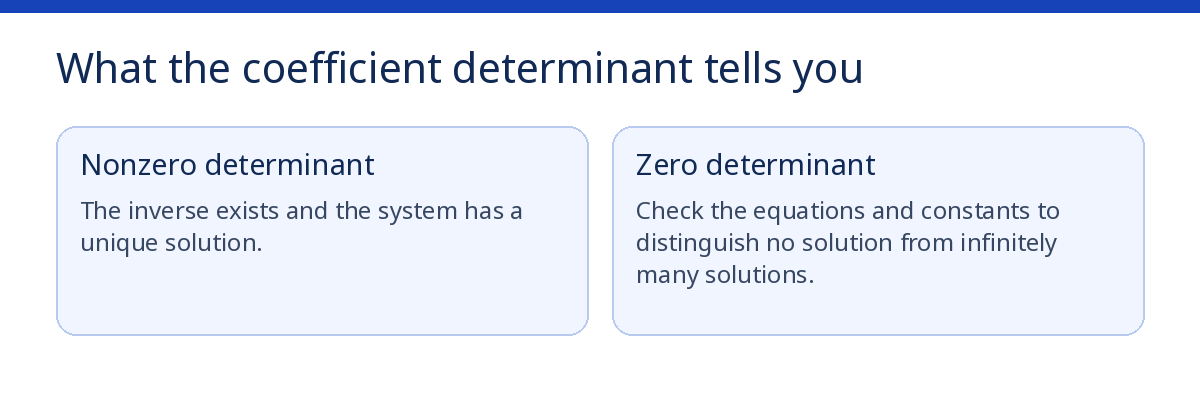
For a square matrix , the adjoint identity holds even when is singular. The inverse formula applies only when the determinant is nonzero. The adjoint can therefore exist even when the inverse does not. In questions with a parameter, determine which values make the determinant zero before attempting to divide by it.
For a square system written as , a nonzero coefficient determinant gives a unique solution by the inverse method. A zero determinant rules out a unique solution, but it does not tell you whether the equations are inconsistent or have infinitely many solutions. Check whether the equations, including their right-hand sides, are compatible before classifying a singular system.
Quick self-check: build the system before solving it
In the applications set, decide on an order for the unknowns and read each equation across in that order. Each equation gives one row of the coefficient matrix and one corresponding entry in the constants column. Before reaching for an inverse, ask: Does the displayed matrix actually match those rows? If the coefficient matrix is the transpose of the displayed matrix, its inverse is the transpose of the displayed matrix’s inverse, provided that inverse exists.
Some exercises use reciprocals of the original unknowns. In those questions, the matrix method finds the substituted variables first, not the original ones. Keep the nonzero restrictions from the denominators, and check that the substituted values can be converted back before reporting a solution.
Use the worked solutions to check your setup
In applied questions about prices, investments, or a fixed sum shared among people, write what each unknown measures and identify the condition behind each equation. For case-based practice, compare your verbal interpretation, equations, and matrix form before checking the calculation. That way, a correct computation does not hide a mistake in the model.
When reviewing a written attempt, find the first step where your reasoning differs from the worked method rather than checking only the final line. This guide leaves out the cover calculation and individual answer options; it discusses case-based practice without relying on the truncated final case.
Spotted an error? Report a correction. Practise this in the app: notes, formula sheets and mind maps.





























































































































































Loading comments…