CBSE Class 12 Mathematics 2023 Paper 65/4/2: Practice Guide
CBSEMathematics2023 Previous Year Paper
Paper code: 65/4/2 · 2023Use the full English-version CBSE Class 12 Mathematics 2023 main examination paper to practise the three-hour, calculator-free format. Then use the worked solutions to review why a method applies, not just whether your final answer matches.
This set is one of the year's papers. See every set from 2023, grouped by series.
Know the format before starting the clock
Paper 65/4/2 carries 80 marks and contains 38 compulsory questions across five sections. Section A has 18 multiple-choice questions followed by two assertion–reason questions, all worth one mark each. Sections B, C and D contain very short, short and long answers worth two, three and five marks per question, respectively. Section E contains three case studies worth four marks each.
There is no overall choice. Where an internal choice appears in Sections B to E, select one of the printed alternatives for the relevant question or subpart. On a timed attempt, follow that rule and work without a calculator. Afterward, try the unused alternatives as separate practice. For assertion–reason items, judge each statement independently before deciding whether the reason explains the assertion; two true statements do not necessarily form a valid explanation.

Mathematics 2023 | Class 12 | Previous Year Paper | Code 65/4/2
In the StudentCurio app
The complete CBSE Class 12 Mathematics 2023 examination paper (code 65/4/2), with worked solutions across the syllabus, including application of derivatives. Helps students practise the exam format and review solution methods.
Check what the algebra method depends on
The paper uses matrices in both objective and extended-response formats. For a product involving a matrix and its transpose, check the dimensions in the stated order before calculating: reversing the order can change the dimensions of the result. In the longer problem on solving simultaneous equations by a matrix inverse, keep the coefficients in the same variable order throughout. The inverse method requires a square coefficient matrix with a nonzero determinant.
The functions and relations questions call for different kinds of justification. A proof that a relation is an equivalence relation must establish reflexivity, symmetry and transitivity. A one-to-one test asks whether distinct inputs can share an output; an onto test asks whether every element of the stated codomain is reached. Keep that codomain in view rather than replacing it with the range you obtain.
Common mistakes when applying derivatives
The paper tests derivatives through implicit differentiation, strict increase and a case study on a piecewise function. In implicit differentiation, treat as a function of , so differentiating a term involving can introduce . In a question about increase, look at the sign on an interval: a positive derivative throughout its interior is sufficient for strict increase there. Finding a point where the derivative vanishes does not, by itself, tell you whether the function changes from increasing to decreasing.
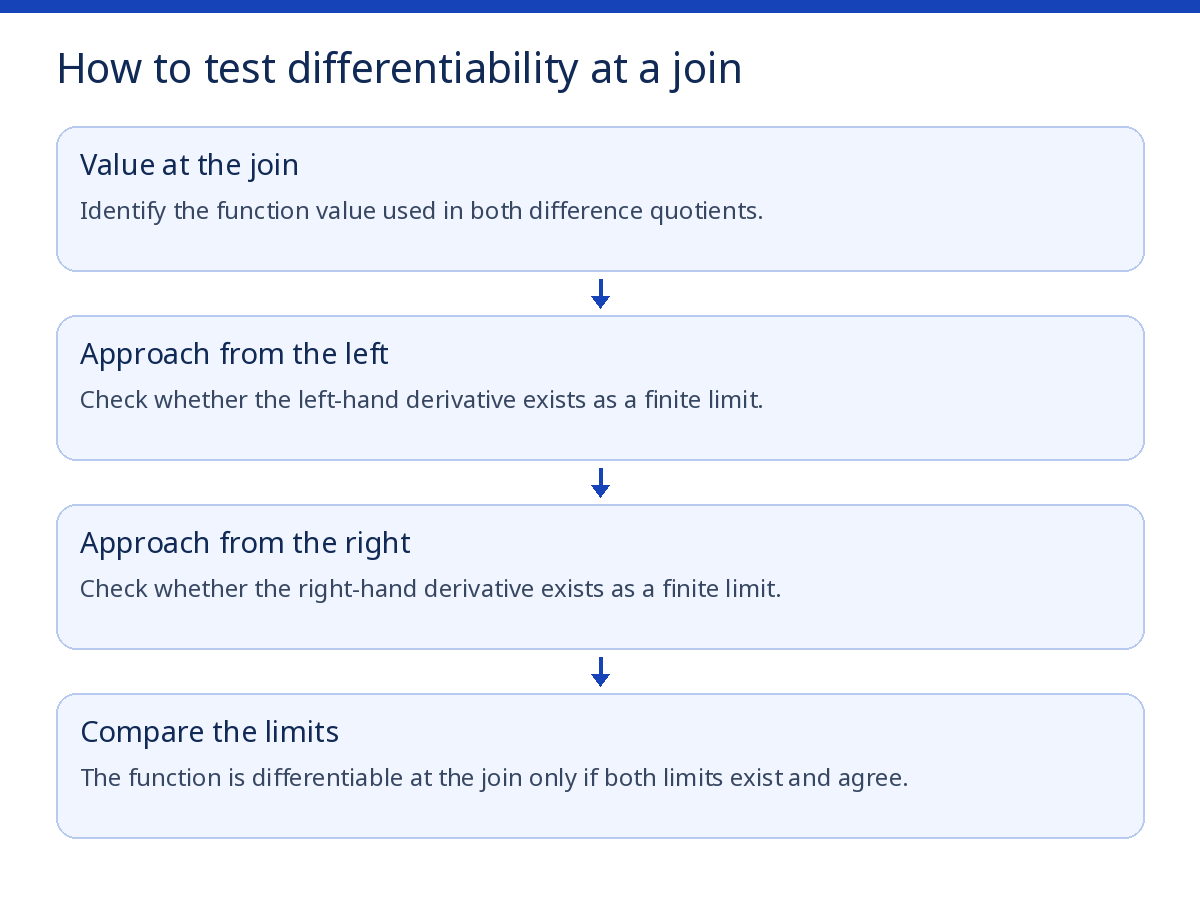
At the join of a piecewise function, continuity alone does not establish differentiability. Use the function value at the join in both one-sided difference quotients. The left-hand and right-hand derivatives must both exist as finite limits and agree. This is why the case study asks for the two sides separately before asking for a conclusion.
Separate the calculus setup from the computation
The integration questions include finding antiderivatives, evaluating definite integrals and finding a bounded area. In the area question involving a circle and straight boundaries, start by sketching the specified region and locating its intersections. The first-quadrant restriction determines which part of the picture is relevant. If you integrate with respect to , identify the upper and lower boundaries over each interval you use; a definite integral gives a signed result, so the order of those boundaries matters for geometric area.
For differential equations, distinguish a general solution from a particular solution selected by an initial condition. Before using a method that divides by an expression, check where that expression is nonzero. When an initial value is given, check that its input lies where the original equation is defined, not just where a rearranged solution formula can be evaluated.
Keep directions, points and angles distinct
The vector and three-dimensional geometry questions move between vector components, line equations, direction cosines and angles. When converting a line equation, identify a point on the line and a direction vector separately. A point fixes the line’s position; a direction vector tells you how the line runs. For nonzero direction vectors, a zero dot product tells you their directions are orthogonal, but it does not show that the lines meet.
That distinction matters in the longer geometry questions: testing intersection means checking whether the two line equations can describe a common point, whereas finding the angle between lines uses their directions. During review, check that your computation answers the geometric question actually asked.
A useful connection: translate the conditions first
The probability case study distinguishes joint and conditional information. Before calculating, label the events and identify which event is given: uses as the conditioning event and requires . Reversing the event order changes what is given. Likewise, in the random-variable question, the mean concerns the number of occurrences counted by the variable, not the chance of one particular outcome.
The same habit of translating conditions helps with optimisation. In the graphical linear programming question, the feasible region contains only points that satisfy every constraint; a strict inequality excludes its boundary. In the garden case study, identify which sides require fencing before writing an area function. The wall is already one side, so a full-perimeter model would represent a different problem.
Turn the worked solutions into a second attempt
The file links question numbers to worked solutions. The sampled solution pages separate Formula Used, Concept Used and Explanation in Steps. After attempting the paper, use those parts to locate your first error: did you choose the wrong rule, miss a condition, or make an algebraic slip after a sound setup? Then redo the question without the solution open and write down the condition that makes your chosen method valid.
For close reading of mathematical notation, refer to the rendered PDF rather than extracted text. This guide omits the answers and option letters for Questions 9, 10 and 14, as well as the distance expression in Question 14’s solution formula box and the endpoint-evaluation wording in Question 9’s solution.
Spotted an error? Report a correction. Practise this in the app: notes, formula sheets and mind maps.





























































































































































Loading comments…