CBSE Class 12 Mathematics 2022 Term 2 Question Paper
CBSEMathematics2022 Previous Year Paper
Paper code: 65/4/2 · 2022Practise the full CBSE Class 12 Mathematics Term 2 paper from 2022, set 65/4/2. The worked solutions separate formulas, concepts and steps, so you can check whether an error began with your setup or came later in the calculation.
This set is one of the year's papers. See every set from 2022, grouped by series.
How the 2022 Term 2 paper is organised
This English-language paper is from the main examination for the 2021–22 session. It carries 40 marks and allows two hours. It is organised year-wise as a full paper, so use it to practise this particular exam format rather than as a chapter-wise question bank or a guide to the format of a later CBSE exam.
All three sections are compulsory. Section A has six two-mark short-answer questions, Section B has four three-mark short-answer questions, and Section C has four four-mark questions. The last question is a case study with two subparts worth two marks each. Internal choices appear within some questions; they do not make an entire section optional. The file retains the English question layout and provides worked solutions for every question, including the alternatives.

Mathematics 2022 | Class 12 | Previous Year Paper | Code 65/4/2
In the StudentCurio app
A Class 12 CBSE Mathematics Term 2 paper with worked solutions covering vectors, probability, calculus, differential equations and three-dimensional geometry. It helps students practise exam-style questions and review solution methods.
Vectors and 3D geometry: what the data determine
The geometry questions use vectors to turn spatial information into equations. A nonzero segment joining a point to its perpendicular foot on a plane supplies a normal vector, not a direction along the plane. The foot itself supplies a point on the plane. Another question asks about planes through a shared line and adds a distance condition. Here, belonging to the family of planes through the line and meeting the distance requirement are separate checks.
The vector questions also test how you interpret directions. Direction cosines refer to angles with the positive coordinate directions, whereas equal inclinations to unoriented axes can mean equal absolute direction cosines. Check the wording before deciding what the signs must be. The sum of the squares of the direction cosines is one, but an equation for a square alone does not select the positive root.
Integration: read the expression before choosing a method
The integration questions reward different observations. A polynomial multiplied by an exponential gives a reason to consider integration by parts: differentiating the polynomial reduces its degree. In an absolute-value integral, the first task is to locate the zeros of the expressions inside the absolute values and see which fall within the integration interval. A sign change inside that interval can require a different expression on each side.
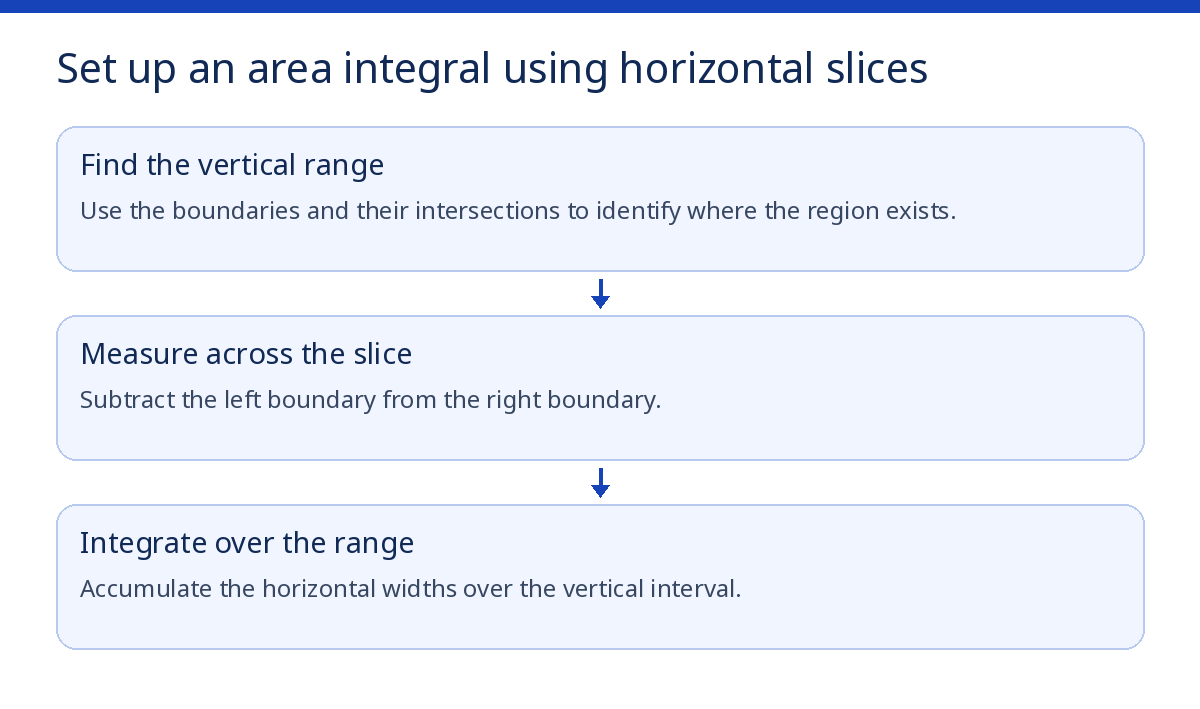
The area question tests a different decision: what a slice measures. If the boundaries are expressed as horizontal coordinates in terms of the vertical coordinate, a horizontal slice has width right boundary minus left boundary. The range of vertical coordinates comes from the region itself, not from whichever curve is easier to integrate. The paper also includes a definite integral where reflection is useful because the denominator stays unchanged under the reflection.
Differential equations: keep track of valid intervals
The differential-equation questions include recognising a product derivative and using a homogeneous substitution. Before separating variables, look for terms that are already the derivative of a product. Also distinguish the task of finding a general solution from finding a particular solution: an initial condition selects a member of the solution family, and the interval used must contain the point where that condition is imposed.
Before you divide: A substitution such as with requires . If separation divides by an expression involving the new variable, check separately whether the values that make it zero give solutions of the original equation. Likewise, an equation containing tangents must be interpreted on intervals where the relevant tangent expressions are defined.
Probability: distinguish the model from the arithmetic
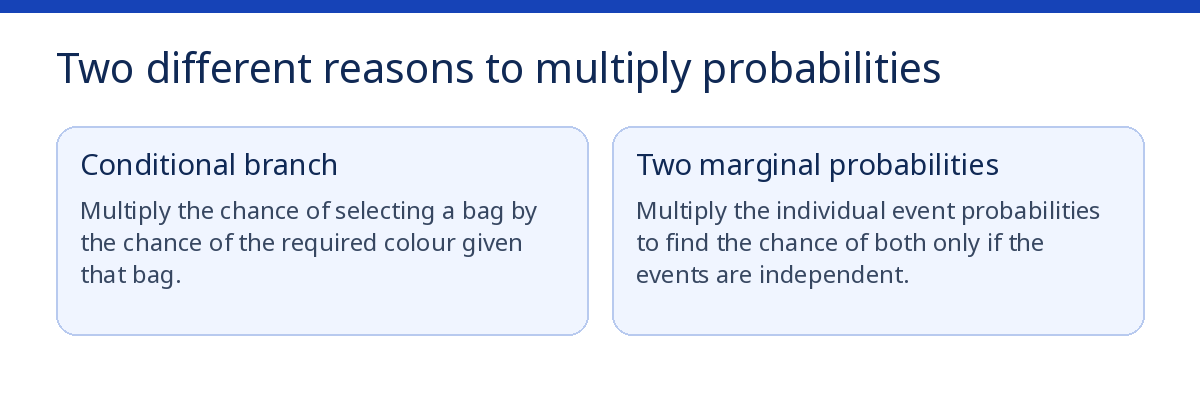
The paper uses a distribution table, a two-stage bag draw and an archery case study to test different kinds of reasoning. To normalise a distribution, use the fact that the probabilities of all its possible values sum to one. For the bag draw, distinguish the probability of choosing a bag from the conditional probability of drawing the required colour from that bag. Weight each conditional probability by the chance of choosing its bag before combining the branches.
When multiplication applies: Multiplying two marginal probabilities gives the probability of both events only under independence. The archery question does not explicitly state independence, and its worked solution flags that assumption. The numerical case-study answers are omitted here: the two individual scoring probabilities do not, by themselves, determine the probabilities of both archers scoring or of exactly one scoring.
Quick self-check after a timed attempt
Attempt the question pages before opening the linked solutions. During the timed pass, choose one branch where an internal choice is offered; afterwards, try the other branch separately to see whether it calls for a different method. In the worked solution, read the Concept used entry first. If it identifies an idea you missed, try restarting from that cue before reading the remaining steps.
When comparing your work, ask where the approaches first diverged. Did you translate the geometry into the right condition? Did you check whether an absolute value changes sign inside the interval? Did you state the assumption needed for a probability product? These checks distinguish a sound setup with an algebra slip from a calculation that was correct for the wrong setup.
Spotted an error? Report a correction. Practise this in the app: notes, formula sheets and mind maps.





























































































































































Loading comments…