CBSE Class 12 Mathematics 2023 Paper with Worked Solutions
CBSEMathematics2023 Previous Year Paper
Paper code: 65/5/3 · 2023Use this full, year-wise CBSE Class 12 Mathematics paper to practise the 2023 main examination under its printed time limit, then use the worked solutions to check not just your results but the reasons your methods apply.
This set is one of the year's papers. See every set from 2023, grouped by series.
What’s in the 2023 paper
This file contains the English version of the 2023 CBSE Class 12 Mathematics main examination, paper code 65/5/3. The cover gives a time limit of 3 hours and a maximum of 80 marks. The resource is organised by year, not by chapter: you can work through one complete board paper rather than assemble a practice set from separate topics. The cover indexes Q1 through Q38 and states that the original question layout, options and diagrams are preserved.
The visible worked solutions separate the formula used, concept used and explanation in steps. That distinction makes it easier to see whether a mistake came from choosing a method or carrying it out. The final solution pages are not shown in the supplied excerpt, so this guide does not assign topics or methods to those questions.

Mathematics 2023 | Class 12 | Previous Year Paper | Code 65/5/3
In the StudentCurio app
Complete 2023 CBSE Class 12 Mathematics paper with worked solutions, including questions across the syllabus and detailed solutions to questions 37 and 38 on matrices and differential equations. Helps students practise the board-exam format and review problem-solving methods.
Use the paper for a timed attempt and a separate review
For a full practice attempt, use the printed three-hour limit and keep the worked solutions closed. Follow the paper’s own instructions for printed OR choices. Those alternatives serve a different purpose in review: once the timed attempt is over, an unattempted alternative can give you another problem to work on without changing what you count as your original attempt.
During review, use the question-number index to return to a specific item. Compare your first decisive step with the solution’s concept label before reading the rest. If you chose the same method, look for the first line where your work diverges. If you chose a different method, check whether both approaches satisfy the question’s conditions. A difference in presentation is not necessarily a mathematical error.
Good to remember: check the domain before differentiating
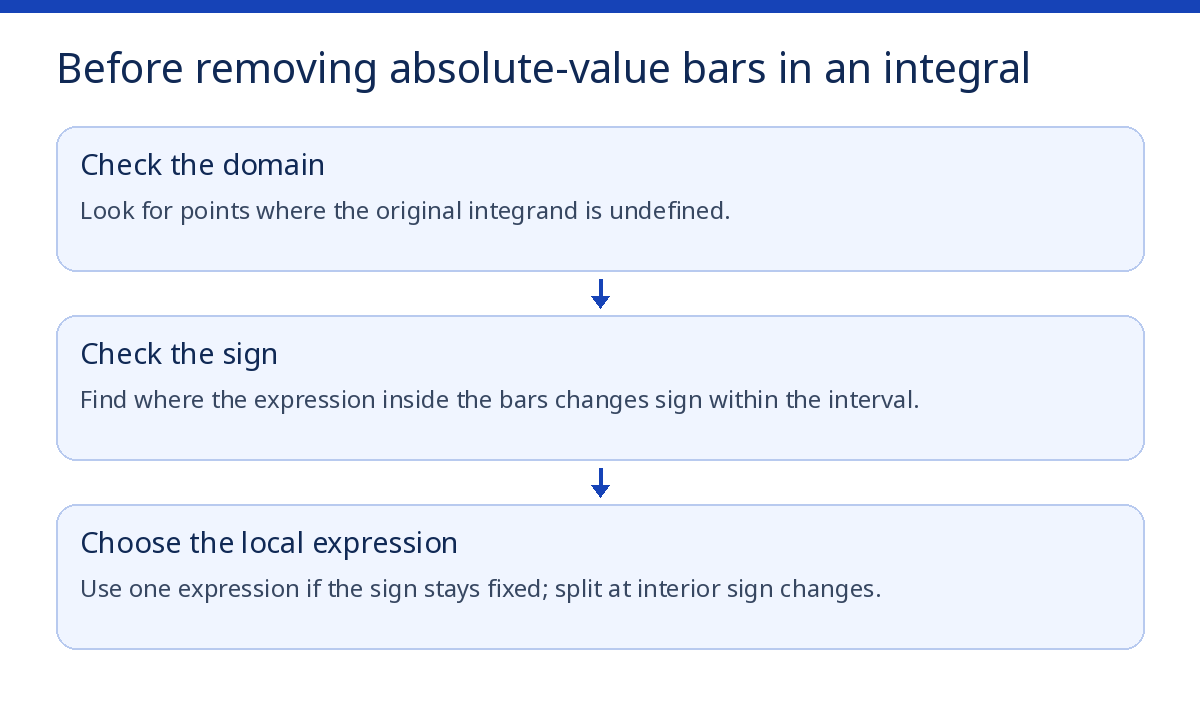
The visible calculus solutions use signs and intervals to reason about functions. For an expression such as , decide which sign cosine has near the point before dropping the absolute-value bars. The local expression is where cosine is positive and where it is negative. At a boundary where the sign changes, a derivative found on one side does not by itself establish differentiability at the boundary.
The greatest-integer function offers a related distinction: it is locally constant at non-integers but jumps at integers. The derivative-sign example makes a different point: a derivative that is positive throughout an interval establishes strict increase there, not merely at the points tested. In review, mark whether your argument concerns a neighbourhood, an entire interval or all of .
Common integration mistake: checking the sign at only one point
In a definite integral involving an absolute value, look for zeros of the expression inside the bars across the full interval of integration. If its sign stays fixed, one expression can replace the absolute value throughout that interval. If the sign changes at an interior point, split the integral there and use the appropriate expression on each side. When the same expression also appears in a denominator, check its zeros before simplifying: cancellation does not make the original integrand defined at a zero of that denominator.
The visible solutions also show a different integration move: rewriting a trigonometric integrand with an identity so that a derivative becomes recognisable. Check where the original expressions are defined, then verify the proposed antiderivative by differentiating it on the interval in question.
Matrices and differential equations: identify the defining feature
The matrix solutions illustrate why properties matter more than surface resemblance. For a square matrix, symmetry means , so entries in reflected positions across the main diagonal must match. An inverse argument asks a different question: whether a proposed matrix multiplies with the original to give the identity. A matrix polynomial relation can help establish that identity, but a rearranged expression alone is not a justification unless the required product has been checked.
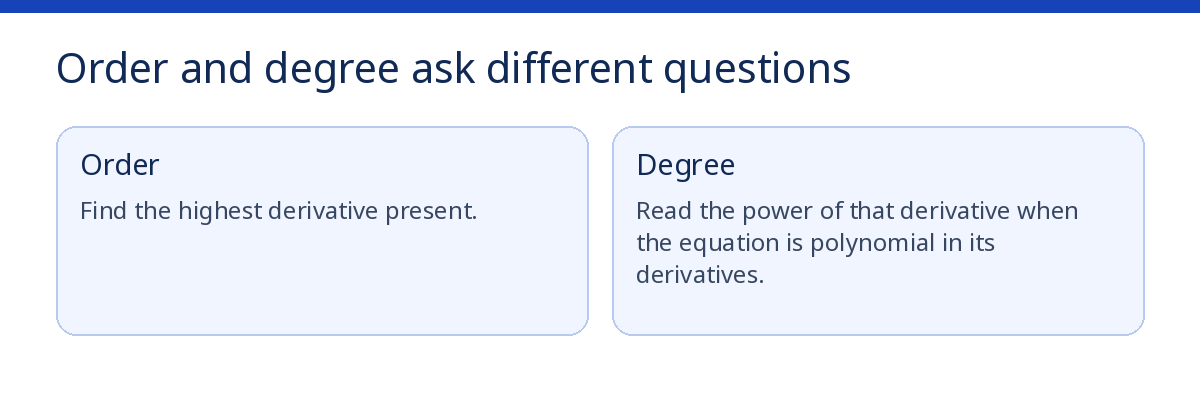
For a differential equation, distinguish order from degree. Order comes from the highest derivative that appears. When the equation is polynomial in its derivatives, degree is the exponent of that highest-order derivative, not the largest exponent anywhere in the equation. A power on a lower-order derivative can therefore be visually prominent without determining the degree.
Vectors and probability: translate the wording first
The visible vector and three-dimensional geometry solutions use direction ratios, direction cosines, dot products and magnitude. Direction ratios specify a direction through proportional components; direction cosines are the cosines of the angles a directed line makes with the positive coordinate axes. For perpendicularity, use the dot product of two nonzero direction vectors. The magnitude of one vector answers a different question and cannot establish the angle between two lines.
In probability, the wording determines the setup. An “at least one” event is the complement of “none,” which can make it easier to count. If you multiply probabilities to find the chance of several outcomes occurring together, justify independence. In conditional probability, identify the event after “given” first: its probability is the denominator, and it must be positive.
Quick self-check: can you justify the step you missed?
Choose a question you missed even though you recognised the topic. Before reopening the worked solution, write down the condition you needed to check. Was it a sign across an interval, an identity product for a proposed inverse, or the probability of the event you were conditioning on? Put that check immediately before the line where you use it, so your reasoning is visible in your written work.
Then retry the question without the solution open. If you can recall the procedure but cannot explain why it applies, revisit the concept label rather than memorising the last line. If your reasoning was sound and only the calculation slipped, redo the calculation separately. The two errors call for different kinds of practice.
Spotted an error? Report a correction. Practise this in the app: notes, formula sheets and mind maps.





























































































































































Loading comments…