CBSE Class 12 Mathematics 2025: Solved Previous Year Paper
CBSEMathematics2025 Previous Year Paper
Paper code: 65/2/1 · 2025Attempt the full English-language 2025 CBSE Class 12 Mathematics main examination paper, set 65/2/1, under its printed three-hour, 80-mark conditions. Then use the worked solutions to check not just your calculations, but also whether you chose a method that fits the question.
This set is one of the year's papers. See every set from 2025, grouped by series.
What this year-wise paper contains
This resource pairs the original English question layout, options and diagrams with worked solutions. The cover lists 38 questions and indicates that the printed internal choices also have solutions. The solutions are organised by question number, so you can return to a specific item without reading the entire file in sequence. This is one complete board paper arranged by year, rather than a chapter-wise question bank.
That distinction matters for practice. In a chapter exercise, the heading often suggests the technique; in a full paper, you have to recognise it from the wording, notation or diagram. The visible solutions separate Formula Used, Concept Used and Explanation in Steps. Read those labels as three different checks: what rule is available, why it applies here and how it is carried through. If your calculation went wrong, identify which of those three stages needs attention.

Mathematics 2025 | Class 12 | Previous Year Paper | Code 65/2/1
In the StudentCurio app
A complete solved CBSE Class 12 Mathematics paper for 2025, covering topics across the syllabus, including matrices, calculus, vectors, probability and linear programming. Helps students practise the board examination and review worked solutions.
Calculus: choose the representation before calculating
The calculus material includes monotonicity, continuity and differentiability, related rates, definite integration and area. For monotonicity, examine the sign of the derivative over an interval rather than treating a single point where it vanishes as proof that the function stops increasing there. Also keep the implication between differentiability and continuity in the right direction: differentiability at a point implies continuity there, but continuity alone does not rule out a corner.
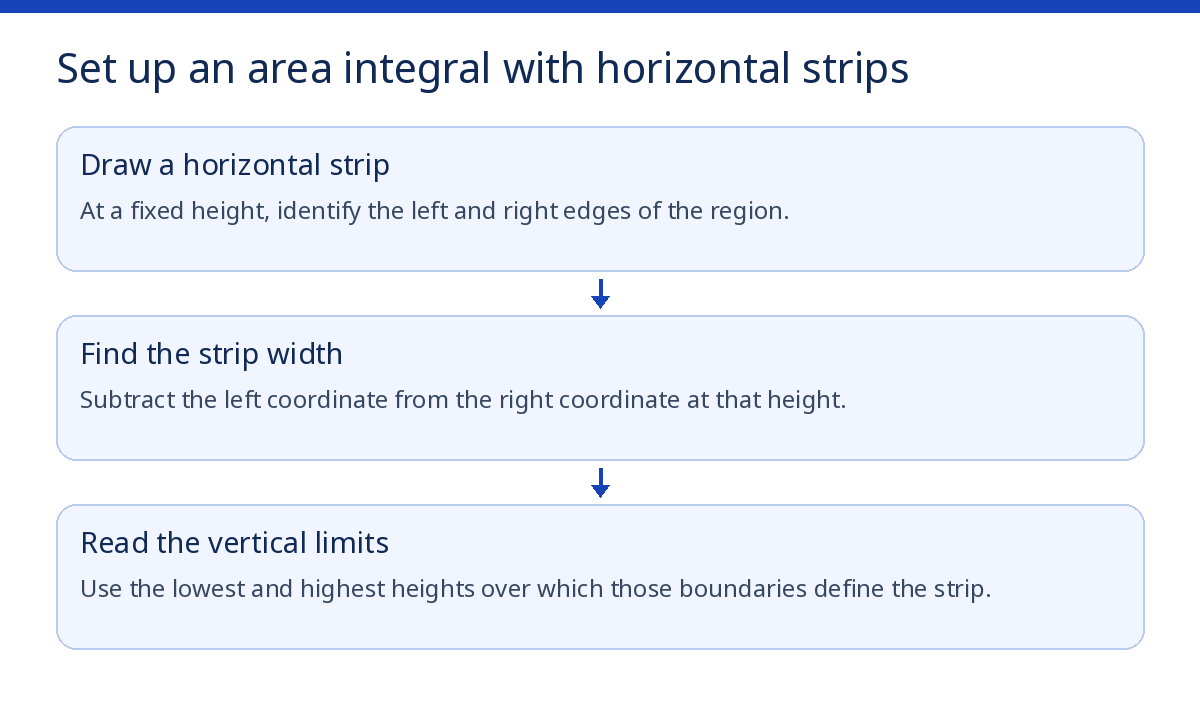
For definite integration, splitting an interval gives two contributions. A reflection substitution makes those contributions equal only when the integrand has the corresponding symmetry; equal interval lengths alone are not enough. In an area problem, the sketch helps you choose the strips. A horizontal strip has width given by the right boundary minus the left boundary, expressed in terms of . Its limits are -values, and the integral is taken with respect to .
Common mistakes: matrix order and vector notation
In the matrix questions, distinguish a transpose condition from a multiplication rule. For a symmetric matrix, matching entries across the main diagonal must be equal. When expanding a matrix product, however, keep the factors in their original order. Even when both products are defined, and need not be equal. A cancellation that depends on their equality requires a reason; a familiar identity from scalar algebra is not enough.
In vectors, distinguish a scalar component from a vector projection. The scalar component is a signed number measured along a specified direction. To obtain the vector projection, multiply that number by the unit vector in the specified direction. The reference vector must be nonzero for this unit vector to exist. For a line in three dimensions, make a different distinction: the fixed coordinates give a point on the line, while the coefficients of the parameter give its direction.
Before using a formula, check its conditions
In conditional probability, the event after the conditioning bar determines the denominator, and its probability must be positive. If the expression involves two complements, write the event in the numerator before replacing it with a probability. The intersection of the complements is the complement of the union. Keeping the event identity separate from the division makes it easier to spot a misplaced complement.
Related rates call for a different check: decide what varies with time. In the cylinder setting, the radius is fixed, so the base area acts as a constant when differentiating the volume with respect to time. If the radius varied, the same shortcut would not apply. In the linear programming material, check what the objective measures. When its coefficients are unit profits, multiplying each by the corresponding quantity and adding gives total profit. The objective states what to maximise; the constraints determine which quantities are feasible.
Use the full paper first, then review by question
For an exam rehearsal, work from the question pages for three hours before opening the solutions. Keep diagrams and answer options available as printed, and make your internal choices during the attempt. Afterwards, use the question-number references to revisit items you left blank, items you answered with hesitation and items where you can no longer justify a step. A correct final choice does not tell you whether your reasoning would work on a similar question.
On review, stop at the first step where your reasoning differs from the worked explanation. If you misread a graph or diagram, redraw and label the relevant boundaries. If you used an identity without checking its assumptions, write down the missing condition before retrying. For focused practice rather than a timed rehearsal, attempt the other printed internal choice separately to see whether it calls for a different setup.
Quick self-check: explain the setup without the answer
Before moving on from a reviewed item, cover the final line and describe why the setup works. In an area question, can you justify your choice of strip from the boundaries? In a probability question, can you name the conditioning event in words? In a matrix expansion, can you point to the exact step at which commutativity would be needed? These checks test whether you can reconstruct the method without relying on the answer option.
This guide omits the final answer lines for the definite-integral and horizontal-strip items, the evaluated area from the horizontal-strip item, and the disputed direction-angle option. The underlying concepts can be reviewed independently of those details.
Spotted an error? Report a correction. Practise this in the app: notes, formula sheets and mind maps.





























































































































































Loading comments…