CBSE Class 12 Mathematics 2022 Term 2 Solved Paper
CBSEMathematics2022 Previous Year Paper
Paper code: 65/5/1 · 2022Practise the full 2022 CBSE Class 12 Mathematics Term 2 main examination paper, set 65/5/1. Use the worked solutions to compare not just your final results, but also your choice of method and the conditions that make each step valid.
This set is one of the year's papers. See every set from 2022, grouped by series.
What this year-wise paper contains
This is the English version of the 2021–22 session’s Term 2 paper. The cover gives a time limit of 2 hours and a maximum of 40 marks. The file preserves the original question layout, options and diagrams, and the worked section covers the questions, subparts and printed OR choices. It is organised as a full paper from one year, rather than as a chapter-wise question bank.
For a timed attempt, work from the question pages first and make your OR choices before opening the worked section. For a topic review, use the question-number links to go straight to a solution. The Formula Used, Concept Used and Explanation in Steps labels let you check separately whether you knew the relevant rule, recognised when to use it and carried out the algebra correctly.

Mathematics 2022 | Class 12 | Previous Year Paper | Code 65/5/1
In the StudentCurio app
A solved CBSE Class 12 Mathematics Term 2 paper from 2022, with questions and worked solutions across topics including integration, differential equations, probability and vectors. Useful for practising past-paper questions and reviewing solution methods.
Integration: recognise the form before choosing a rule
The integration questions illustrate why the first rewrite matters. A quadratic under a square root can be completed to a square to reveal the inverse-sine form. For a real integrand of the form with , the condition is : the denominator must be real and nonzero. The inverse sine may be defined at its endpoints even though this integrand is not.
Other questions call for different signals. In a trigonometric quotient, rewriting the numerator to expose a multiple of the denominator’s derivative can produce a logarithm. In an exponential–trigonometric product, repeated integration by parts can bring back the original integral, giving an equation for it. The alternative involving partial fractions shows a different order of work: make the substitution first, then decompose the resulting rational expression.
Differential equations: check what the rewrite changes
One equation uses the chain rule in reverse: a factor involving the dependent variable helps turn one side into a single derivative. If the resulting relation is then written with a real logarithm, its argument must be positive. That restriction comes from the new form and is part of specifying where the solution is valid.
The paper also uses an integrating factor after rewriting a first-order equation in linear form. In an OR branch, changing which variable is treated as independent and introducing a new dependent expression makes a linear equation visible. When reviewing either approach, mark the factors you divide by. Work on intervals where those divisions are valid, and check any excluded case in the original equation rather than assuming the transformed equation accounts for it.
Probability: separate totals, products and conditioning
In the discrete distribution question, the given relations first have to be expressed in terms of individual probabilities. Only then can you impose the requirement that the probabilities of all possible values add to one. In the box-draw alternative, multiplication applies within each colour pairing because the draws are independent; addition combines the mutually exclusive ways the colours can match. These are different justifications, even when both operations occur in the same calculation.
The Bayes question instead asks you to update a selection probability after an observation. The denominator must account for the observation across all possible selections, not just the selection you are asked about. The discussion here omits Q6(a) because its printed event probabilities are inconsistent. As a general check, an intersection cannot have a larger probability than either event that contains it.
Vectors and 3D geometry: distinguish the conditions
The vector questions connect algebraic expressions with geometry. The dot product and the cross-product magnitude together relate to the lengths of two vectors. A zero dot product establishes orthogonality, but interpreting it as a right angle between directions requires both vectors to be nonzero. The direction-cosine question uses a separate fact: the squared direction cosines of a direction, measured relative to the three coordinate axes, sum to one.
In three dimensions, the plane question combines two plane equations to preserve their common line, then uses an extra point to select a plane. The line question makes another distinction: the cross-product denominator in the shortest-distance formula requires nonparallel directions. In the motion setting, a shared point is a possible collision location, not proof of a collision. The riders must also arrive there at the same time.
Before integrating an area, check where the boundary changes
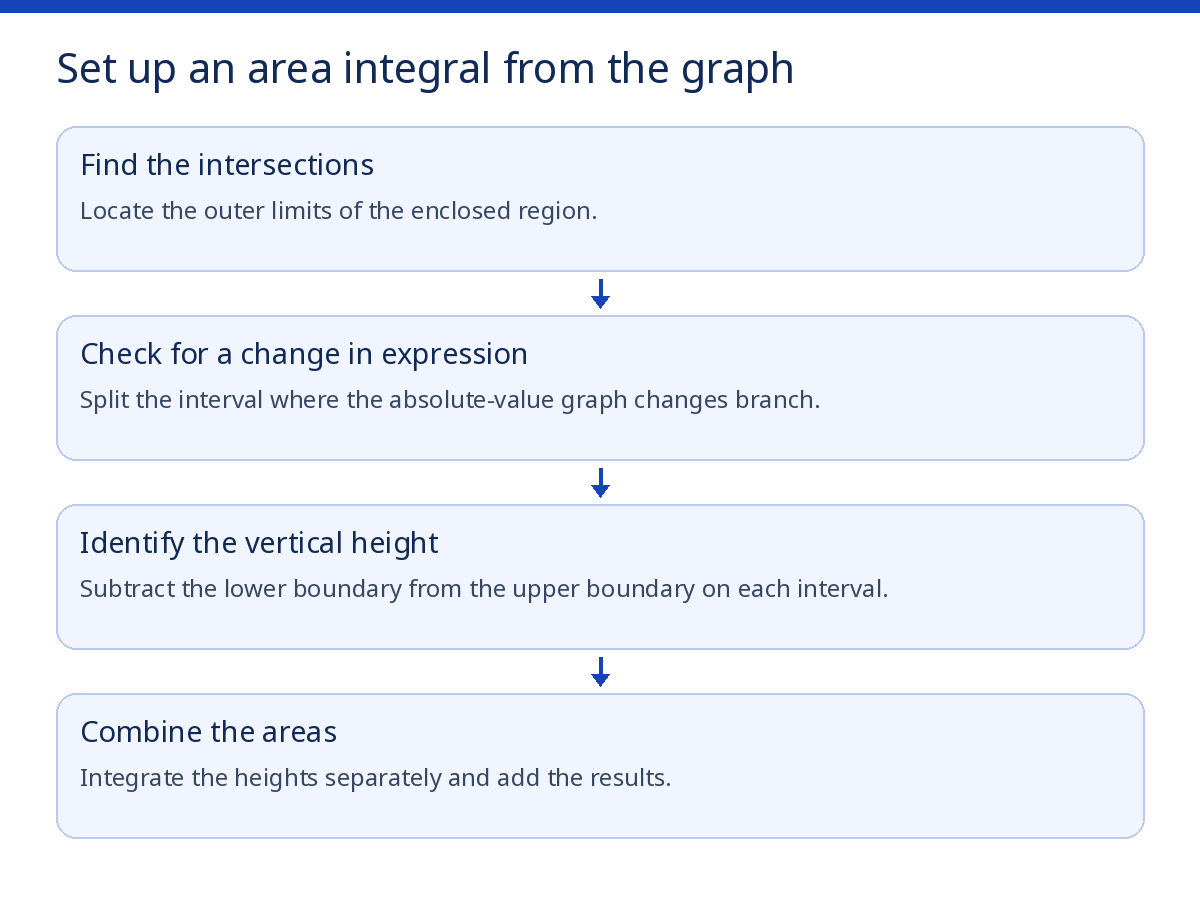
The area question pairs a horizontal line with an absolute-value graph. The intersections locate the outer limits of the enclosed region, but they do not tell you whether one expression describes the full boundary between those limits. Here the absolute-value graph changes its expression at its vertex, so the vertical height must be described piecewise.
Before looking at the worked setup, identify the upper and lower boundaries on each interval. Ask whether subtracting the lower expression from the upper one gives a nonnegative height throughout that interval. This check separates the geometric decision about what to integrate from the algebraic task of evaluating the integrals. The result of an area calculation is expressed in square units.
Spotted an error? Report a correction. Practise this in the app: notes, formula sheets and mind maps.





























































































































































Loading comments…