Integral Calculus: CBSE Class 12 2022 Term 2 Paper Solutions Guide
CBSEMathematicsIntegral Calculus
Paper code: 65/2/1 · 2022This guide explains the methods behind the worked solutions to the CBSE Class 12 Mathematics 2022 Term 2 paper (65/2/1). The paper is listed under Integral Calculus but is a full previous-year board paper, so the guide covers how it handles integrals, bounded areas, differential equations, vectors, 3D lines and planes, and probability.
Paper 65/2/1: a 40-mark Term 2 board paper
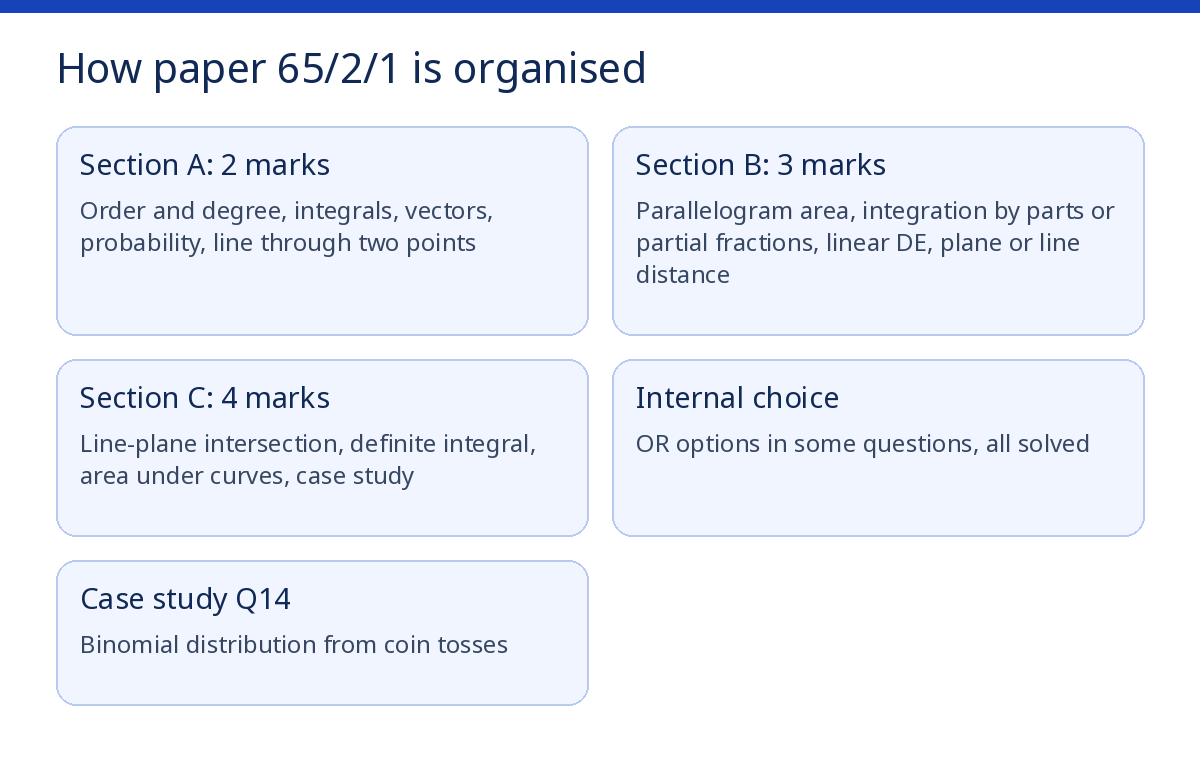
This file is not a set of NCERT exercise solutions. It is the 2022 CBSE Class 12 Mathematics paper, code 65/2/1, from the 2021-22 Term 2 examination, with worked solutions. The paper allows 2 hours and carries 40 marks.
It has three compulsory sections:
- Section A: six short answer type I questions of 2 marks each.
- Section B: four short answer type II questions of 3 marks each.
- Section C: four long answer type questions of 4 marks each. Question 14 is a case-study with two 2-mark sub-parts.
Some questions offer an internal choice, and solutions are given for both OR options. Each solution follows the same pattern: Formula used, Concept used and numbered Explanation in steps. Domain conditions are stated where they matter. This layout shows the working a board examiner expects to see.

Integral Calculus | Class 12 | NCERT Solutions | 2022 | Code 65/2/1
In the StudentCurio app
Worked solutions to questions from a CBSE Class 12 Mathematics paper, with coverage including definite integrals and areas bounded by curves, as well as differential equations, vectors, probability and three-dimensional geometry. Useful for reviewing exam methods across these topics.
Choosing an identity, substitution or integration by parts
The integral questions reward spotting the deciding step early.
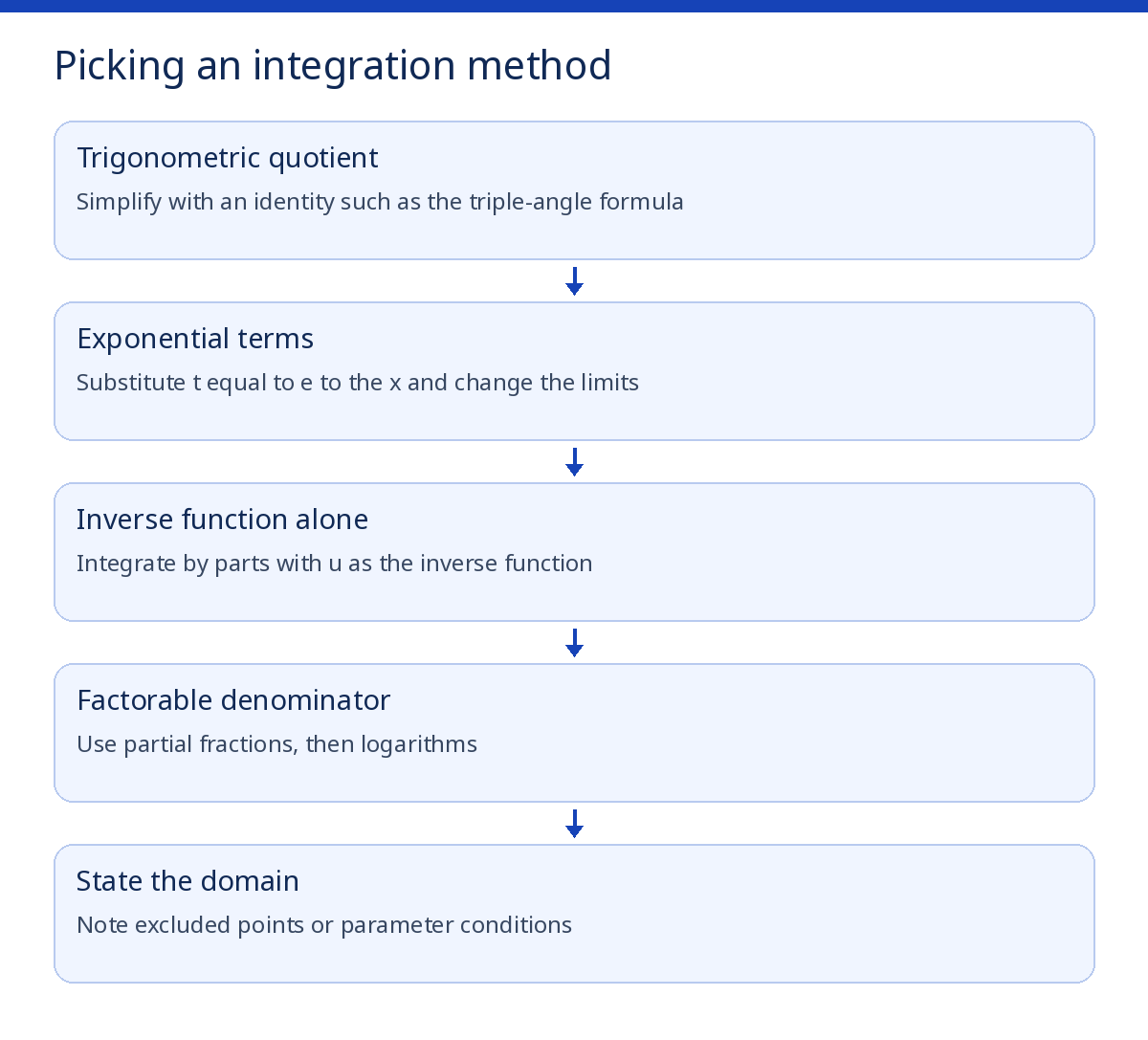
In one choice of Q2, an integrand of the form is simplified first with the triple-angle identity . This reduces the quotient to terms that integrate directly. The solution adds that the result holds only on intervals where .
The other choice involves exponentials. There, the substitution turns the integrand into the standard form . The key habit is to change the limits along with the variable. The lower limit becomes , and the upper limit becomes .
Q8 shows two different routes:
- For , use integration by parts with and . This leaves an integral of , which gives a logarithm.
- For a rational function, factor the denominator . Then use partial fractions and integrate term by term into logarithms of absolute values. The answer is valid only for .
Q12 uses the property-style substitution on . This splits the integral into two power terms. The solution states the condition , because the integral diverges for .
Setting up area as upper curve minus lower curve
Q13 applies the principle .
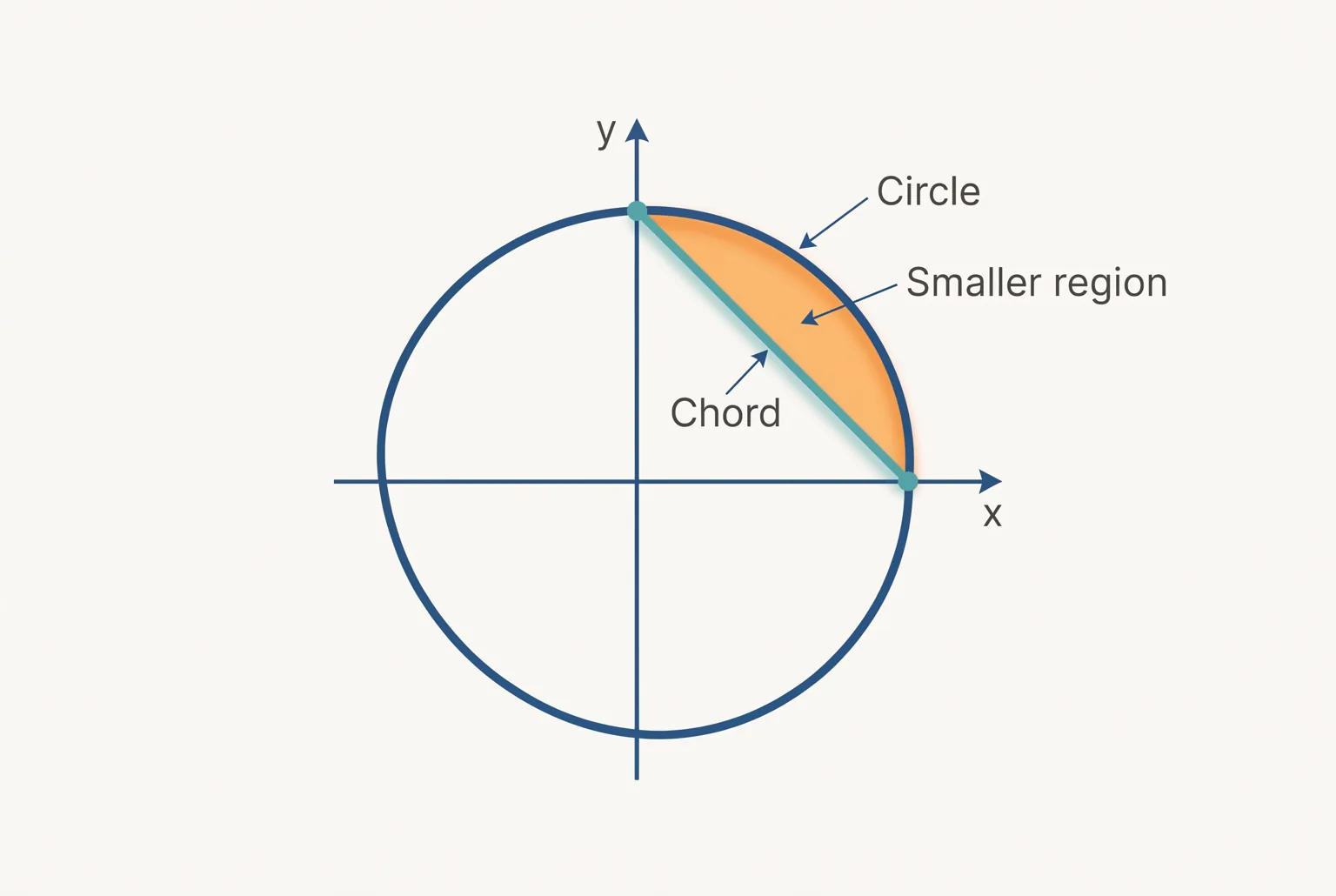
In option (a), the circle has radius . The line cuts off a chord. The smaller region is the circular segment between the arc and the chord. So the integrand is , taken between the two intersection points.
A sketch shows that the chord meets the circle at its intercepts on the positive axes, so those points supply the limits. The segment area is then the circular integral minus the line integral, and the circular part is where enters the result.
In option (b), the parabola has two branches, . The region up to the line uses the full width between the branches. A common error is to use only the upper branch. Once the area is equated to the given value, the condition picks the valid root.
Order, degree and linear equations in x
For order and degree (Q1), the solution expands the derivative first. This writes the equation as a polynomial in its highest derivative. The degree is then read as the power of that derivative. Degree is only read once no product is hidden inside a derivative, which is why expansion comes before counting.
Q9 is the more instructive case. The equation is not linear in . Near the given point, the solution treats as a function of and inverts to . It then sets , which gives a linear equation with integrating factor . Integration by parts handles . The initial condition then fixes the constant to give the particular solution.
Direction vectors, normals and line–plane intersections
The vector and 3D questions rely on a few set-ups:
- Equal magnitudes (Q3): square both sides using . For unit vectors, .
- Line through two points (Q6): use as the direction vector, then use the parameter to find a missing coordinate.
- Parallelogram from diagonals (Q7): write and , then solve for the sides. The area is .
- Plane through three points (Q10a): take the cross product of two difference vectors as the normal. The distance from the origin then follows by dividing the constant term by the length of that normal.
- Parallel lines (Q10b): use for the shared direction .
- Intersection first (Q11): substitute the parametric line into the plane before measuring any distance.
Conditional probability, independence and the cricket-toss case study
Q4 restricts the sample space to ordered dice outcomes with an even sum. An even sum needs both dice odd or both even, which fixes the size of this reduced sample space. The solution then counts favourable outcomes within that set, using .
Q5 uses the complement. A problem stays unsolved only if both independent attempts fail, so .
The case study (Q14) models unbiased coin tosses as a binomial distribution, . An "at least one head" question is again handled through its complement.
Errors the worked solutions avoid
- Domain dropped: the indefinite answers state where they hold, such as and . The power integral needs .
- Limits left unchanged: after , the definite integral must use limits in .
- Half the region: for , both branches bound the area.
- Parallel-line formula misapplied: it is used in Q10b only because both lines share the same direction vector.
- Distance from the wrong point: in Q11, the intersection point must be found before the distance is measured.
- Unordered dice outcomes: outcomes such as (3, 1) and (1, 3) are counted separately.
Quick self-check before attempting the paper
Before opening the solutions, ask yourself:
- For each integral, which feature decides the method: an identity, an exponential to substitute, an inverse function for parts, or a factorable denominator?
- In Q9, why does treating as the dependent variable make the equation linear?
Attempt each question under the 2-hour limit. Then compare your steps with the Concept used line, not just the final answer.
Frequently asked questions
Is this file NCERT exercise solutions?
No. It contains worked solutions to the CBSE Class 12 Mathematics 2022 Term 2 board paper, code 65/2/1, which carries 40 marks over 2 hours.
Are both internal-choice options solved?
Yes. The file states that every question, subpart and both printed OR choices have worked solutions.
Which topics besides integrals does the paper test?
Areas bounded by curves, differential equations, vectors, three-dimensional geometry and probability, including a case-study question on coin tosses.
Spotted an error? Report a correction. Practise this in the app: notes, formula sheets and mind maps.





























































































































































Loading comments…