CBSE Class 12 Mathematics 2026 Previous Year Paper
CBSEMathematics2026 Previous Year Paper
Paper code: 65/3/3 · 2026Practise the full 2026 CBSE Class 12 Mathematics main examination paper (65/3/3) under its three-hour, 80-mark format. Then use the worked solutions to check why a method applies, not just whether your final answer matches.
This set is one of the year's papers. See every set from 2026, grouped by series.
Know the format before you start
This year-wise resource contains the complete English question paper and a question-number index for the worked solutions. There are 38 questions across five sections. Section A has 18 multiple-choice questions and two assertion–reason questions, all worth one mark each. Sections B, C and D contain two-mark very short answers, three-mark short answers and five-mark long answers, respectively. Section E has three case studies worth four marks each.
There is no overall choice: all question numbers are compulsory, but where an internal choice is printed, attempt one of the alternatives. For a timed sitting, keep the solutions closed and work without a calculator, as the paper requires. Save the alternatives you did not attempt for a separate practice session.

Mathematics 2026 | Class 12 | Previous Year Paper | Code 65/3/3
In the StudentCurio app
Complete CBSE Class 12 Mathematics examination paper identified as 2026, with worked solutions. It includes multiple-choice, short-answer, long-answer and case-study questions across topics such as calculus, vectors, probability and matrices.
Matrices: check the structure before calculating
The paper tests matrix order, transposes, determinants and inverses, then asks you to use matrices in longer problems. These tasks call for different checks. A matrix product is defined only when the first matrix’s column count matches the second matrix’s row count. The product takes its row count from the first matrix and its column count from the second. That lets you check the shape of a result before computing any entries.
Order matters in the algebra too: transposing a product reverses the factors. And scaling a square matrix is not the same as scaling its determinant: for an matrix, . In the voucher problem, the step to review before the matrix calculation is whether each equation accurately represents the stated relationship between the two quantities.
When a derivative answers the question
Calculus appears in several forms, including rates of change, increasing intervals, parametric and implicit differentiation, integration and differential equations. For a rate question, identify the variable in the denominator before differentiating: a derivative with respect to diameter is not the same as one with respect to radius. For increasing intervals, use the sign of the derivative on the function’s domain, rather than treating a stationary point as an interval answer.
The ladder case study makes a related distinction: differentiating the sum of the lengths and minimising the sum of their squares involve different expressions. In differential equations, distinguish a general solution, which contains an arbitrary constant, from a particular solution selected by a given condition.
Vectors and lines: separate direction from position
The vectors and three-dimensional geometry questions move between direction ratios, direction cosines and vector equations of lines. Direction ratios describe a direction up to a nonzero scale; direction cosines are the components of a unit direction vector. For perpendicular directions, check that the dot product of nonzero direction vectors is zero. To find the smaller angle between undirected lines, use the absolute value of the dot product after dividing by the product of the vector lengths.
An intersection test needs more than direction information. In vector form, each line has a point, a direction vector and its own parameter. To establish that the lines meet, the parameter values must give the same point in all three coordinates.
Common mistakes when reading probability
The paper uses probability in distinct settings. The surgery question explicitly assumes independent outcomes, so probabilities can be multiplied for a specified sequence of successes and failures. But exactly one successful outcome can occur in more than one position. At most two describes a range of possible counts, not just the case of two successes.
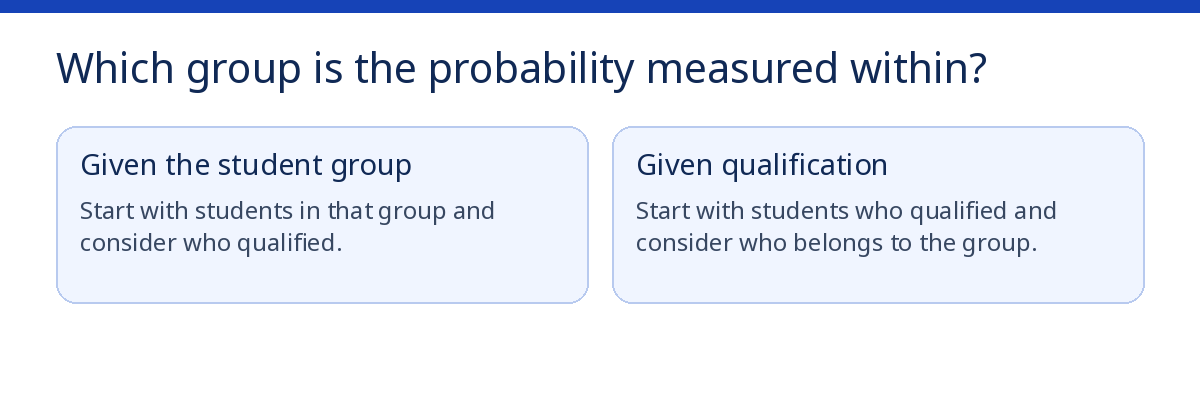
The survey case study asks for probabilities conditioned on different groups and outcomes. The chance of qualifying given a student’s group is not the same as the chance of belonging to that group given qualification. Before using any percentage, name the group it is measured within. Reversing the condition changes the reference group; it does not merely change the order of the words.
From a diagram or description to a model
In the triangular park case study, the boundary-line equations are part of the setup for finding an area by integration. When reviewing your work, check that each integrand represents the appropriate width or height of a strip and that the limits cover the requested region. A correct antiderivative cannot compensate for choosing the wrong boundary or interval.
The graphical linear programming question also starts with a region, but the goal is different. Its inequalities, including nonnegativity, determine which points are feasible. The objective function then determines what to maximise over that region. Keep those roles separate: drawing the feasible region is not yet the same as comparing objective values.
Before you open the worked solutions
For an assertion–reason item, decide whether each statement is true before asking whether the reason explains the assertion. For a written response, mark the first line where you were unsure. Then use the question index and the solution’s formula, concept and step-by-step explanation to identify whether you missed a condition, chose the wrong method or made an algebraic error.
This guide leaves out Q11’s incomplete sine fraction, Q24(b)’s malformed relation listing, Q32(b)’s inconsistent square geometry and Q33’s incompatible domain and codomain specification. It does not reconstruct those details. Use the independently clear questions to assess your understanding rather than treating a disputed item as a reliable benchmark.
Spotted an error? Report a correction. Practise this in the app: notes, formula sheets and mind maps.





























































































































































Loading comments…