CBSE Class 12 Maths 2024 Supplementary Paper with Solutions
CBSEMathematics2024 Previous Year Paper
Paper code: 65/S/1 · 2024Use the full 2024 CBSE Class 12 Mathematics supplementary paper (65/S/1) for a three-hour, calculator-free attempt. Then use the worked solutions to check how you chose a method, handled its conditions and showed your reasoning.
This set is one of the year's papers. See every set from 2024, grouped by series.
What the 2024 supplementary paper includes
This English-language paper is a year-wise resource for CBSE Class 12 Mathematics, not a chapter worksheet. It is worth 80 marks and contains 38 questions across five sections. The file presents the question paper with its original English layout, options and diagrams, alongside worked solutions that separate the formula, the concept and the steps.
Section A has 18 standard multiple-choice questions and two assertion–reason questions, all worth one mark each. Sections B, C and D contain very short, short and long answers worth two, three and five marks per question, respectively. Section E contains three four-mark case studies. There is no overall choice: attempt every question, choosing one of the alternatives wherever an internal OR is printed.

Mathematics Supplementary 2024 | Class 12 | Previous Year Paper | Code 65/S/1
In the StudentCurio app
Complete CBSE Class 12 Mathematics supplementary examination paper with worked solutions, covering questions across the syllabus, including probability distributions and matrix methods. Helps students practise a full board-style paper and review solution methods.
Matrices, vectors and lines: check the setup first
The matrix questions test different decisions: whether a product is defined, how determinants and adjugates are related, and when an inverse can be used. For a product, the number of columns in the first matrix must match the number of rows in the second; the outer dimensions give the order of the result. An ordinary matrix inverse requires a square matrix with nonzero determinant. These checks tell you whether an operation is valid before you do the arithmetic.
In three-dimensional geometry, keep the point on a line separate from its direction. Nonzero proportional direction vectors describe the same direction up to orientation, but direction alone does not locate a line. The paper tests both reading direction ratios and using line equations to reason about angles, intersections or distances.
Common mistakes in calculus: ignoring the conditions
The calculus questions cover continuity, differentiation, rates of change, integration and differential equations. For a function defined in pieces, checking continuity at a join means comparing the left-hand limit, the right-hand limit and the assigned function value. In an inverse trigonometric expression, check the principal-value range rather than taking any angle with the required trigonometric value.
A zero first derivative does not by itself establish a maximum or minimum. A first-derivative sign change can classify an extremum; an inflection point instead involves a change in concavity. In a rate problem, identify which quantity is changing with time before differentiating. A negative derivative represents a decrease, while a question asking how fast a quantity is decreasing may call for the magnitude of that rate.
When a definite integral represents area
This paper uses definite integrals both for evaluating expressions and for finding areas bounded by curves and lines. A definite integral gives a signed result, whereas geometric area is nonnegative. If a curve crosses the horizontal axis within the stated interval, split the calculation where its sign changes so that the areas on opposite sides do not cancel.
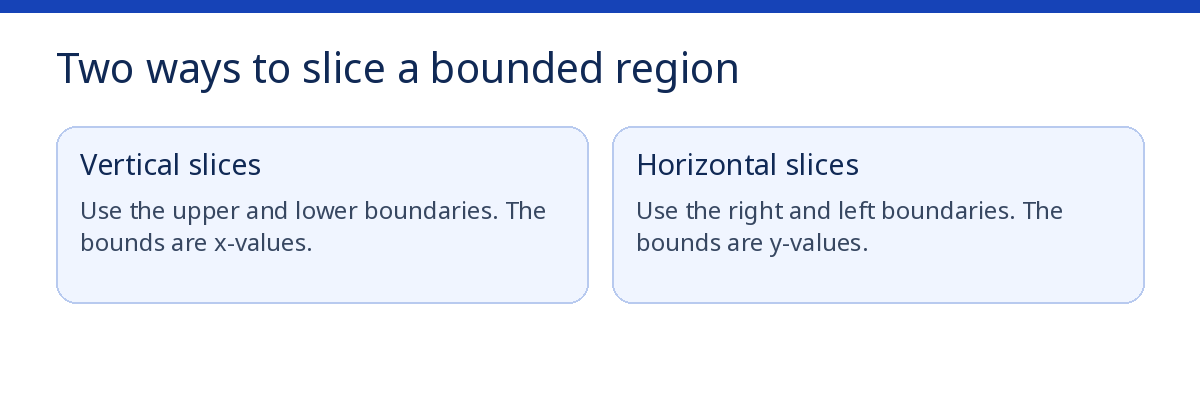
The boundary lines also help determine the variable of integration. With vertical slices, use upper minus lower and bounds in . With horizontal slices, use right minus left and bounds in . Before looking at the worked setup, sketch the region and label the boundaries. That makes it easier to tell whether a mismatch comes from your choice of bounds or from the integration itself.
What the three case studies ask you to model
The sandbag case connects height and shadow distance through the geometry in the diagram. Its rate questions require you to distinguish a vertical change from a change along the ground. The sales case gives a discrete probability distribution and connects sales to daily income. Use the fact that the probabilities of all possible outcomes sum to one as a check on the table. Keep the probability of a group of outcomes separate from expected income, which is a probability-weighted average.
The plot case works in the other direction: start with verbal descriptions of changes in area, write equations, and then use a matrix method. Check that you have translated each increase or decrease with the correct sign before manipulating the equations.
Quick self-check: identify the kind of reasoning
Before writing equations, ask what you need to justify. In a relation question, reflexivity concerns every element paired with itself, symmetry concerns reversing a pair, and transitivity concerns linking two pairs. A counterexample can disprove a property, but one example cannot establish it for the whole domain. In graphical linear programming, the constraints define the feasible region; the objective tells you what to optimise. A point that violates even one constraint is not a candidate, regardless of its objective value.
For assertion–reason items, judge each statement separately before deciding whether the reason explains the assertion. This guide leaves out the probability assertion–reason item because its event-inclusion wording requires qualification.
Attempt first, then review the worked steps
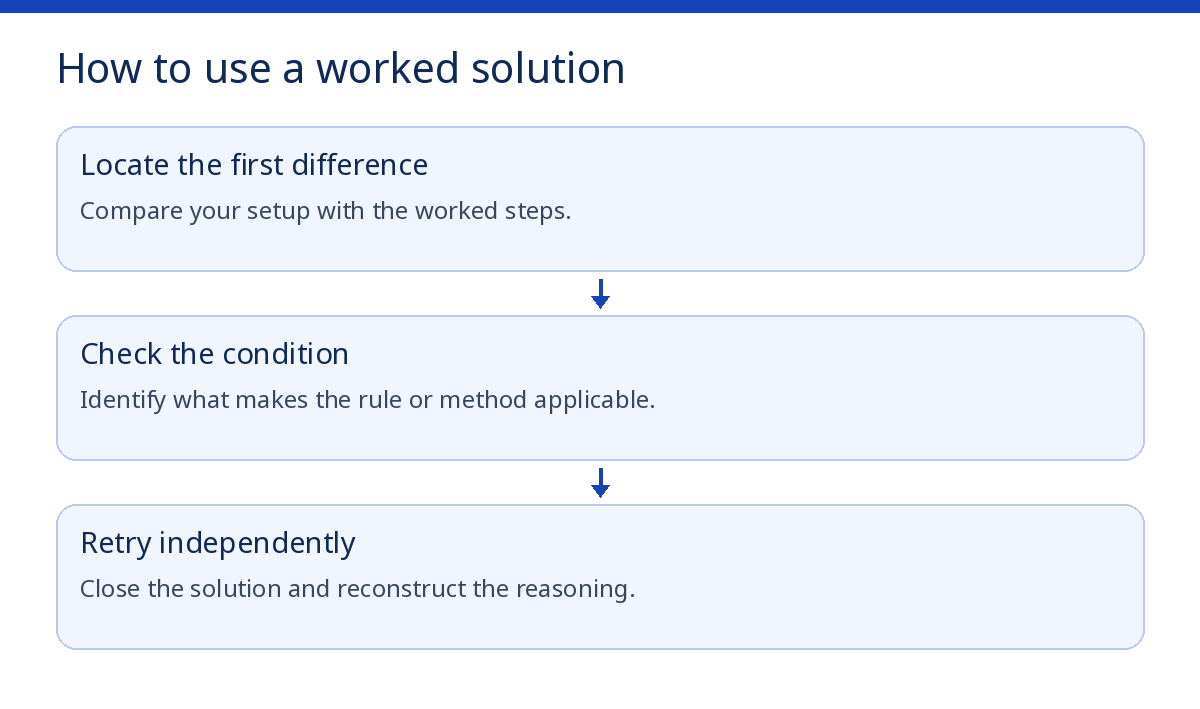
For a full-paper rehearsal, use the three-hour limit without a calculator and choose only one branch of each printed OR. Keep the solution pages closed while you work. During review, use the question-number links to go straight to the relevant solution and compare your first substantive step, not just your final result.
If your setup agrees with the worked method, check for a sign, bound or arithmetic error. If the setup differs, read the concept note and identify the condition that makes the method valid. Finally, try the unused OR branches without timing yourself. They give you a second way to use the same paper without changing the conditions of your first attempt.
Spotted an error? Report a correction. Practise this in the app: notes, formula sheets and mind maps.





























































































































































Loading comments…