Continuity and Differentiability: Class 12 CBSE Practice Guide
CBSEMathematicsLimit, Continuity and Differentiability
This guide covers Chapter 5, Continuity and Differentiability, for Class 12 CBSE: joining-point tests with one-sided limits, domain exclusions versus discontinuities, greatest integer functions and the limit tools behind 'find k' questions. It also maps the derivative topics and a practice order from topic sets to the chapter practice.
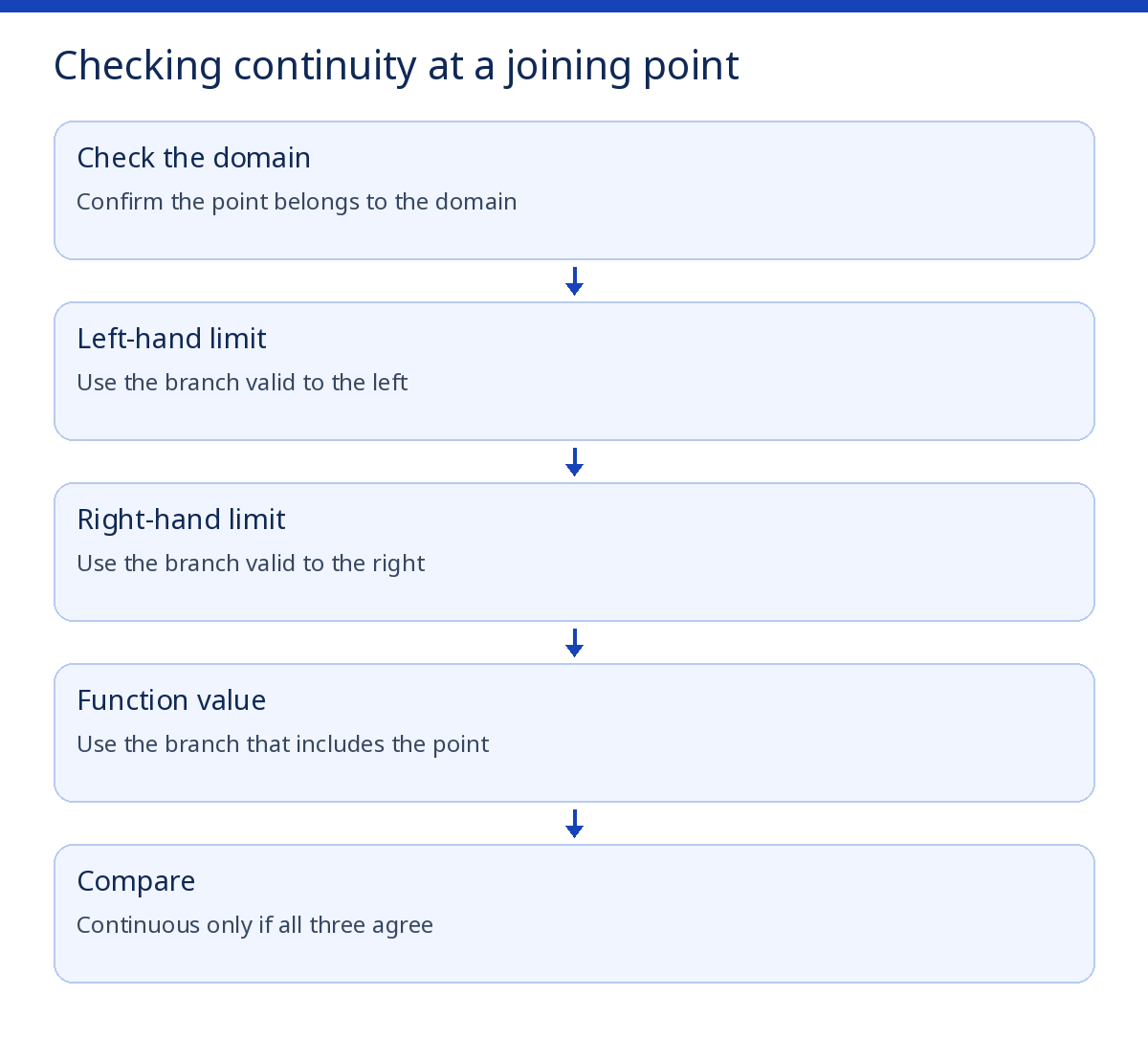
Testing continuity at a joining point with one-sided limits
A function is continuous at a point when its limit there exists and equals the function value: . Most questions in Topic Practice 1 reduce to checking this one equation, but the work changes with the function.
For a polynomial, the worked solutions substitute the point into both the expression and its limit, because polynomials are continuous at every real number.
For a piecewise function, the real work happens at the joining point, where two formulas meet. There you need three quantities:
- the left-hand limit , from the left branch;
- the right-hand limit , from the right branch;
- the value , from the branch that includes the equals sign.
Continuity requires . Away from the join, each branch is usually a standard function, so it is continuous inside its own interval.
Absolute values are handled the same way. Writing as for and for turns an expression such as into a piecewise function. On a closed interval, the endpoints need only one-sided continuity.

Limit, Continuity and Differentiability | Class 12 | CBSE Assessment
In the StudentCurio app
This Class 12 CBSE assessment covers limits, continuity and differentiability, including standard derivative rules, inverse trigonometric functions, implicit and parametric differentiation, and higher derivatives. Its varied questions and worked solutions help students practise the chapter and prepare for assessments.
Why points outside the domain are not discontinuities
This assessment stresses one distinction: a point excluded from the domain is not the same as a genuine discontinuity. Strictly, continuity is assessed only at points in the domain.
For example, has poles where , that is , , yet it is continuous on its domain. Some objective questions still count such excluded points as discontinuities. The source adds clarifications in those places, so read each question's wording carefully.
Good to remember: cancelling a common factor in a rational function does not restore an excluded point, because the original denominator still vanishes there.
- If a finite limit exists at the excluded point, the point is a removable hole.
- If no finite limit exists, the point is a pole.
For a composite function such as with , keep both restrictions. The inner function needs , and the outer function needs . Simplifying the final quotient does not bring the excluded points back.
Greatest integer and fractional-part functions
The greatest integer function is the greatest integer less than or equal to . Its behaviour depends on whether the point is an integer.
At a non-integer point, choose a small neighbourhood lying between two consecutive integers. On that neighbourhood is constant, so its limit can be compared directly with its value.
At an integer , the worked solutions approach from each side using a small with , writing and explicitly before comparing the one-sided limits with the value at .
The fractional part equals the linear expression between consecutive integers and . A reciprocal such as also needs a nonzero denominator, which brings back the domain distinction above.
Limit tools behind the 'find k' questions
Many questions define by a formula for and by a constant at . For continuity, that constant must equal the limit. The worked solutions rely on a small set of tools:
- Factorisation: cancel a factor such as before substituting.
- Rationalisation: simplify differences of square roots.
- Standard limits: and as , with identities such as .
- Shifting the variable: put , for example at or , so the limit is taken as .
- The squeeze theorem for oscillating factors: .
- One-sided analysis of : it tends to as , while on the right, dividing by helps.
Throughout the source, means the natural logarithm unless a base is stated, and is an exponential.
Proving continuity with sums, products, quotients and compositions
Topic Practice 2 asks you to justify continuity without computing every limit from scratch.
- Sums, differences and products of continuous functions are continuous.
- A composition of continuous functions is continuous. Since is itself continuous, this covers forms like and .
- A quotient is continuous only where its denominator is nonzero. That is why a quotient of two polynomials can fail at a point while their sum and product cannot.
Some problems have two parameters, such as finding and for a function with three branches. Apply the joining-point test at each join, then solve the resulting equations together.
From the corner of y = |x| to derivative techniques
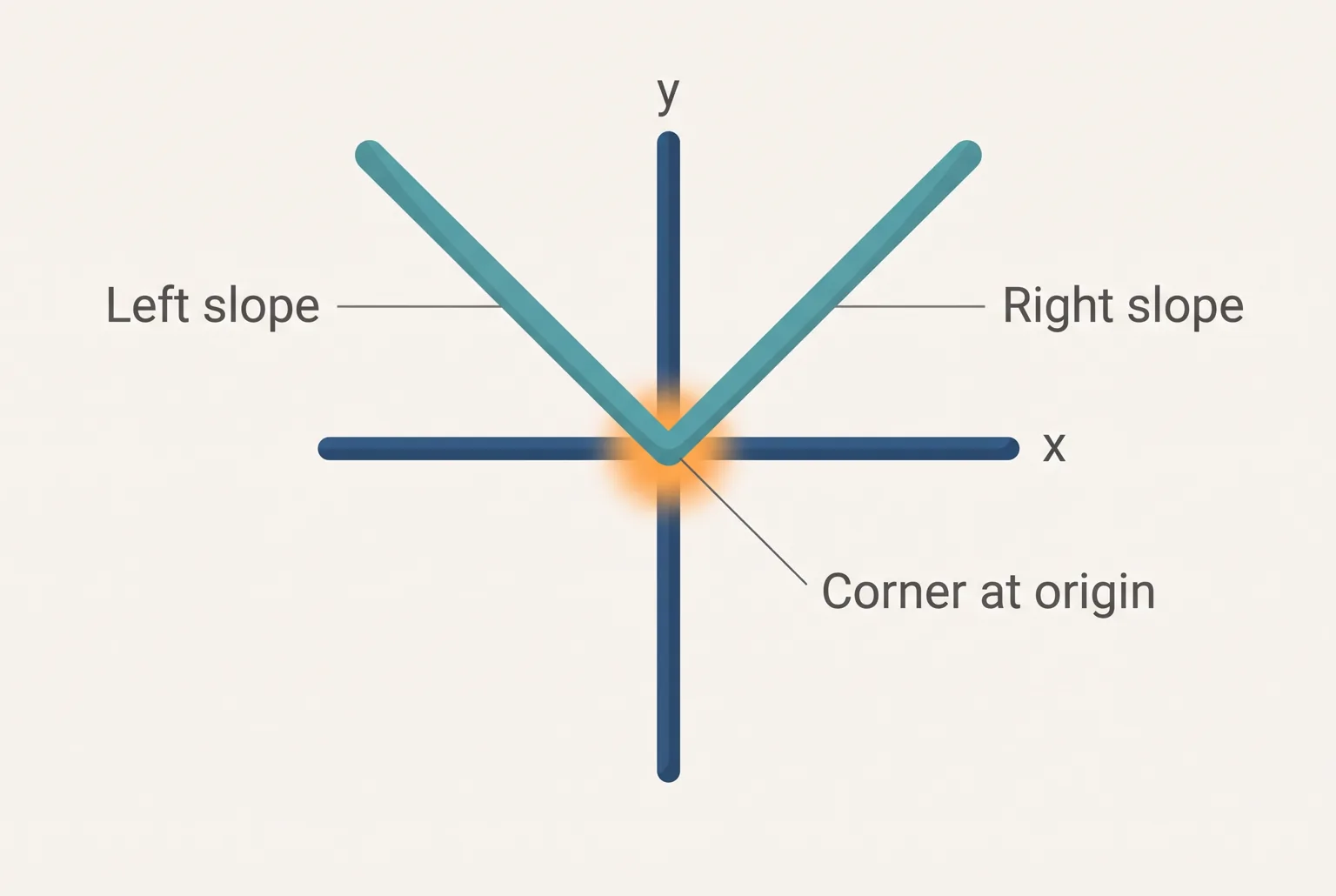
The cover diagram shows why continuity alone does not guarantee a derivative. At the origin, has slope from the left and from the right. The one-sided slopes disagree, so the graph has a corner there.
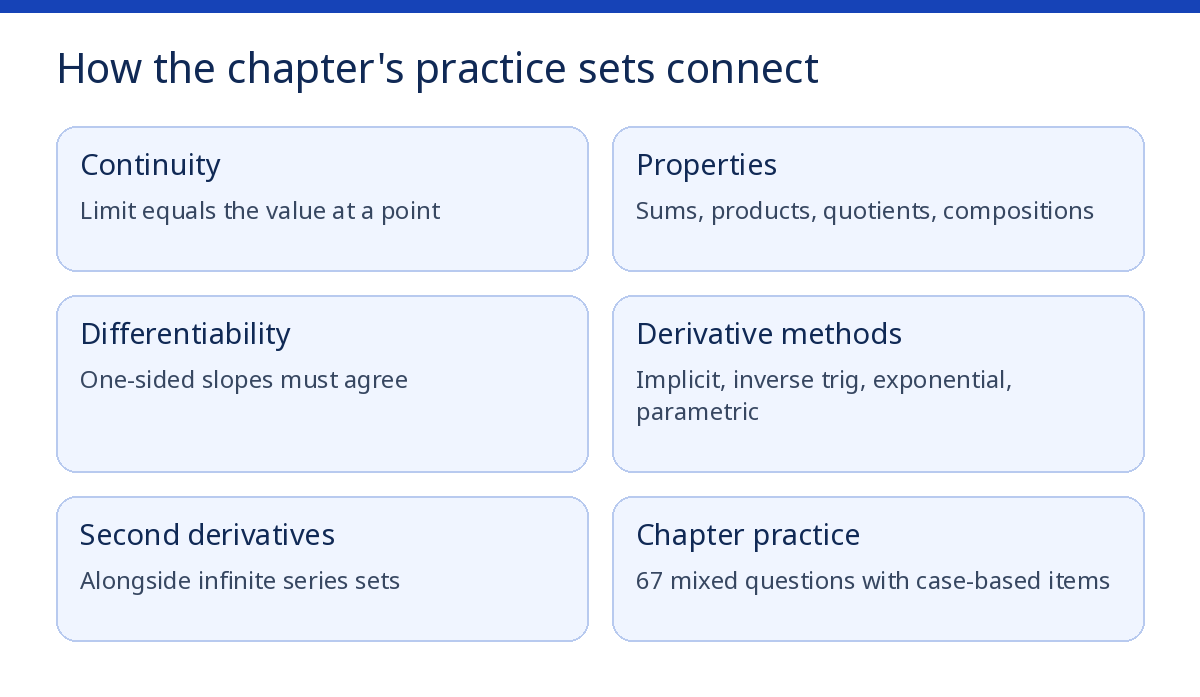
Topic Practice 3 covers differentiability and derivatives of various functions. The later sets follow the chapter's sequence:
- implicit functions;
- inverse trigonometric functions;
- exponential and logarithmic functions;
- parametric functions;
- one function with respect to another;
- infinite series;
- second order derivatives.
One worked solution shows the implicit method. Differentiate both sides with respect to , collect the terms and divide. The expression you divide by must be nonzero.
Working from topic sets to the 67-question chapter practice
The assessment is arranged in ten topic practices followed by a 67-question chapter practice. The cover lists 232 topic questions and 299 questions with worked solutions in total.
The topic sets use these board formats:
- Objective Type;
- Very Short Answer, which some sets omit;
- Short Answer Type I;
- Short Answer Type II.
Case Based Questions appear in the chapter practice. Question numbers restart in each practice.
Work topic by topic first, and attempt each set before opening its worked solutions. Then compare your steps with the solution's: did you write , and separately, and did you state the domain? Keep the chapter practice for mixed revision.
Quick self-check: can you explain why a removable hole differs from a pole, and why cancelling a factor leaves the domain unchanged?
Frequently asked questions
Does this assessment follow NCERT Chapter 5?
Yes. It is labelled Chapter 05, Continuity and Differentiability, for Class 12 CBSE Mathematics. Its ten topic practices run from continuity to second order derivatives.
What does log mean in these questions?
The source states that log denotes the natural logarithm unless a base is stated.
Spotted an error? Report a correction. Practise this in the app: notes, formula sheets and mind maps.





























































































































































Loading comments…