Class 12 NCERT Three-Dimensional Geometry: Lines in Space
CBSEMathematicsThree-Dimensional Geometry
This CBSE Class 12 NCERT Mathematics chapter uses vector algebra to describe lines in space, find the angle between them and calculate their shortest distance. The supplied pages include worked examples, two numbered exercises, a miscellaneous exercise and a summary.
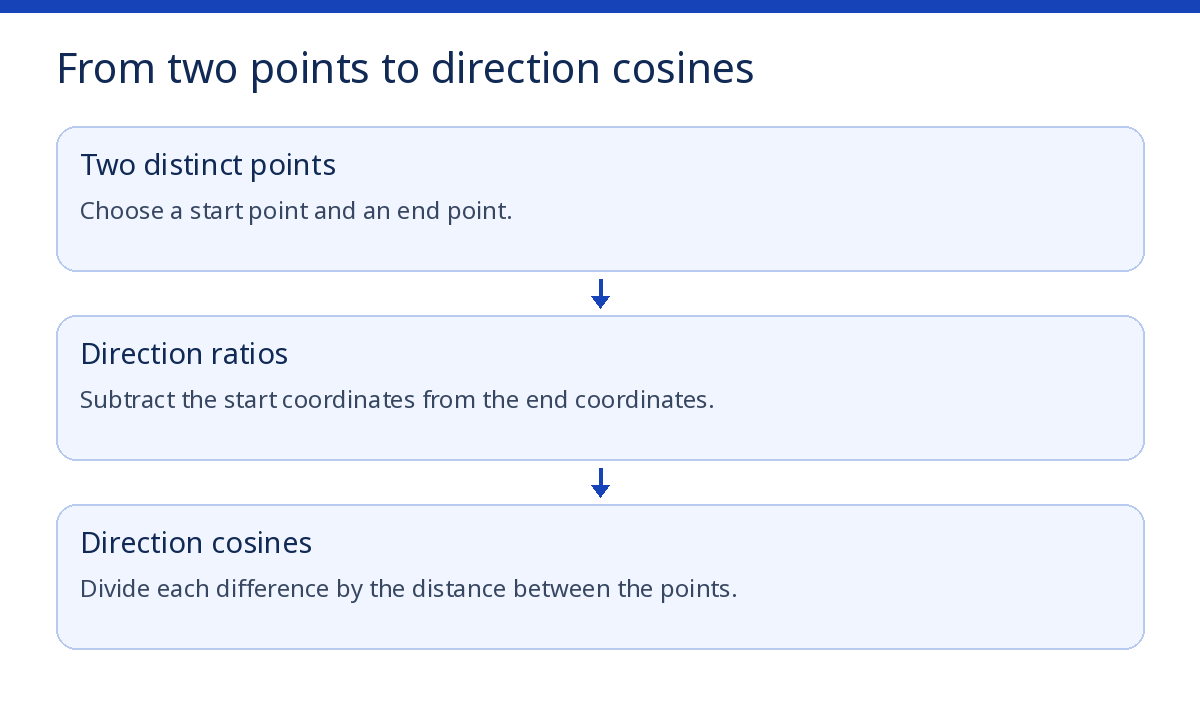
From coordinate differences to direction cosines
The chapter builds on Class 11 coordinate geometry and the preceding chapter on vectors. Its starting point is that a line’s direction can be described independently of its location. If a line does not pass through the origin, you can use a parallel line through the origin to read its direction angles. The cosines of the angles made with the positive coordinate axes are its direction cosines.
For two distinct points and , subtract the coordinates of from those of in the same order throughout. The three differences are direction ratios for the line. Dividing each difference by the length gives the direction cosines for the direction from to . Their squares add to one. Direction ratios need not satisfy that condition: multiplying all three by any nonzero number gives another valid set for the same line.
Reversing the order of the points reverses all three differences. The line stays the same, but its orientation reverses. This is why an undirected line has two opposite sets of direction cosines, while a specified direction has only one.

Three-Dimensional Geometry | Class 12 | NCERT Textbook
In the StudentCurio app
This NCERT chapter covers coordinates and direction ratios and cosines, equations of lines in space, angles between lines, skew lines, and shortest-distance calculations, with worked examples and exercises. It helps Class 12 students learn and practise three-dimensional geometry.
One line, three ways to write it
A unique line is determined by a point and a nonzero direction vector, or by two distinct points. In the second case, use either point as your starting point and the displacement between the points as your direction vector. In the vector equation , locates the starting point, gives the direction, and the real parameter selects a point on the line.
Equating the three vector components gives the parametric equations. Each coordinate equals the corresponding starting coordinate plus the same parameter times its direction component. This shared parameter matters: choosing a different value for each coordinate would no longer describe the same line. When all three direction components are nonzero, you can isolate the parameter in each coordinate equation and equate the three fractions to obtain the symmetric Cartesian form.
Common mistake: dividing by a zero direction component
A direction vector may have a zero component without being the zero vector. If its x-component is zero, the x-coordinate is constant along the line. Keep that fact as a separate equation rather than writing a fraction with zero in the denominator. The parametric form remains valid without any special notation.
This distinction also helps when testing for parallel directions. Check whether one nonzero direction vector is a scalar multiple of the other. That test works even when some components are zero, whereas a test based on dividing corresponding components may be undefined.
Why the angle depends on direction alone
To find the angle between two lines, extract their direction vectors rather than using the position vectors of their starting points. The chapter moves the directions to a common origin to explain the angle. That construction also works for skew lines: the original lines need not meet for their directions to be compared.
For the smaller angle between two undirected lines, use . The absolute value ensures that reversing one direction vector does not change the angle between the lines. A zero dot product gives a right angle. If you start with direction cosines instead of direction ratios, the vectors already have unit length, so there is no further normalisation to do. None of these angle checks tells you by itself whether the original lines meet.
When each shortest-distance method applies
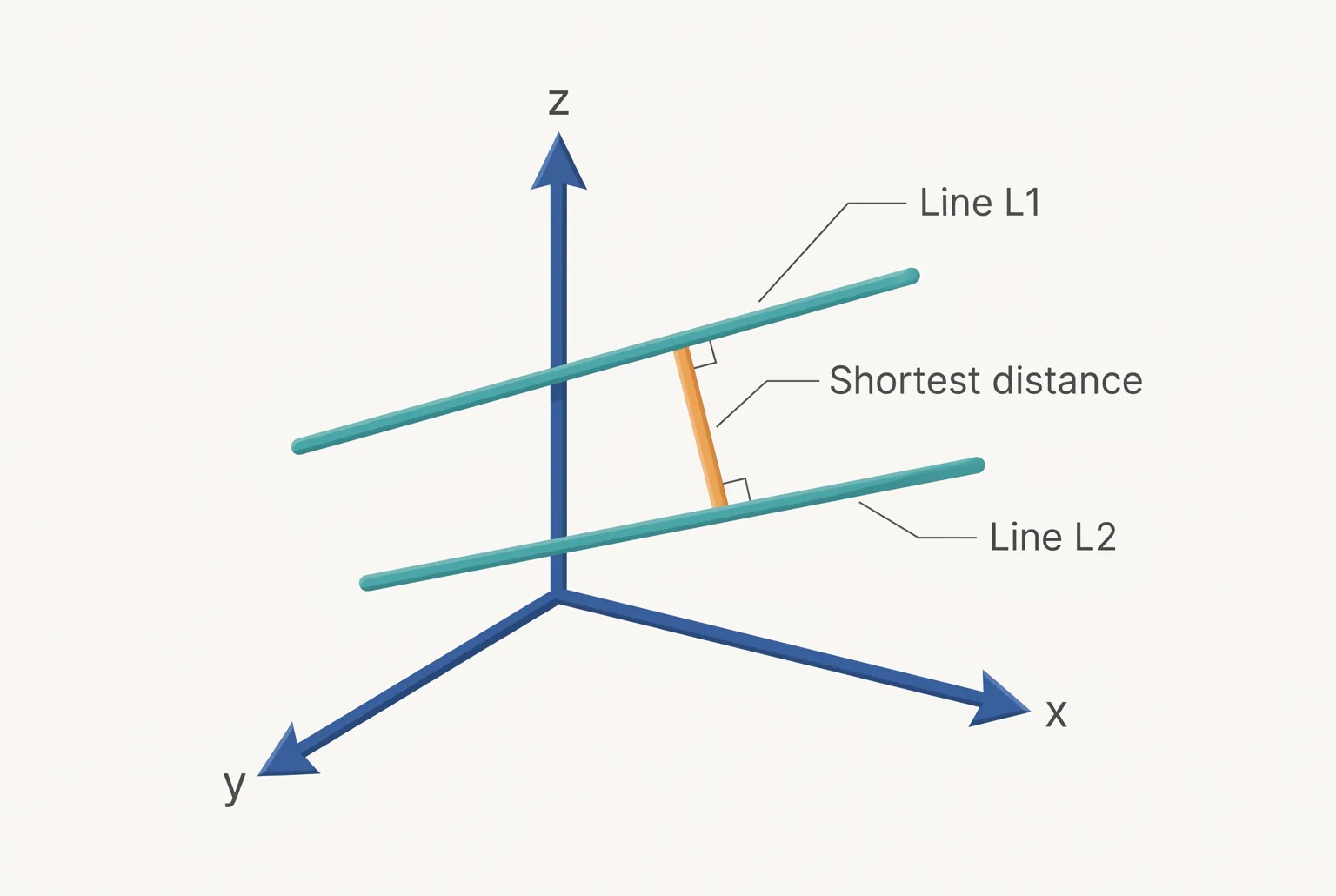
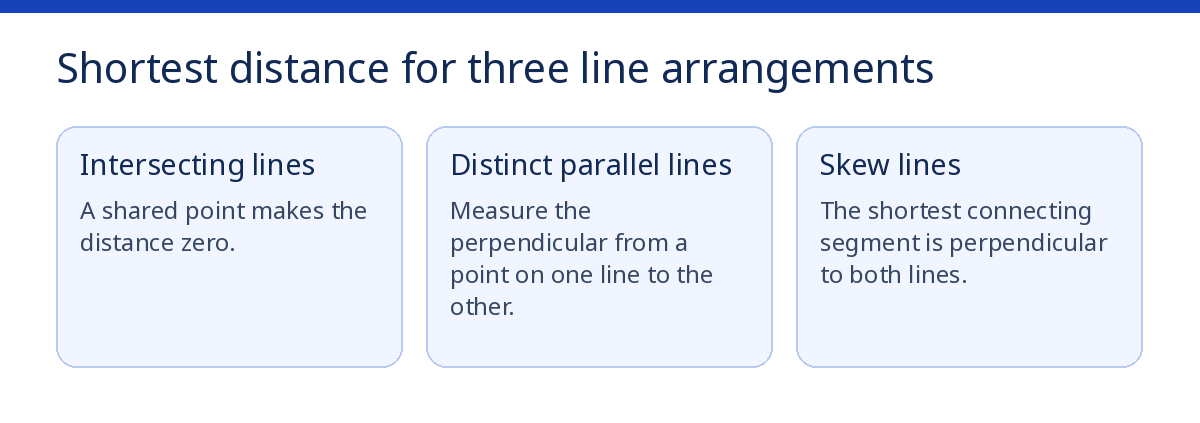
Unlike an angle calculation, a distance calculation depends on where the lines are as well as how they point. If the lines intersect, their shortest distance is zero because they share a point. For distinct parallel lines, measure the perpendicular distance from a point on one line to the other. The choice of point does not change the distance.
Skew lines are neither parallel nor intersecting. Their shortest connecting segment is perpendicular to both lines. The cross product of their direction vectors gives a direction perpendicular to both. Join any point on the first line to any point on the second, then take the magnitude of that joining vector’s projection onto the common perpendicular direction. The joining segment itself need not be the shortest segment; only its component along the common perpendicular gives the distance.
Do not use this projection procedure with the cross product of parallel direction vectors. That cross product is zero and cannot be normalised to a unit vector. This is why the chapter treats parallel and skew distances separately.
How to work through the examples and exercises
Use the examples before Exercise 11.1 to practise identifying direction data from angles, ratios or coordinates. Notice how proportional displacements can support a collinearity argument when the segments share a point. In Exercise 11.2, practise switching between line equations before comparing directions or finding distances. For a distance problem, first identify a point and a direction for each line; then decide which geometric case applies.
Use the Miscellaneous Exercise to practise choosing a method without relying on the preceding section heading. Check that you can explain what the given information determines before opening the summary: a direction, a particular line, an angle or a separation. The supplied pages develop these line topics; they do not develop the plane topics mentioned in the introduction.
Spotted an error? Report a correction. Practise this in the app: notes, formula sheets and mind maps.





























































































































































Loading comments…