Continuity and Differentiability: CBSE Class 12 PYQs and Solutions
CBSEMathematicsLimit, Continuity and Differentiability
Continuity and Differentiability (NCERT Class 12, Chapter 5) is tested in this CBSE collection of 164 previous-year questions with worked solutions. This guide explains how continuity of piecewise functions, one-sided derivatives, the chain rule and inverse-trigonometric rules, and implicit, logarithmic, parametric and second-order differentiation are examined.
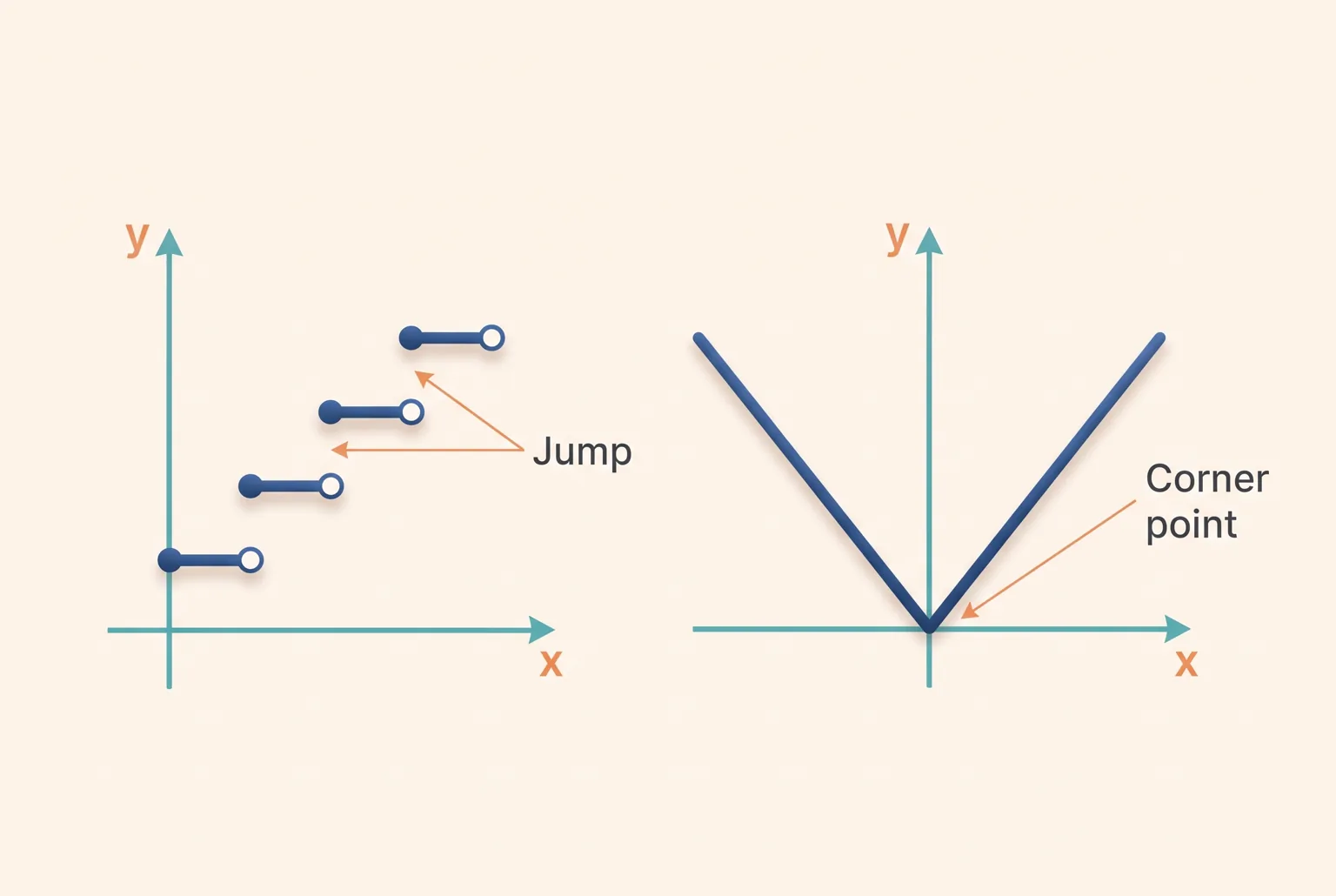
Continuity at a point: matching both limits with the value
Continuity and piecewise functions form a major group in the topic index. Every question in it rests on one condition: a function is continuous at when . The assertion-reason items quote this condition, so write it out before you substitute any values.
The questions are framed in two ways. In the first, one branch is defined for and a constant is assigned at . You evaluate the limit of the first branch and equate it to . A typical stem defines for , sets and asks for . Expect standard limits such as , factorisation of a form, or logarithmic limits.
In the second, several branches meet at boundary points, and continuity at each junction gives one equation. Two unknown constants therefore need two junctions. Questions that ask for the number of discontinuities follow the same logic. You only need to check the junctions, because each branch is already continuous on its own interval.

Continuity and Differentiability | Class 12 | Previous Year Paper
In the StudentCurio app
A collection of solved CBSE Class 12 previous-year questions on limits, continuity, differentiability and standard differentiation rules, including implicit, logarithmic, parametric and higher-order derivatives. Useful for exam practice and reviewing step-by-step solution methods.
Differentiability: comparing left and right derivatives
A function is differentiable at when the left-hand derivative equals the right-hand derivative . This sub-topic concentrates on two families of functions:
- sums and differences of modulus functions, such as or
- the greatest integer function on intervals such as
For modulus expressions, the critical points are where each expression inside a modulus becomes zero. Rewrite the function without modulus signs on either side of those points, then compare the two one-sided derivatives at each point.
For , examine the integer points inside the stated interval. Read the inequality signs carefully, because an open interval excludes its endpoints.
Good to remember: NCERT shows that every differentiable function is continuous, but the converse does not hold. A discontinuity rules out differentiability immediately, while continuity on its own settles nothing. Several MCQs and assertion-reason items ask you to label a function as continuous, differentiable, both or neither, so test each property separately.
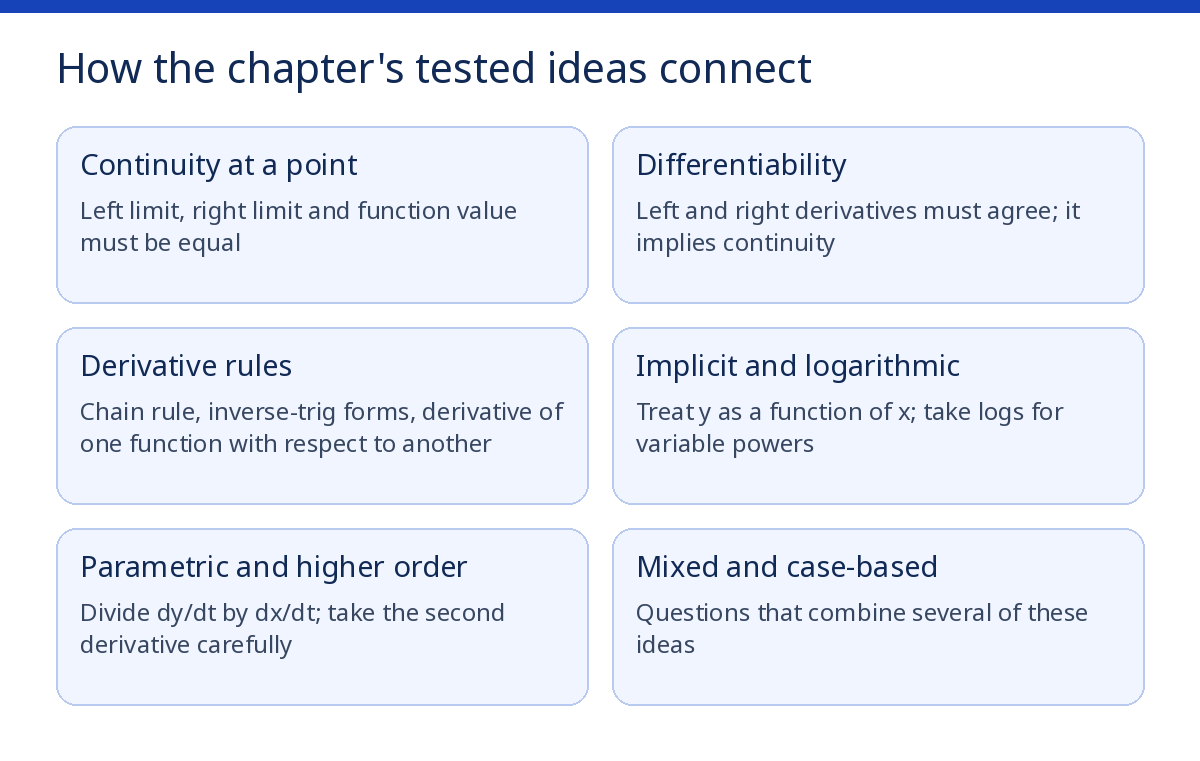
Chain rule, inverse-trig forms and 'with respect to' questions
Rules of differentiation share the largest topic count. Most items combine the chain rule with a standard result, for example , , or . Work from the outside in. Differentiate the outer function, keep the inner expression unchanged, then multiply by the derivative of the inner part. The core forms are , and .
Some stems ask for a derivative at a specific point, such as the derivative of at . Differentiate the whole expression first and substitute the value only at the end. If you substitute before differentiating, you are left with a constant, whose derivative is zero. The same care applies when a stem gives and asks about a composite such as : the chain rule still multiplies by the derivative of the inner expression.
A recurring pattern asks for the derivative of one function with respect to another, such as with respect to . Name the functions and , then use .
Some stems attach an interval, such as , to an inverse-trigonometric expression. The interval tells you which simplification is valid, so do not ignore it.
Implicit and logarithmic differentiation
Some equations mix and together, such as , or . Differentiate every term with respect to , treating as a function of . Each term containing then produces a factor , and products such as need the product rule. Collect the terms on one side and factorise. When the value of is wanted at a given , first find the matching from the original equation, then substitute both.
Logarithmic differentiation suits a variable raised to a variable power, such as . Take logarithms first, , then differentiate implicitly. When a logarithm has a variable base, convert it first with .
Common mistake: writing . The chain rule requires . The same factor appears for , and any other function of .
Parametric and second-order derivatives
When and are both given in terms of a parameter, as in or , use , provided .
The second derivative is where marks slip. The correct form is . Dividing by is not a valid rule.
Other higher-order items ask you to identify or prove a relation. One example asks for the value of when , where and are the first and second derivatives. An efficient route has three steps:
- Differentiate once.
- Multiply through to clear the denominator.
- Differentiate again, so that the original function reappears and can be substituted back.
Working through the 164 questions by sub-topic
The collection keeps the 164 questions in their original serial order. Each question is tagged with its exam year, whether it is a main or compartment paper, and a set code such as 65/4/1. A topic index sorts the questions into six groups:
- continuity and piecewise functions (26)
- differentiability and one-sided derivatives (22)
- rules of differentiation (33)
- implicit and logarithmic differentiation (33)
- parametric and higher-order derivatives (26)
- mixed and case-based questions (24)
The questions are divided into MCQ (Single Correct Answer) and Subjective blocks, and every question links to a numbered worked solution.
A sensible practice order follows the chapter itself. Start with continuity and differentiability, move through the derivative rules, implicit and logarithmic methods, and parametric and second derivatives, then finish with the mixed set. Attempt each block before opening the solutions. Then compare your steps with theirs: the stated continuity condition, both one-sided limits, and every place where appears.
Quick self-check: could you explain how a function can be continuous at a point yet not differentiable there, and which test you would apply to each property?
Frequently asked questions
Which question formats appear in this Continuity and Differentiability collection?
The questions are grouped into MCQ (Single Correct Answer) and Subjective blocks. Assertion-reason items appear among them, and a separate topic group covers mixed and case-based questions.
Does the collection include compartment papers?
Yes. Many questions are labelled as compartment papers, alongside main-paper sets, and each question carries its set code.
Spotted an error? Report a correction. Practise this in the app: notes, formula sheets and mind maps.





























































































































































Loading comments…