CBSE Class 12 Mathematics 2022 Term 2 Paper with Solutions
CBSEMathematics2022 Previous Year Paper
Paper code: 65/3/3 · 2022Practise the full 2022 CBSE Class 12 Mathematics Term 2 paper (65/3/3) in its original English layout. Use the worked solutions to review how each method is chosen, from setting up a vector calculation to identifying the event that a probability is conditioned on.
This set is one of the year's papers. See every set from 2022, grouped by series.
What this year-wise paper includes
This file contains the 2022 main examination paper from the CBSE 2021–22 Term 2 session. The original paper allowed 2 hours and carried 40 marks. Use those figures if you want to recreate the conditions for this particular sitting, rather than treating them as the pattern for another year.
The question paper preserves the English layout, options and diagrams. The worked solutions are organised by question number and distinguish the formula used, the concept used and the steps of the calculation. They cover the subparts and both routes wherever the paper prints an OR choice. For a timed attempt, follow the choices as printed. For revision, try the alternative separately: it can test a different method even though it occupies the same question slot.

Mathematics 2022 | Class 12 | Previous Year Paper | Code 65/3/3
In the StudentCurio app
A 2022 CBSE Class 12 Mathematics paper with worked solutions, covering topics including vectors, three-dimensional geometry, integration, differential equations and probability. It helps students practise exam questions and review solution methods across syllabus areas.
Vectors and 3D geometry: identify what you need to find
The vector and geometry questions ask for different kinds of results: a projection, a unit direction, an area or a distance. Start by naming the requested quantity. A scalar projection is a signed component in a specified direction; a vector projection is a vector along that direction. Both require a nonzero reference vector. Likewise, to get a unit vector along a diagonal, first identify the diagonal vector and then divide by its length, provided it is nonzero.
For geometry in three dimensions, distinguish the direction of a line from the normal to a plane. The paper uses a common-normal direction to find the shortest distance between skew lines. The cross product supplies that direction, and its magnitude can appear in the denominator only when the direction vectors are not parallel. A distance involving a line–plane intersection is a different task: identify the intersection before measuring the distance from the specified point.
Integration: look for the structure before choosing a rule
The paper illustrates several ways of making an integral easier to recognise. Completing the square can expose a shifted quadratic of the form , with , which gives an inverse-tangent antiderivative when the numerator is constant in the new variable. A different rational integrand in the paper is handled by partial fractions. When reviewing these methods, compare the algebraic rewrite before integration, not just the appearance of the final antiderivatives.
For definite integrals, the limits can be as informative as the expression. Doubling the integral over the positive half works when the original interval is symmetric about zero and the integrand is even. The paper also uses a circular-area interpretation after rewriting a square root. In an area question, identify the relevant branch and bounds from the region being described before setting up the integral. Recognising the curve alone does not specify which area to measure.
Good to remember: differential-equation steps have domains
The differential-equation solutions show that a useful first step may be algebraic rather than an integration formula. One route recognises a quotient derivative; another introduces the ratio as a new variable. The quotient method involves division by a power of , so that step is valid only where . When an initial value is supplied, use it to determine the integration constant on an interval where the method is valid.
In the logarithmic alternative, the original logarithms impose the stronger requirements and . Keep these restrictions attached to the solution rather than checking only whether the final expression can be evaluated. Also notice how the worked method retains a zero case for an intermediate variable. If a different method divides by that variable, the zero case needs to be checked separately.
Probability: track what is known and what is being asked
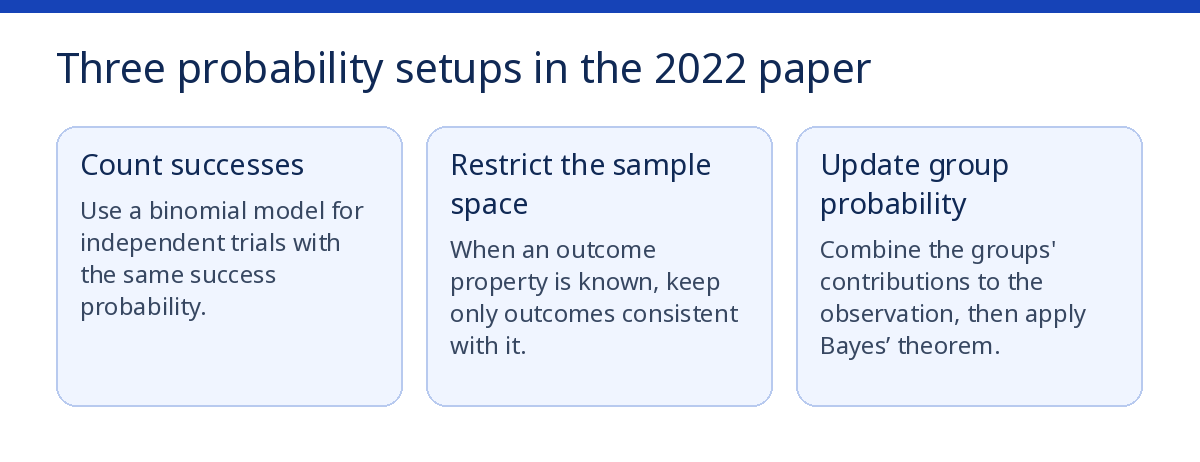
The probability questions use several models. In the card-draw example, replacement keeps the success probability the same and makes the draws independent, which supports a binomial model for the count. In the dice example, an observed sum restricts the sample space. Counting favourable outcomes and dividing by the number of remaining outcomes works there because the ordered outcomes under consideration are equally likely.
A separate alternative uses the complement of at least one success. Taking the complement does not require independence, but multiplying the individual failure probabilities to find the chance of both failures does. The paper also connects total probability with Bayes’ theorem: first combine the contributions from the different groups to find the probability of the observation, then use the observation to update the probability of group membership. The order of the events around the conditioning bar matters.
Quick self-check: explain the step before checking the result
After attempting the paper, open the solution for a question where you hesitated. Read its concept used note first and try to restart your own work before looking at the steps. Then identify the first difference between your setup and the worked method. Was it a calculation error, or did you choose the wrong quantity, domain or probability model? The distinction tells you whether to redo the arithmetic or revisit the underlying idea.
- Before using symmetry in an integral, can you justify both the shape of the interval and the parity of the integrand?
- Before multiplying probabilities, can you say whether you are using independence or conditioning on an earlier event?
- Before normalising a vector, can you identify which direction it must represent and check that its length is nonzero?
Spotted an error? Report a correction. Practise this in the app: notes, formula sheets and mind maps.





























































































































































Loading comments…