CBSE Class 12 Mathematics 2022 Term 2 Paper with Solutions
CBSEMathematics2022 Previous Year Paper
Paper code: 65/2/3 · 2022Use the full CBSE Class 12 Mathematics 2022 Term 2 paper, set 65/2/3, for a two-hour practice attempt. The worked solutions cover every question, subpart and printed internal choice, so you can review how each method is selected and applied.
This set is one of the year's papers. See every set from 2022, grouped by series.
How this 40-mark paper is organised
This is the English version of the 2022 main examination paper from the 2021–22 session. It is organised as a full paper for that year, not as a chapter-wise question bank. The file preserves the original question layout, options and diagrams, with a question-number index for navigating to the worked solutions.
All three sections are compulsory. Section A contains six short-answer questions worth two marks each, Section B contains four short-answer questions worth three marks each, and Section C contains four long-answer questions worth four marks each. Internal choice applies within some questions, not between entire sections. Question 14, in Section C, is a case study with two subparts worth two marks each. Use this structure to rehearse the 2022 Term 2 format rather than treating it as a description of a current paper.

Mathematics 2022 | Class 12 | Previous Year Paper | Code 65/2/3
In the StudentCurio app
Complete CBSE Class 12 Mathematics Term 2 examination paper (set 65/2/3) with worked solutions to every question and internal choice. It covers probability, vectors, differential equations, integration and three-dimensional geometry, helping students practise the 2022 paper and review solution methods.
Probability: identify the event before calculating
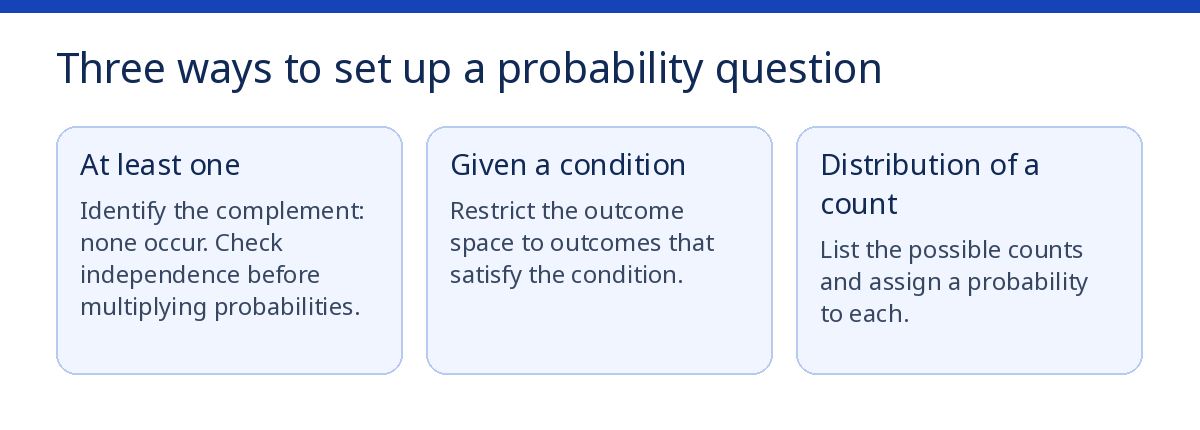
The paper tests three different ways of setting up probability: independent attempts to solve a problem, dice outcomes subject to a given condition, and repeated tosses of an unbiased coin. The important distinction is whether the question asks for an event, an event given some information, or a distribution of a random variable.
For an at least one event, the complement is none. That equivalence does not require independence, but multiplying the individual failure probabilities to find the probability of joint failure does. In the dice question, the stated condition changes which outcomes are eligible. A ratio of outcome counts works when the outcomes being counted are equally likely and the denominator counts only those satisfying the condition. In the coin case study, a distribution assigns a probability to each possible tail count, whereas an at-least-one question asks for a single event probability.
Vectors and 3D geometry: distinguish direction from normal
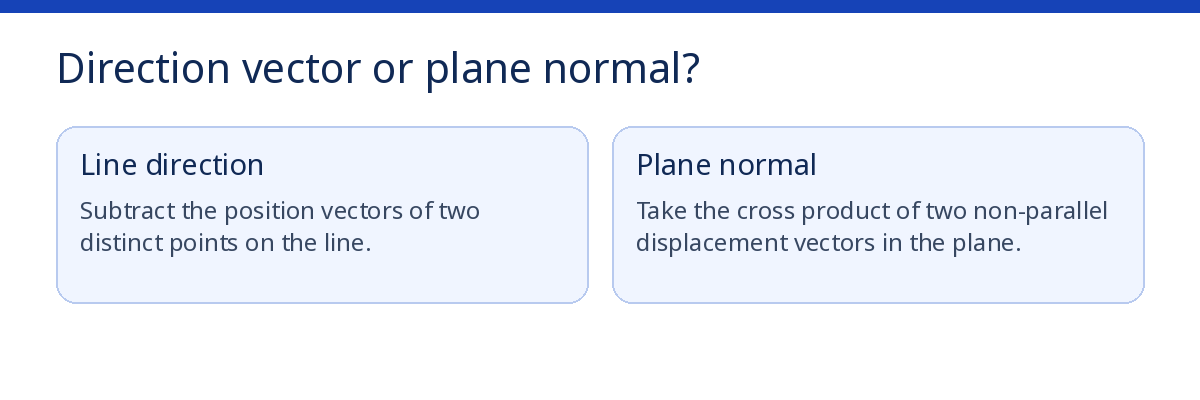
The geometry questions move between equations of lines, a plane through three points, distances and a line’s intersection with a coordinate plane. For a line through two distinct points, their difference gives a direction vector along the line. For a plane through three non-collinear points, the cross product of two displacement vectors in the plane gives a normal, which is perpendicular to it. Before calculating, ask which of those two kinds of vector the equation needs.
The vector questions also distinguish what a dot product tells you from what a cross product tells you. In a magnitude comparison, the dot product connects the algebra to the angle between vectors. In a question that specifies both a dot product and a cross product, check a candidate vector against both conditions: satisfying one relation does not verify the other. For the distance choice, establish the relationship between the lines before applying a formula specific to parallel lines.
Differential equations: classification versus recognition
One question asks you to classify a differential equation, while another asks you to solve one. For classification, expand a derivative of a product when needed before reading off the order and degree. Order is determined by the highest derivative present; degree is the power of that derivative once the equation is expressed as a polynomial in its derivatives. A power on the dependent variable itself is not the degree.
In the solving question, the worked explanation instead recognises the expression as a total differential. When reviewing that method, check that differentiating the proposed expression reproduces the coefficients of both differential terms. The ratio also excludes from the domain under consideration.
Integration checks: method, domain and region
The integration questions give you reasons to choose between substitution, partial fractions and integration by parts. Substitution is useful when an inner expression and its derivative can be matched after rewriting. Factoring a rational denominator can make partial fractions useful, but it does not remove the need to exclude values at which the original denominator vanishes. The worked solutions also distinguish those exclusions from restrictions arising from a real square root.
The parameter-dependent definite integral raises a different issue: an endpoint can make an integral improper. Check convergence before applying an antiderivative at that endpoint. In the area question, the first decision is geometric rather than algebraic. Identify the intended region, locate its boundaries and decide which curve or branch is above the other over the interval of integration. With vertical slices, integrate upper minus lower; if both branches bound the region, using only one may leave part of the area out.
Before you open the worked solutions
For a timed attempt, work from the question pages and choose one route wherever an internal choice is printed. Afterwards, use the question-number index to compare your work with the file’s formula, concept and step-by-step explanations. Find the first point where your reasoning diverged. Choosing the wrong sample space or the wrong region, for example, calls for a different correction from a sign error after a sound setup.
Then return to an internal choice you did not take. Its worked solution is useful for comparing methods, not just checking an answer. Before reading it, ask what feature of the alternate problem determines your first step. Being able to justify that choice gives you a better check on your understanding than recognising the method once it is shown.
Spotted an error? Report a correction. Practise this in the app: notes, formula sheets and mind maps.





























































































































































Loading comments…