CBSE Class 12 Mathematics 2022 Term 2 Paper With Solutions
CBSEMathematics2022 Previous Year Paper
Paper code: 65/1/1 · 2022This year-wise resource contains the full English version of the 2022 CBSE Class 12 Mathematics Term 2 paper (65/1/1) and worked solutions. Use it to practise under the original time limit and check how you choose methods in calculus, vectors, three-dimensional geometry and probability.
This set is one of the year's papers. See every set from 2022, grouped by series.
What this 2022 paper contains
This is the main examination paper for Term 2 of the 2021–22 session. The printed time is 2 hours and the maximum is 40 marks. Keep those conditions when attempting it as a mock: they belong to this particular paper, rather than serving as a timing or marks guide for a different CBSE exam format.
The file preserves the original English question layout, options and diagrams. A question-number index links to worked solutions for each question and subpart, including both branches of the printed OR choices. The solutions distinguish the formula, the concept and the steps, so you can locate the reason for a method without having to start by reading the final answer.

Mathematics 2022 | Class 12 | Previous Year Paper | Code 65/1/1
In the StudentCurio app
Complete 2022 CBSE Class 12 Mathematics examination paper with worked solutions. It includes questions across topics such as integration, differential equations, vectors, three-dimensional geometry and probability, helping students practise the exam and review solution methods.
Integration: recognize the form before choosing a method
The integration questions reward noticing structure before doing algebra. A trigonometric identity can expose a factor that fits a substitution. A logarithmic expression, by contrast, may be easier to read as a product derivative in reverse. In that case, check a proposed antiderivative by differentiating it on an interval where the original integrand is defined. A logarithm in the denominator requires both a positive argument and a nonzero logarithm.
Other questions use a common-root substitution to turn fractional powers into integer powers, or transform a definite integral into a rational expression suitable for partial fractions. In a definite integral, change the limits along with the variable. The paper also illustrates a symmetry check: reflecting to on simplifies a weighted integral when the remaining factor is unchanged by the reflection.
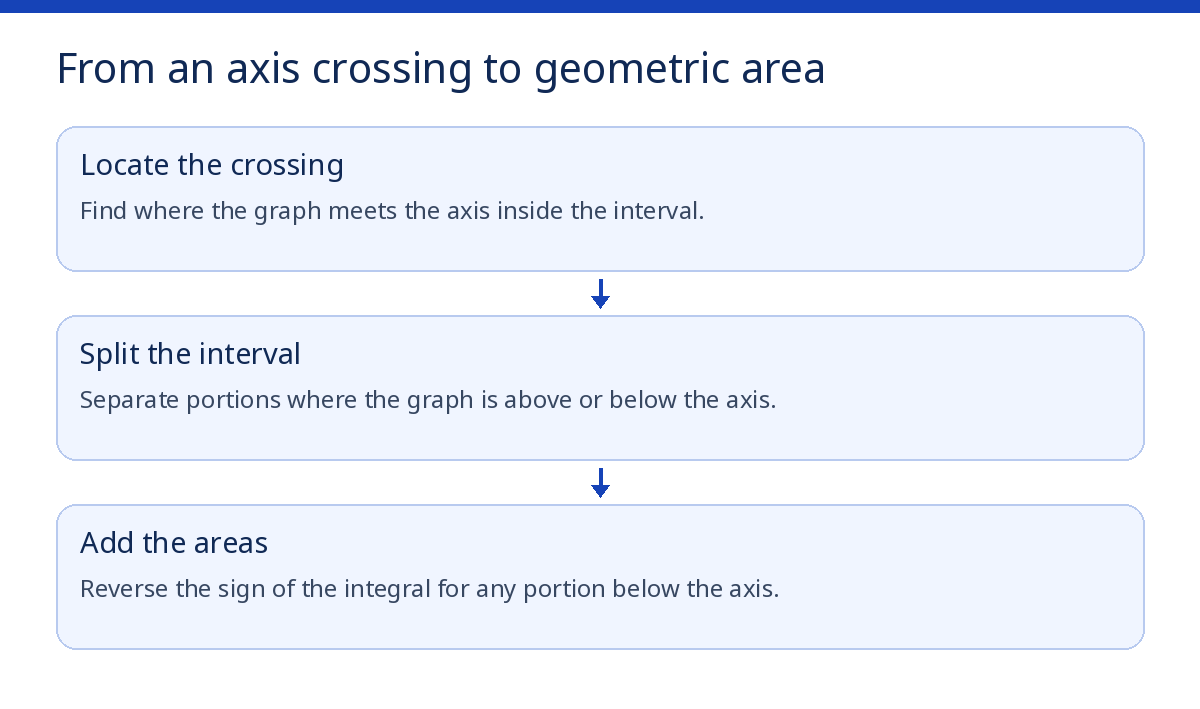
Common mistake: treating signed integrals as area
An integral of a function below the horizontal axis contributes a negative value, but geometric area is nonnegative. The paper illustrates this distinction with a straight line that crosses the axis. Locate the crossing before integrating and treat the portions on either side separately; otherwise, they can cancel instead of adding to the total area.
The ellipse-and-line alternative calls for a different decision: identify the two boundaries of the specified region. When vertical slices run from a lower curve to an upper curve, integrate upper minus lower over the relevant interval. The intersections delimit that region, and the diagram helps you select the correct branch of the ellipse.
Differential equations: classify, substitute, check the branch
For classification, simplify before reading off the order and degree. The order is the order of the highest derivative present. The degree is the power of that derivative when the equation is expressed as a polynomial in its derivatives. A squared derivative that cancels from both sides does not determine the degree.
For solving, the paper uses the ratio as a cue to set , where . Here depends on , so differentiating requires the product rule. After separation and integration, the initial condition does more than fix a constant: it also helps identify the branch of the solution through the given point. Check that the interval used for the final expression contains that point.
Vectors and three-dimensional geometry: match the test to the task
For a parallelogram, the sum and difference of adjacent side vectors give directed diagonals. Reversing the order of subtraction reverses the direction, not the length. A cross product can test parallelism for two nonzero vectors or provide an area through its magnitude. Keep those uses distinct: a parallelism test asks whether the vector is zero, whereas an area calculation uses a nonnegative scalar.
The three-dimensional questions distinguish a perpendicular distance, a plane through the intersection of two planes, and the relationship between two lines. For point-to-plane distance, the absolute value prevents a negative distance, and division by the length of the plane’s normal accounts for how the equation is scaled. For two nonparallel lines, a zero scalar triple product establishes coplanarity; finding their intersection still requires a point that satisfies both line equations.
Probability: identify what is already known
The conditional probability questions are a reminder that and use different denominators: the event after the conditioning bar determines the denominator, which must be nonzero. Both probabilities refer to the same intersection in the numerator. In the Bayes question, the task is to update the probability of an earlier event after observing the result of later draws. The probability of that observation must include both the event and its complement as possible cases.
For a distribution based on draws without replacement, the available pool changes after each draw. When counting equally likely unordered selections, use combinations consistently in both the favourable count and the total count. Then check that the probabilities across all possible values sum to one.
Quick self-check before opening a worked solution
For a timed attempt, follow the printed choices and set the unused alternatives aside. When you review, go back to each question where you hesitated and name the feature that should have guided the first step. Was it the change of sign in an area problem, the appearance of a common ratio in a differential equation, or a change in which event was given in a probability question?
Use the concept label first if you chose the wrong method, and the steps if you chose the right method but lost track of a condition or sign. Then attempt the unused OR branch separately: it may test a different technique even though it occupies the same place in the paper.
Spotted an error? Report a correction. Practise this in the app: notes, formula sheets and mind maps.





























































































































































Loading comments…