CBSE Class 12 Mathematics 2024 Previous Year Paper (65/1/1)
CBSEMathematics2024 Previous Year Paper
Paper code: 65/1/1 · 2024Practise the full English-language CBSE Class 12 Mathematics main examination paper from 2024. Use the three-hour, 80-mark paper to rehearse the board format, then use the worked solutions to see whether you chose a suitable method and justified the steps that matter.
This set is one of the year's papers. See every set from 2024, grouped by series.
How the 38 questions are organised
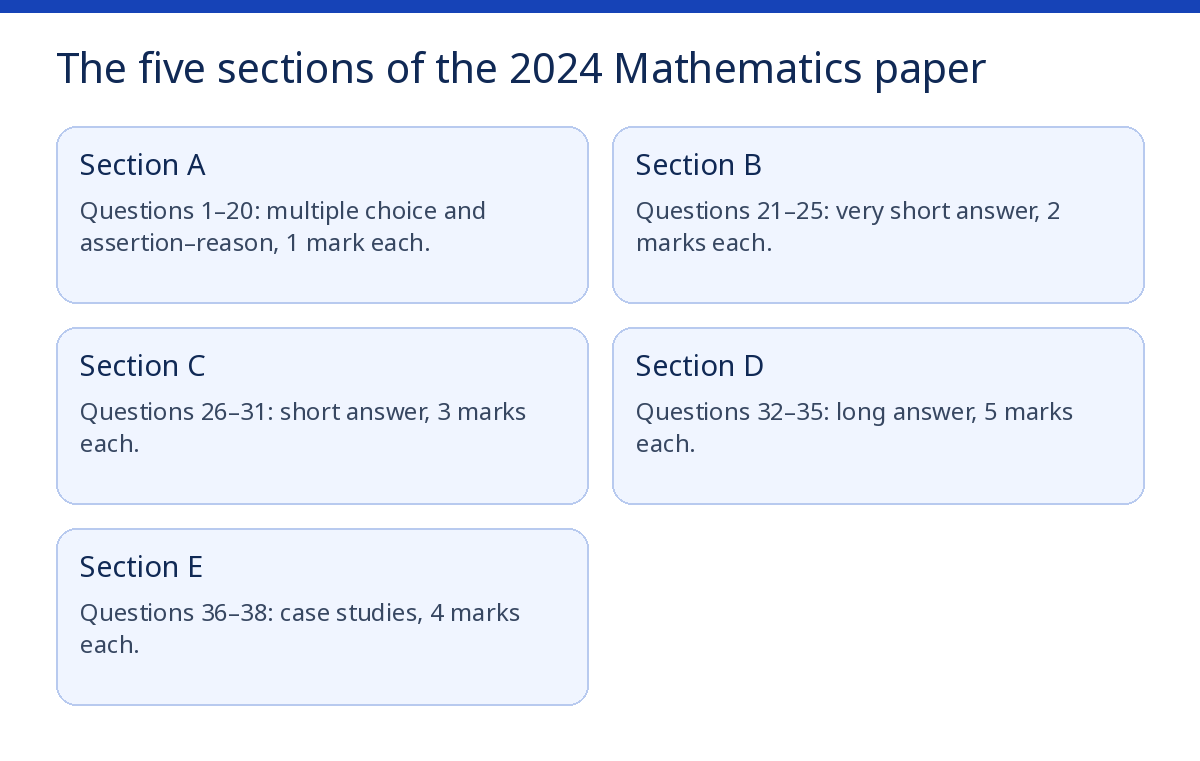
This is a year-wise paper, not a chapter worksheet: it lets you practise switching between topics and answer formats in the order they appeared in the exam. Section A contains 18 multiple-choice questions and two assertion–reason questions, each worth one mark. Section B has five very short-answer questions worth two marks each. Section C has six short-answer questions worth three marks each, and Section D has four long-answer questions worth five marks each. Section E contains three case studies worth four marks each.
All questions are compulsory, but there is internal choice in some questions in Sections B, C, D and E. There is no overall choice: a printed OR lets you choose an alternative within that question, not skip another question elsewhere.

Mathematics 2024 | Class 12 | Previous Year Paper | Code 65/1/1
In the StudentCurio app
The complete CBSE Class 12 Mathematics examination paper for 2024 (code 65/1/1), with questions spanning the syllabus and worked solutions. Helps students practise the board-paper format and review solution methods.
Functions and matrices: read the definitions first
The paper tests functions through one-one and onto checks, and relations through reflexivity, symmetry and transitivity. An onto check compares the range with the declared codomain, not just with the values that happen to appear in a calculation. In the inverse-sine case study, the domain of sine is restricted so that an inverse exists with codomain equal to the chosen branch. The principal branch is a specific choice, not the only interval on which sine can be made one-one and onto .
The matrix questions move from possible matrix orders and corresponding entries to determinants and the use of an inverse in a system of equations. When reviewing an inverse-matrix method, distinguish between finding the inverse and setting up the system so that the inverse can be applied to it.
Calculus: decide what the question is testing
In the differentiation questions, distinguish checking whether a derivative exists from finding it using a rule. At a point where a definition changes, continuity is a necessary, but not sufficient, condition for differentiability. In questions about increasing behaviour or extrema, the derivative is evidence about how the function behaves on an interval; merely finding where it vanishes does not establish a maximum or minimum.
Integration appears both as an evaluation task and as a way to find area. In the ellipse question, the given vertical lines specify the portion whose area is wanted. When setting up an area integral, identify the upper and lower boundaries on the relevant interval. That setup is a separate decision from how to evaluate the resulting integral.
Common mistakes: dividing too early or reversing a vector
Before putting a first-order differential equation into linear form, check where the coefficient of the derivative can be divided out. The integrating-factor method applies on an interval where the equation is in linear form and its coefficients are continuous. Also distinguish finding an integrating factor from finding a particular solution: in the latter task, the given initial condition is needed to determine the constant in the general solution.
In the vector questions, reversing the initial and terminal points reverses the vector. The coordinate difference is terminal minus initial, even when the terminal point is named first in the sentence. Keep that orientation in mind when moving from a coordinate question to the parallelogram diagram: identify which directed segment each piece of information represents before combining vectors.
From spatial geometry to feasible regions
The three-dimensional geometry questions include direction cosines, distance from an axis and the image of a point with respect to a line. These tasks call for different setups. For a distance to an axis, identify the perpendicular displacement rather than using the distance to the origin. For a question about a line, distinguish its direction from the coordinates of a point on it.
In graphical linear programming, keep the constraints separate from the objective function. The inequalities determine which points are feasible; the objective determines how feasible points are compared. When reviewing a graph, check which side of each boundary line satisfies its inequality, then check their overlap. A boundary intersection is not automatically feasible: it still has to satisfy every constraint.
Quick self-check: what does each case-study model connect?
The three case studies use different kinds of reasoning. In the speed-camera scenario, the angle depends on the car’s distance from the pole, and that distance changes with time. Before calculating, ask which rate is with respect to distance and which is with respect to time. Can you explain why those rates are not interchangeable?
In the turbulence scenario, distinguish the overall probability of arriving late from the probability of a turbulence category given a late arrival. The event after “given” determines the group you are conditioning on. In the sine case study, ask which inputs and outputs belong to the original restricted function and which belong to its inverse. Reversing their roles is central to interpreting the inverse graph and its domain.
Run a timed attempt, then review the method
For a board-format rehearsal, allow three hours, work without a calculator and attempt only one alternative wherever an internal choice is printed. Save the other alternative for a later practice round. In Section A’s assertion–reason items, check the truth of each statement separately before deciding whether the reason explains the assertion.
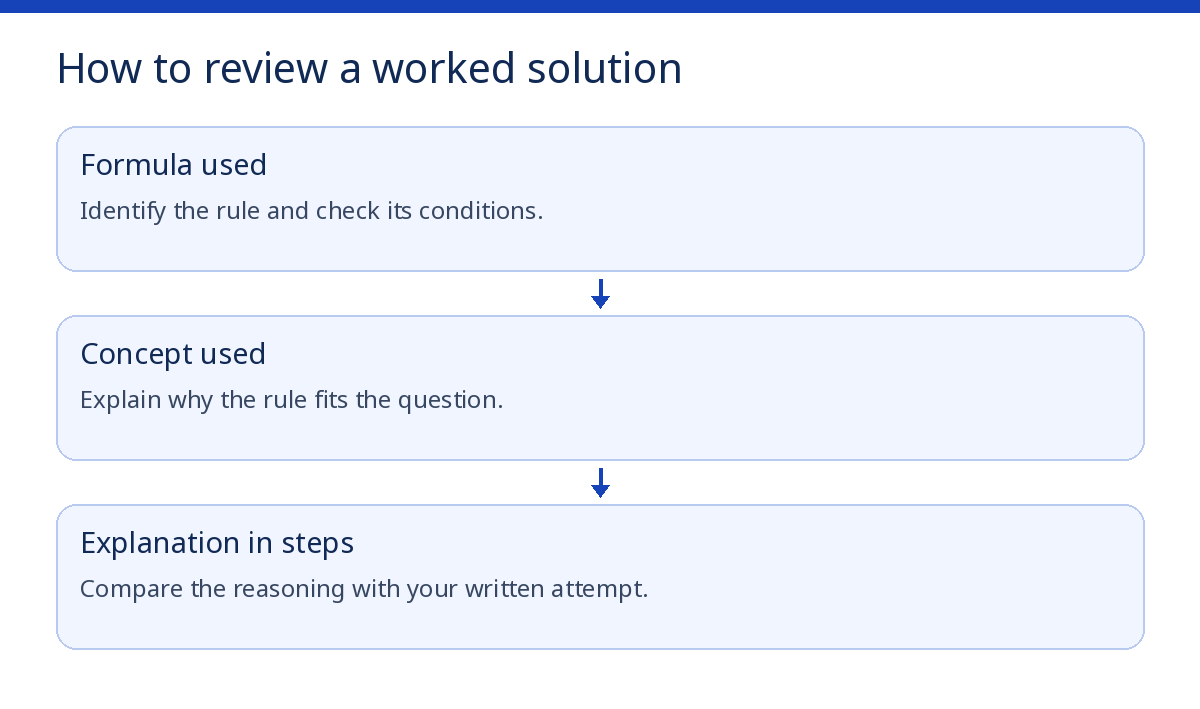
After the attempt, use the PDF’s question-number navigation to review selected solutions. The worked explanations distinguish formula used, concept used and explanation in steps. Compare those parts with your own work and find the first point of divergence: did you misread a condition, choose the wrong method or make an error carrying it out? This guide omits the answer choices and question-specific results for Questions 3, 6 and 7.
Spotted an error? Report a correction. Practise this in the app: notes, formula sheets and mind maps.





























































































































































Loading comments…