Relations and Functions: CBSE Class 12 NCERT Notes
CBSEMathematicsSets, Relations and Functions
These CBSE Class 12 Mathematics notes connect ordered pairs and Cartesian products to equivalence classes and function types. Use the guide to see what each classification tests and why the underlying set, domain or codomain matters.
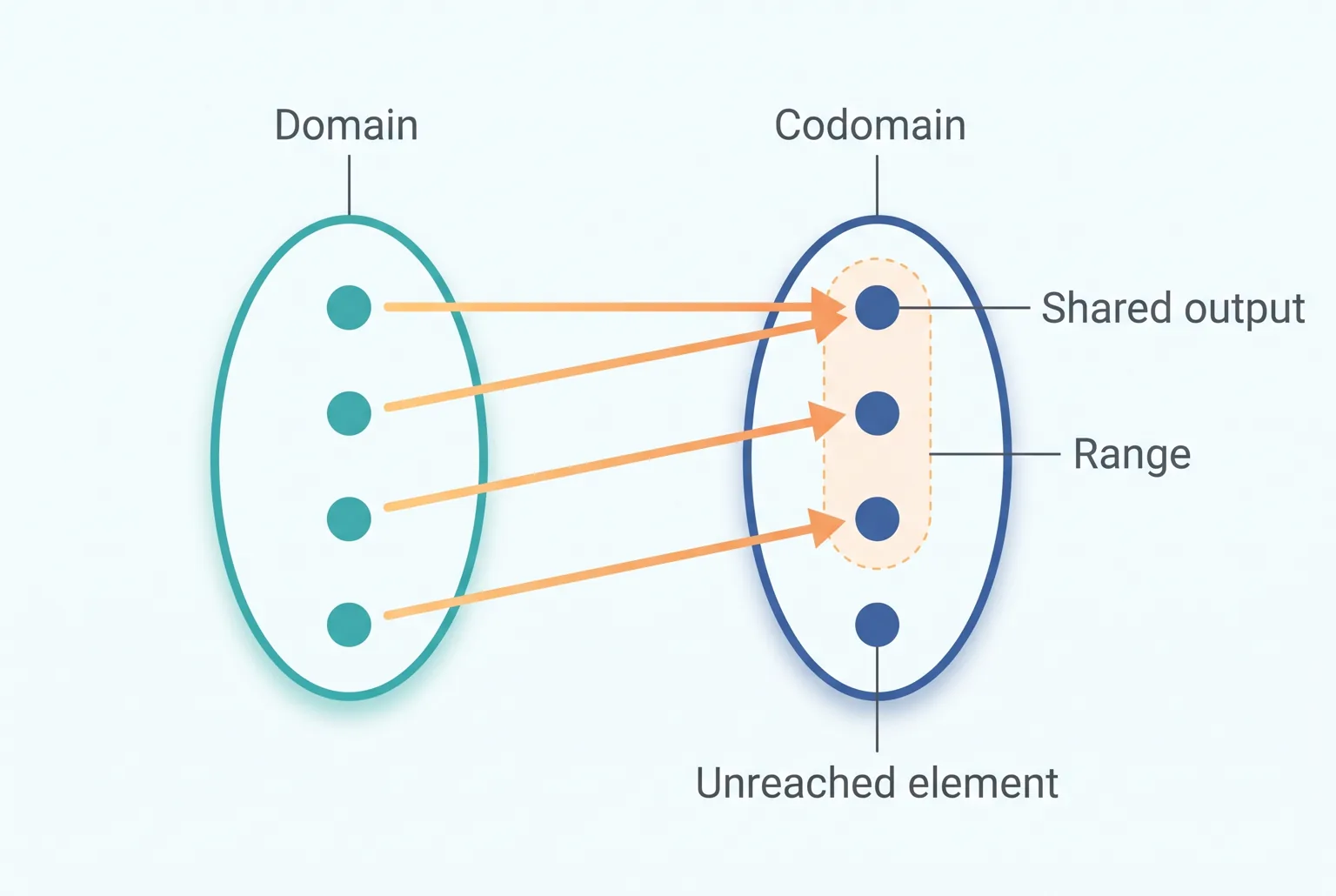
From Cartesian products to relations
The notes begin with ordered pairs because a relation records not just which elements are linked, but which comes first. The Cartesian product contains every pair whose first component comes from and whose second comes from . Reversing the order changes the roles of the two sets, so do not assume that and are interchangeable.
A relation from to selects a subset of that product. Its domain consists of the first components that actually appear, and its range consists of the second components that actually appear. Its codomain is the whole target set , even if some of its elements never occur in a pair. When both components come from the same set, the relation is a subset of and is called a relation on .

Relations and Functions | Class 12 | NCERT Notes
In the StudentCurio app
These Class 12 revision notes cover relation properties and equivalence classes, function types, domain and range, special real functions, and methods for testing injectivity. They help students revise core concepts and work through NCERT-style examples.
Three checks for classifying a relation
The examples distinguish the empty relation, which selects no pairs, from the universal relation, which selects all pairs. The identity relation selects exactly the pairs that link each element to itself. Reflexivity requires those same self-pairs but allows other pairs too. This is why finding every self-pair establishes reflexivity but does not establish that the relation is the identity.
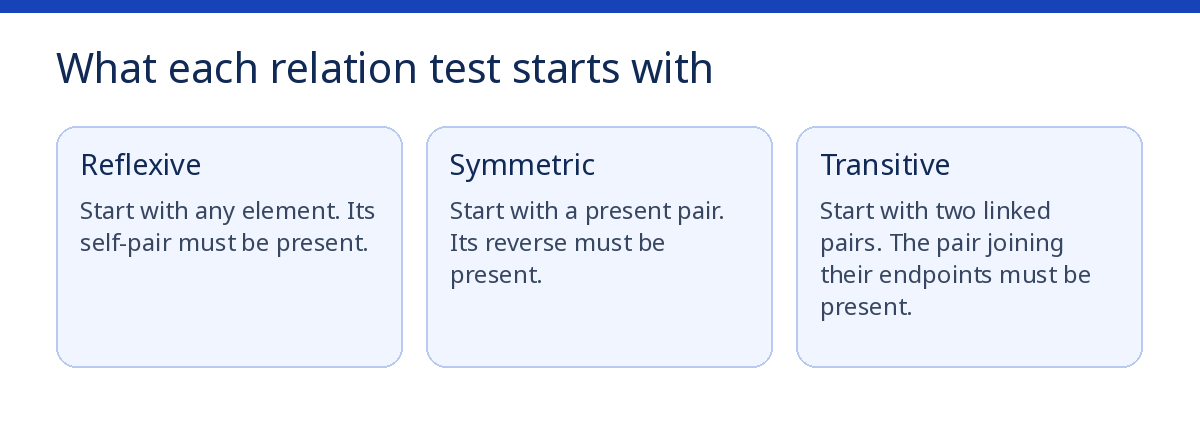
- Reflexive: Check the self-pair for every element of the underlying set, including any element that does not appear in the listed pairs.
- Symmetric: Start with a pair that belongs to the relation. Its reverse must also belong.
- Transitive: Start with two pairs that belong to the relation, with the second component of the first pair matching the first component of the second. The pair linking the start of that chain to its end must also belong.
Common mistake: giving a counterexample without its premise
The notes distinguish proving a property from disproving it. When a relation is given by a rule, a proof starts with arbitrary elements satisfying the relevant conditions and shows that the required pair belongs. For a relation presented as a finite list, you can instead check every applicable case. A few successful checks do not prove a property if other cases remain.
To disprove symmetry, a missing reverse pair matters only if the original pair is present. To disprove transitivity, a missing end-to-end pair matters only if both links of the chain are present. If there are no such chains, there is no counterexample to transitivity. Reflexivity is different: a single missing self-pair disproves it as long as its element belongs to the underlying set.
How equivalence classes partition a set
An equivalence relation is reflexive, symmetric and transitive on the same set. Once all three properties hold, the equivalence class consists of the elements related to . The notes illustrate this with a relation on the integers: two integers are related when their difference is divisible by two. The resulting classes group integers by parity, not by size or sign.
A useful distinction is that a class can have more than one representative. In the parity illustration, any even integer determines the same class as zero. The distinct classes cover the entire underlying set without overlap: if two classes share an element, symmetry and transitivity make them the same class. When reading a class listing, distinguish the number of representatives shown from the number of distinct classes.
What one-one, onto and bijective each test
A function from to assigns exactly one output in to every input in . This is stricter than being a relation: simply selecting pairs from a Cartesian product does not guarantee that each input appears with exactly one output. But different inputs are allowed to share an output; that makes a function many-one, not invalid.
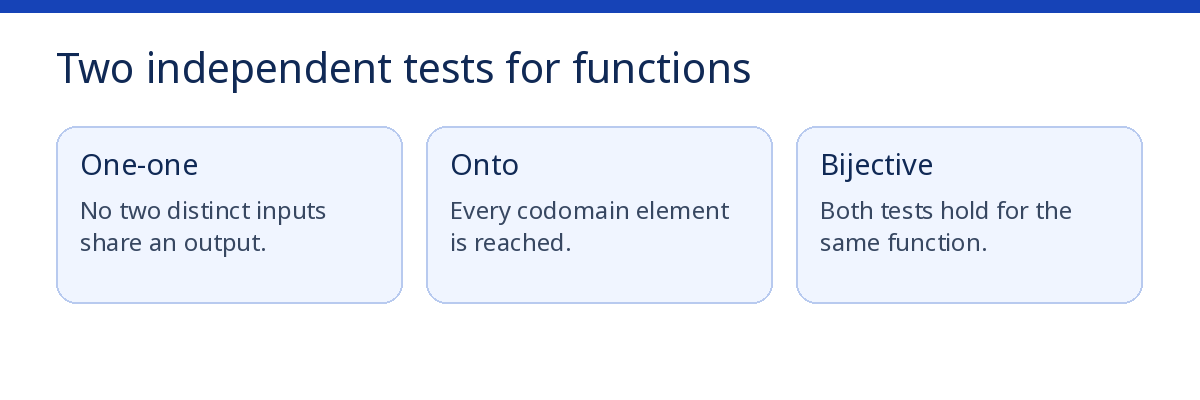
To test whether a function is one-one, or injective, start with for inputs in the stated domain and check whether it forces . To test whether it is onto, or surjective, start with an arbitrary element of the stated codomain and ask whether some permitted input maps to it. Onto means the range equals the codomain; an into function leaves at least one codomain element unreached. A bijection satisfies both tests. Neither test replaces the other.
Quick self-check: what changes when the sets change?
The cover uses the squaring rule to introduce mappings. Before assigning a function type to any rule, write down the domain and codomain as well as the formula. Ask yourself: could restricting the domain remove a pair of distinct inputs with the same image? Could changing only the codomain affect whether every target is reached, provided it still contains all the outputs? These questions separate a change to the allowed inputs from a change to the targets that must be reached.
Use the chapter index to revisit the relevant distinction. Its page numbers follow the notes: relation tests start on page 4, equivalence classes on page 8, and function domain, codomain and range on page 13. The index then points to special real functions and graphs, followed by function classifications and a chapter summary. The worked substitutions and final answer sets from Example 1 are omitted from this guide.
Spotted an error? Report a correction. Practise this in the app: notes, formula sheets and mind maps.





























































































































































Loading comments…