CBSE Class 12 Probability: A Guide to the Chapter Assessment
CBSEMathematicsProbability
This Class 12 CBSE Mathematics assessment offers 155 questions with worked solutions across four topic sets and a mixed chapter set. Use this guide to decide when to condition, when to multiply, when to combine cases and when to build a probability distribution.
Choose a starting point in the assessment
The file covers Chapter 13, Probability. The first topic set has 28 questions on basic and conditional probability; the second has 25 on the multiplication theorem and independent events. The third has 24 on total probability and Bayes’ theorem, and the fourth has 28 on random variables and their distributions. The final 50 questions form the chapter practice set.
+If you can calculate a probability once the method is named but struggle to choose a method yourself, start with a few chapter practice questions. If you already know what breaks down—for example, identifying which event comes after the conditioning bar—go straight to the relevant topic set.

Probability | Class 12 | CBSE Assessment
In the StudentCurio app
This assessment set provides worked practice on probability theorems, conditional probability, independence, Bayes’ theorem, random-variable distributions and expected values. It helps Class 12 students practise objective, long-answer and case-based probability questions for CBSE.
Conditional probability: what changes after “given”?
In , is the event you are told has occurred. You restrict attention to and ask how much of its probability belongs to as well. The rule is , and it requires . If the outcomes are equally likely, you can count within the restricted set. Otherwise, use probability weights rather than treating each remaining outcome as equally likely.
The first topic set makes this distinction concrete through card, dice and two-child questions. Compare a condition about a specified child with a condition about at least one child. Both give information about the family, but they do not specify the same event. Before counting, write the condition in words and identify which outcomes it admits.
When can you multiply the original probabilities?
To find the probability that both events occur, the multiplication theorem gives when . For independent events, the product becomes : knowing that one occurred does not change the probability of the other, whenever the relevant conditional probability is defined. Mutually exclusive events, by contrast, cannot occur together. If both have positive probability, they cannot be both mutually exclusive and independent.
The second topic set lets you compare draws with and without replacement. In successive random draws from an unchanged collection, replacement restores the original composition for the next draw. Without replacement, track how the first draw changes the collection before choosing the probability for the second. The word “and” identifies an intersection; it does not establish independence.
Total probability and Bayes’ theorem ask different questions
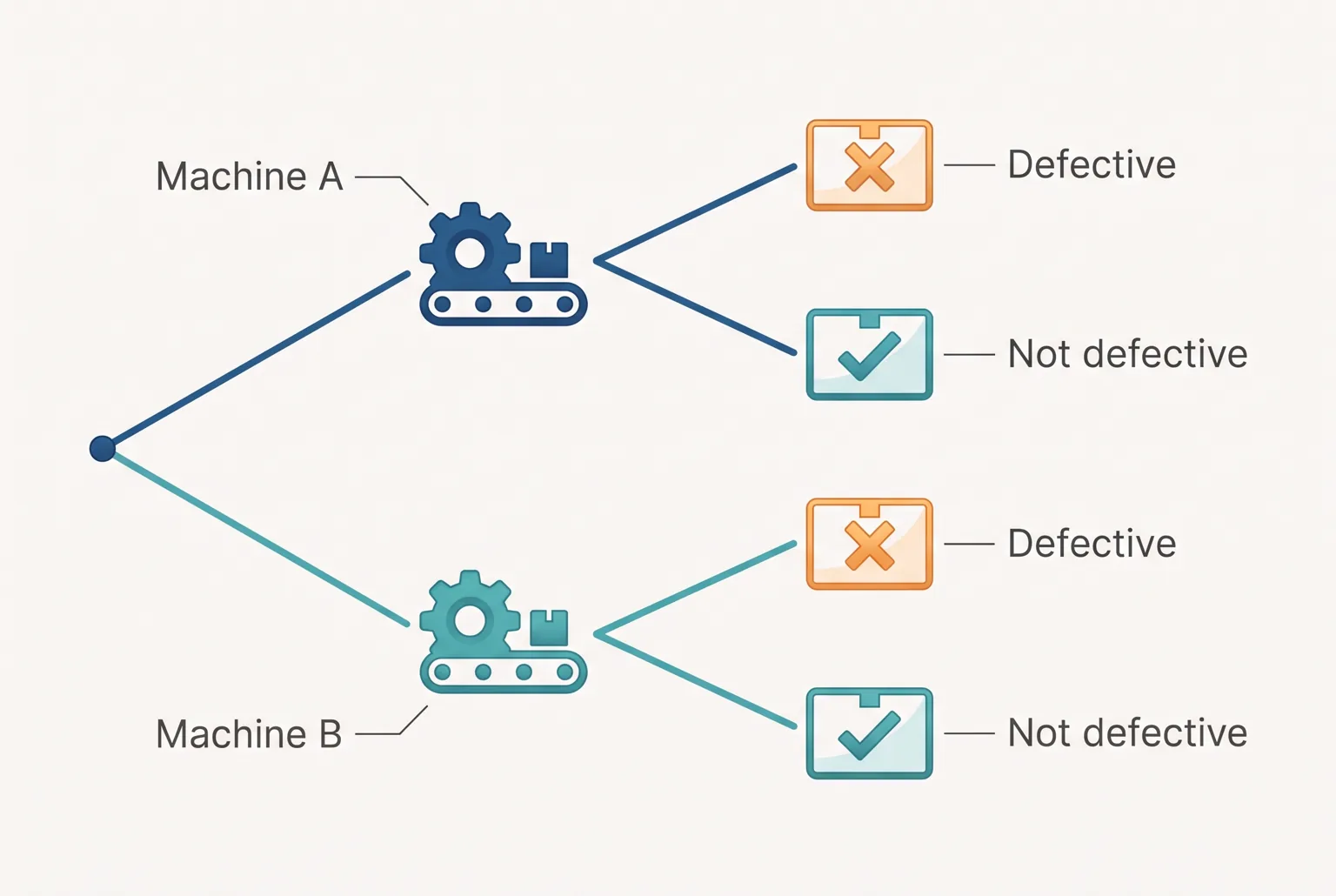
Use total probability to combine the ways an observation can arise. In the setup used here, the cases are mutually exclusive, cover the entire sample space and each have positive probability. For each case, multiply its probability by the conditional probability of the observation in that case, then add the products. The factory questions illustrate why the weights matter: a machine’s share of production and its defect rate describe different things.
Bayes’ theorem starts with an observation and asks how probable a particular case is in light of it. Divide that case’s contribution to the observation by the observation’s total probability, which must be positive. In the diagnostic-test questions, the probability of a positive result given disease is not the probability of disease given a positive result. The latter also depends on prevalence and the possibility of a positive result when disease is absent.
Build a distribution before finding the mean
A random variable assigns a number to each outcome. In the fourth topic set, that number might be a count of red cards, a sum of scores or the largest number drawn. Different outcomes can produce the same value of , so combine their probabilities in one entry for that value. Check that each entry is non-negative and that the probabilities sum to one, especially when the distribution contains an unknown constant.
For the finite distributions in this set, the expected value is . It is a probability-weighted average, not necessarily a value that can occur in one trial. Also check what the variable measures: the lottery question distinguishes the expected prize from the expected net gain after paying for a ticket.
Use the index to practise method selection
The index separates questions from worked solutions and lists ranges by question type. Since numbering restarts in every set, note both the set and the question number when marking an item for review. The chapter set includes objective, very short, short and long answers, plus three case-based questions on players hitting a target, a diagnostic test and knowing an answer or guessing.
Try the question before opening its solution. For a case-based item, reread what each subpart asks rather than carrying over the previous subpart’s condition. When comparing your work with the solution, locate the first difference in setup: the event you defined, the denominator you chose or the reason you treated events as independent.
Quick self-check: name the probability before calculating
Pick an item from chapter practice without opening its solution. Can you say whether it asks for a joint probability, a probability given an observation, or the mean of a random variable? If it is conditional, name the event that goes in the denominator. If it asks for a mean, explain what one value of the variable represents. A clear answer to those questions gives you a way to check your setup before doing the arithmetic.
Spotted an error? Report a correction. Practise this in the app: notes, formula sheets and mind maps.





























































































































































Loading comments…