CBSE Class 12 Mathematics 2022 Term 2 Solved Paper
CBSEMathematics2022 Previous Year Paper
Paper code: 65/4/3 · 2022Practise with the full CBSE Class 12 Mathematics 2022 Term 2 paper, set 65/4/3. Use the worked solutions to review how you chose a method, handled signs and domain restrictions, and stated any assumptions your reasoning required.
This set is one of the year's papers. See every set from 2022, grouped by series.
What this 2022 paper contains
This year-wise file contains the English version of the CBSE Class 12 Mathematics main examination for Term 2 of the 2021–22 session. The paper allows two hours and carries 40 marks. All three sections are compulsory: Section A has six short-answer questions worth two marks each, Section B has four short-answer questions worth three marks each, and Section C has four long-answer questions worth four marks each. The final question is a case study with two parts worth two marks each.
Some questions offer an internal choice. For a timed attempt, answer one alternative where a choice is printed. During review, you can attempt the other: the file provides worked explanations for both printed alternatives, not just the one you select.

Mathematics 2022 | Class 12 | Previous Year Paper | Code 65/4/3
In the StudentCurio app
Solved CBSE Class 12 Mathematics 2022 Term 2 paper, set 65/4/3, covering vectors, integration, probability, three-dimensional geometry and differential equations. The worked solutions help students practise exam-style questions and review problem-solving methods.
Vectors and 3D geometry: choose the right test
The vector questions link magnitude, dot and cross products, scalar projection and direction cosines. A scalar projection onto a nonzero vector is a signed number: a negative projection is not a negative length. The direction-cosine questions raise a different sign issue. Equal acute inclinations to unoriented axes constrain the absolute values of the direction cosines, whereas equal angles to the positive coordinate directions constrain the cosines themselves. Read which meaning the wording supports before deciding which signs to retain.
In three-dimensional geometry, a perpendicular segment supplies a normal direction to a plane. For two lines, establish whether their directions are parallel before interpreting a coplanarity test: nonparallel coplanar lines intersect, while noncoplanar lines are skew. The paper also connects the family of planes through a common line with the point-to-plane distance formula.
When the structure of an integral changes the method
The integration questions reward noticing what the expression and the limits tell you. A polynomial multiplied by an exponential can call for repeated integration by parts because differentiating the polynomial lowers its degree. An absolute-value expression instead requires checking where the quantities inside the modulus change sign. Split the interval at any relevant interior sign change, then use the correct expression on each piece.
For an area bounded by a line and a curve, identify the intersections that enclose the region and determine which graph lies above the other before integrating upper minus lower. In another definite integral, the limits are symmetric about zero, making it useful to pair the integrand at opposite inputs. Symmetric limits alone do not make an integral zero; what matters is how those paired values combine.
Differential equations: check what your algebra permits
Several questions ask you to recognise a derivative rather than expand the expression further. If the terms match a product derivative, integrating that derivative produces a relation with an arbitrary constant. A particular solution must also meet the stated initial condition, which can determine the constant and identify the relevant interval. Keep the original domain in view: an expression involving tangent cannot define a solution across a point where a required tangent is undefined.
The homogeneous alternative illustrates another check. The substitution requires on the interval being considered. If separation involves dividing by an expression that can vanish, test those excluded cases in the original equation rather than assuming the separated calculation accounts for every solution.
Probability: separate the data from the assumptions
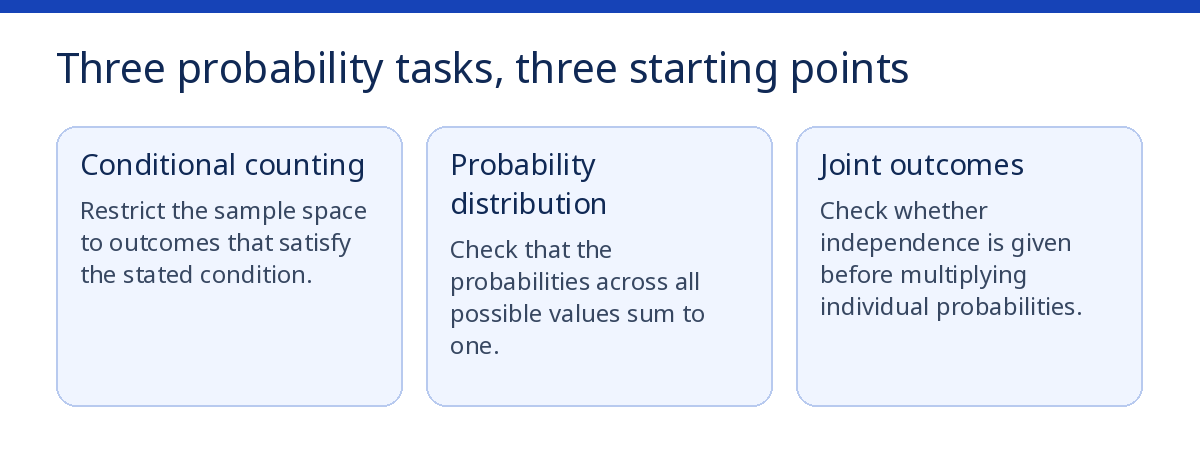
The paper uses probability in three distinct ways. In the arrangement question, a stated condition restricts the sample space before you count favourable outcomes; simple counting works when the remaining arrangements are equally likely. In the distribution question, the probabilities of all possible values must sum to one. That check is separate from comparing the resulting distribution with the model for two independent fair tosses.
The final case study asks about joint outcomes for two competitors. The worked solution explicitly uses independence to obtain numerical results, although the question does not state it. The individual success probabilities alone do not determine the requested joint probabilities. This guide therefore leaves out the numerical results and focuses on the modelling distinction: knowing each event's probability is not the same as knowing how the events occur together.
Quick self-check before opening the worked solutions
Start from the question pages and complete a timed attempt before opening the explanations. Where you get stuck, note the decision you could not make: choosing an integration method, identifying a normal, interpreting a direction cosine, or deciding whether the given information supports a probability calculation. This makes it easier to locate the first gap in your reasoning rather than just comparing final answers.
The file links question numbers to worked solutions and separates the formula, concept and explanation in steps. Use those labels to review a question in stages. Before reading the steps, ask: Can I explain why the named method applies here? Which sign, interval or assumption would change my approach? Then try a printed alternative you skipped and see whether you can justify your method without relying on the explanation.
Spotted an error? Report a correction. Practise this in the app: notes, formula sheets and mind maps.





























































































































































Loading comments…