CBSE Class 12 Integrals Assessment: Practice Guide
CBSEMathematicsIntegral Calculus
This CBSE Class 12 Mathematics assessment pairs six topic practice sets with a separate 94-question chapter review. Use the topic solutions to check how you apply each method, then use the chapter practice to test whether you can choose a method without a topic heading as a cue.
What the assessment contains
The file contains 312 practice questions across six topic sets and one chapter set. The topic sets cover integration and its properties, substitution, partial fractions, integration by parts, definite integrals, and evaluation of definite integrals by substitution. The index groups questions by response type, from objective and very short answers to longer written responses where included. The chapter set also includes case-based questions.
Use the index to open a question range or jump to the solution for a particular topic question. Each practice set starts at Question 1, so note the set name as well as the question number when marking an item to revisit. Page references in the index follow the printed numbering, which differs from the PDF viewer’s page count.

Integral Calculus | Class 12 | CBSE Assessment
In the StudentCurio app
CBSE-style assessment questions and worked solutions cover indefinite integration techniques, including substitution, trigonometric forms, integration by parts and partial fractions, as well as definite integrals and their properties. Helps Class 12 students practise integral calculus and prepare for mathematics assessments.
Antiderivatives: check by differentiating
The first topic set treats integration as the reverse of differentiation. If on an interval, the indefinite integral is the family there. The constant matters because differentiation erases it. When a question also gives the function’s value at a point, that condition selects one member of the family on the interval containing that point.
Before reaching for a new technique, check whether algebra or a trigonometric identity turns the integrand into a sum of familiar terms. Linearity then lets you integrate those terms separately and carry constant factors outside the integral. To check your work, differentiate your final expression and compare it with the original integrand on the interval where it is defined. Simplifying an expression does not remove restrictions in the original.
When substitution fits: look for the chain rule
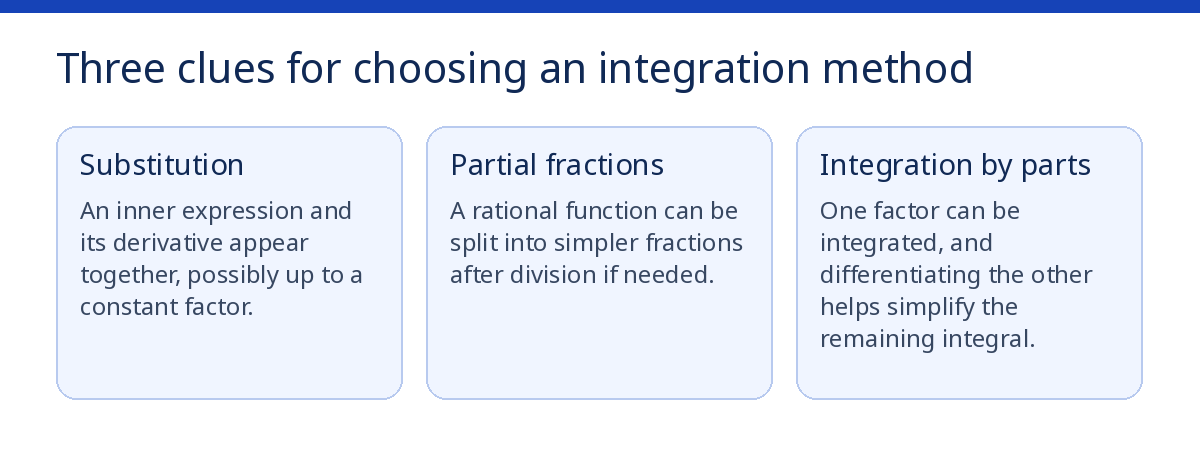
Substitution reverses the chain rule. Look for an inner expression whose derivative, possibly up to a constant factor, also appears in the integrand. A useful choice lets you rewrite the entire integral in the new variable, including the differential. If the rewritten expression still contains both variables, check whether the remaining factor can be expressed in the new variable or whether a different substitution would be simpler.
The substitution set includes algebraic, exponential and trigonometric forms. Compare questions by what makes the change of variable work, not simply by what functions they contain. In a trigonometric expression, an identity may make the inner function and its derivative easier to spot. After an indefinite substitution, return to the original variable before checking the antiderivative.
Partial fractions and parts solve different problems
Partial fractions break a rational function into simpler fractions. First compare the degrees of the numerator and denominator. If the numerator’s degree is at least as large, divide before decomposing any proper rational remainder. The denominator’s factorisation determines the form of the decomposition, so check repeated factors as well as distinct ones. Some questions in this set involve trigonometric or exponential expressions: a substitution can turn the integrand into a rational function of the new variable before decomposition.
Integration by parts reverses the product rule. Use it when one factor can be integrated and differentiating the other makes the remaining integral easier to handle. A visible product is a reason to consider parts, not a reason to skip a simpler substitution or an algebraic rewrite.
Definite integrals: keep limits and signs together
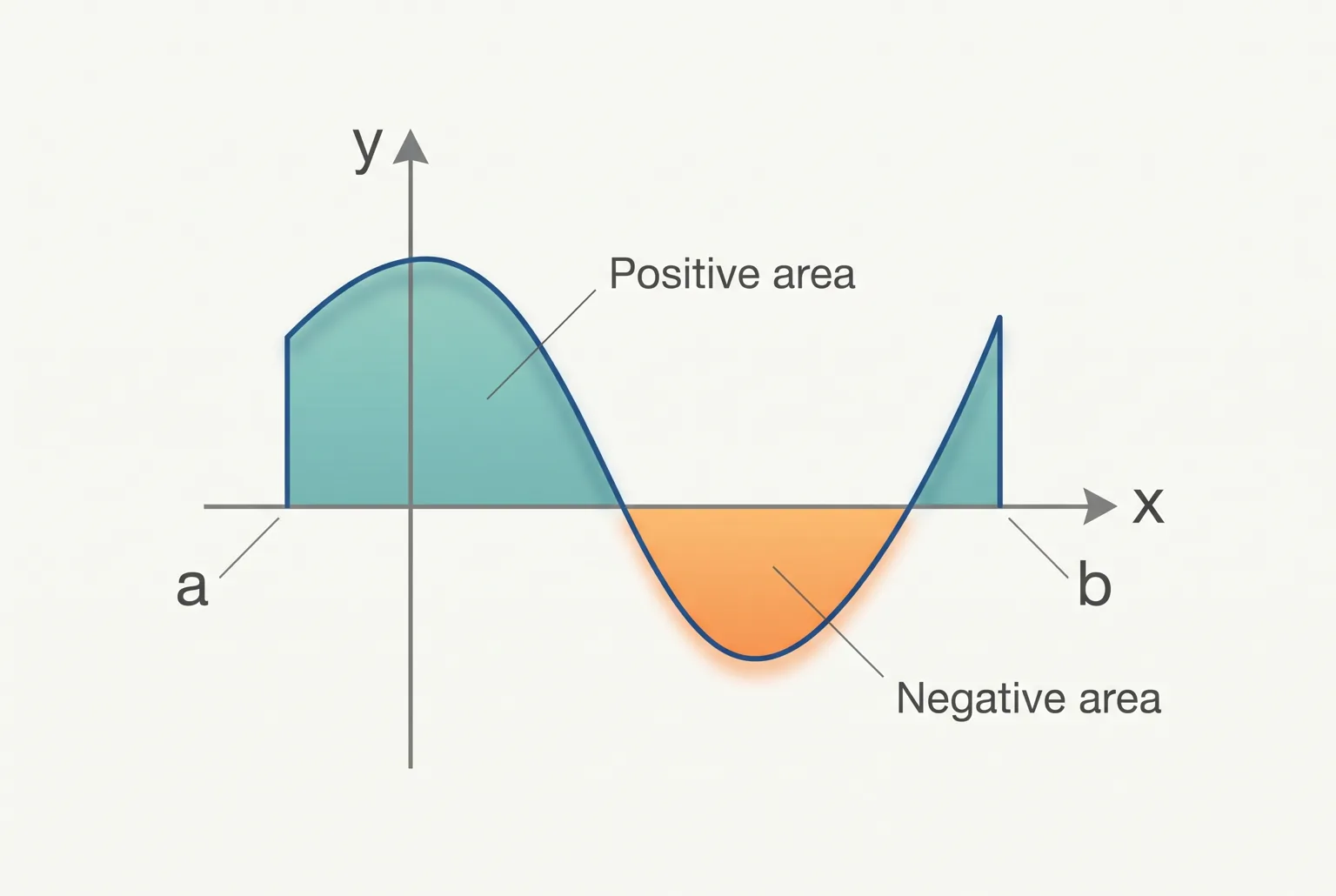
Unlike an indefinite integral, a definite integral with fixed limits gives a value, not a family of functions. For a continuous integrand on the interval, you can use an antiderivative and subtract its value at the lower limit from its value at the upper limit. There is no extra constant in the result. The cover uses a midpoint approximation to illustrate area under a curve. More generally, the definite integral gives signed accumulation: contributions below the horizontal axis subtract rather than add.
In the set on definite integrals by substitution, work consistently in one variable. If you finish in the new variable, convert both limits to their corresponding new values. If you return to the original variable first, use the original limits. Reversing the order of the limits changes the sign.
Quick self-check: does symmetry apply?
Before finding an antiderivative, ask what happens to the integrand when you reflect the variable about the midpoint of the interval. Reflection keeps the value of the integral unchanged when the integrand is replaced by its reflected form and the original limits are retained. For an integrable odd function on a symmetric interval, contributions cancel; for an integrable even function on that interval, the integral is twice the contribution from the right half.
Can you identify the midpoint and predict whether the reflected expression will help before doing the algebra? Check that the integral exists before using cancellation. Opposite signs on either side of a singularity do not by themselves establish that the integral converges.
Move from topic solutions to chapter practice
Use a topic set when you can name the skill you want to practise, such as setting up partial fractions or changing limits under substitution. Attempt an item before opening its solution. If your work diverges from the worked steps, find the first difference that matters: an invalid rewrite, a missing factor or a choice that leaves you with a harder integral. The index also points to expanded explanations for selected topic questions.
Then try the separate chapter practice without relying on a method label. It provides hints and a final-answer key rather than a full worked solution for every question. Keep your intermediate steps: the key can tell you whether your result agrees, but your written work helps you see why.
Spotted an error? Report a correction. Practise this in the app: notes, formula sheets and mind maps.





























































































































































Loading comments…