CBSE Class 12 Mathematics: 2022 Supplementary Paper
CBSEMathematics2022 Previous Year Paper
Paper code: 65/6/1 · 2022Use this full, year-wise CBSE Class 12 Mathematics supplementary paper to practise the 2022 format and review how the worked solutions connect each method to the conditions in the question.
This set is one of the year's papers. See every set from 2022, grouped by series.
The 2022 paper at a glance
This is the English version of the 2022 supplementary examination, paper code 65/6/1. The printed time is 2 hours, and the maximum is 40 marks. The paper is organised by year rather than by chapter, so a single attempt takes you across integration, differential equations, vectors, three-dimensional geometry and probability.
All three sections are compulsory. Section A has six short-answer questions of 2 marks each, Section B has four short-answer questions of 3 marks each, and Section C has four long-answer questions of 4 marks each. Question 14, the last question in Section C, is a case study with two 2-mark subparts. Some questions offer an internal choice: choose one of the printed alternatives during a timed attempt, then use the other for practice if you want to test a different method.

Mathematics Supplementary 2022 | Class 12 | Previous Year Paper | Code 65/6/1
In the StudentCurio app
A complete CBSE Class 12 Mathematics supplementary examination paper with worked solutions, covering questions from several syllabus areas and including a case-study question. It helps students practise a full past paper and review solution methods.
Probability: notice what changes between stages
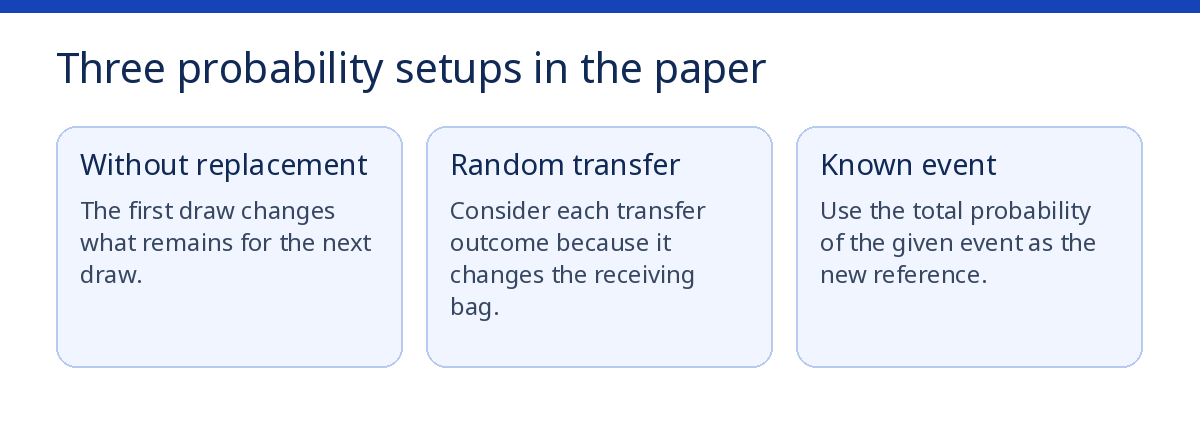
The probability questions distinguish three situations that can look similar at first. In the card-draw question, sampling without replacement means the first draw changes what is available on the second. If you use successive probabilities, the second factor must reflect the outcome specified for the first draw; it cannot simply repeat the first factor.
In the bag-transfer question, the transferred ball changes the composition of the bag used for the final draw. The colour transferred is not given, so the relevant method is to consider both possible transfer outcomes and weight the probability of the final event in each case. The die case study makes a different distinction: all face probabilities together must sum to one, but once an even face is given, the reference set is only the even faces. Because the die is biased, counting faces is not a substitute for adding their probabilities.
Vectors and 3D geometry: identify what the vector represents
The paper uses dot and cross products for different purposes. The unit-vector question connects dot products to the squared magnitude of a vector sum. The perpendicular-vector question instead tests the geometric meaning of a nonzero cross product: it gives a vector perpendicular to both factors. A zero cross product would not provide a nonzero direction.
In the geometry questions, keep a line’s direction distinct from a plane’s normal. For a plane through three non-collinear points, two displacement vectors in the plane can give a normal through their cross product. For the shortest distance between parallel lines, only the component of the displacement perpendicular to their shared direction contributes. The paper also tests where a line crosses the ZX-plane and how to specify a plane containing the intersection of two other planes. These tasks reward identifying the geometric constraint before doing the algebra.
Integration: when the method fits
The integration questions test whether you can recognise useful structure before manipulating the expression. A definite integral may be easier to handle by reflecting its variable across the midpoint of its interval, provided the reflected integrand can be combined usefully with the original. In the indefinite integrals, substitution can reveal a simpler integral without finishing the job: the paper includes routes that then use integration by parts or partial fractions. For trigonometric quotients, a rewritten expression does not remove the need to exclude points where the original denominator vanishes.
For area by integration, sketch the boundaries before setting up the integral. With vertical slices, subtract the lower boundary from the upper one on the interval where that ordering holds. A curve with two branches requires you to identify which branch bounds the intended region. This guide omits the worked result for the parabola alternative because the supplied wording does not explicitly choose between the upper and lower bounded regions.
Differential equations: separate method, domain and condition
The differential-equation tasks distinguish finding a general solution, identifying order and degree, and finding a particular solution. Order is set by the highest derivative present. Degree is the power of that derivative once the equation is expressed as a polynomial in its derivatives, where this is possible. Neither is determined by the highest power of the independent variable.
The general-solution route in the paper uses separation and recognition of a product derivative. The particular-solution question instead uses a first-order linear equation: an integrating factor turns the relevant side into a product derivative, and the given initial condition fixes the arbitrary constant. In the logarithmic equations here, the real logarithm requires a positive argument. Keep that restriction with the solution rather than treating it as a detail that disappears once the integration is done.
Before you open the worked solutions
Attempt the question pages first, then use the numbered links to review the questions you found difficult. The worked pages separate the formula used, the concept used and the explanation in steps. Compare those layers in that order: did you choose an applicable rule, understand why it applied, and carry it through correctly? A mismatch at the first step calls for different revision from an arithmetic slip near the end.
For the case study, check whether you kept the distribution as a whole separate from the event you were told had occurred. For an internal choice, compare the alternatives after the timed attempt: an area question may be won or lost in the sketch, while an integration question may turn on spotting the right substitution. Use that comparison to decide what to practise next.
Spotted an error? Report a correction. Practise this in the app: notes, formula sheets and mind maps.





























































































































































Loading comments…