Application of Derivatives: CBSE Class 12 PYQs and Solutions
CBSEMathematicsApplication Of Derivatives
This guide to Application of Derivatives (Class 12, Chapter 6) explains how CBSE board questions test rates of change, related rates, monotonicity, critical points and absolute extrema. It also covers optimisation and case-based sets, the steps examiners expect, and a practice order for 143 previous-year questions from 2023–2026.
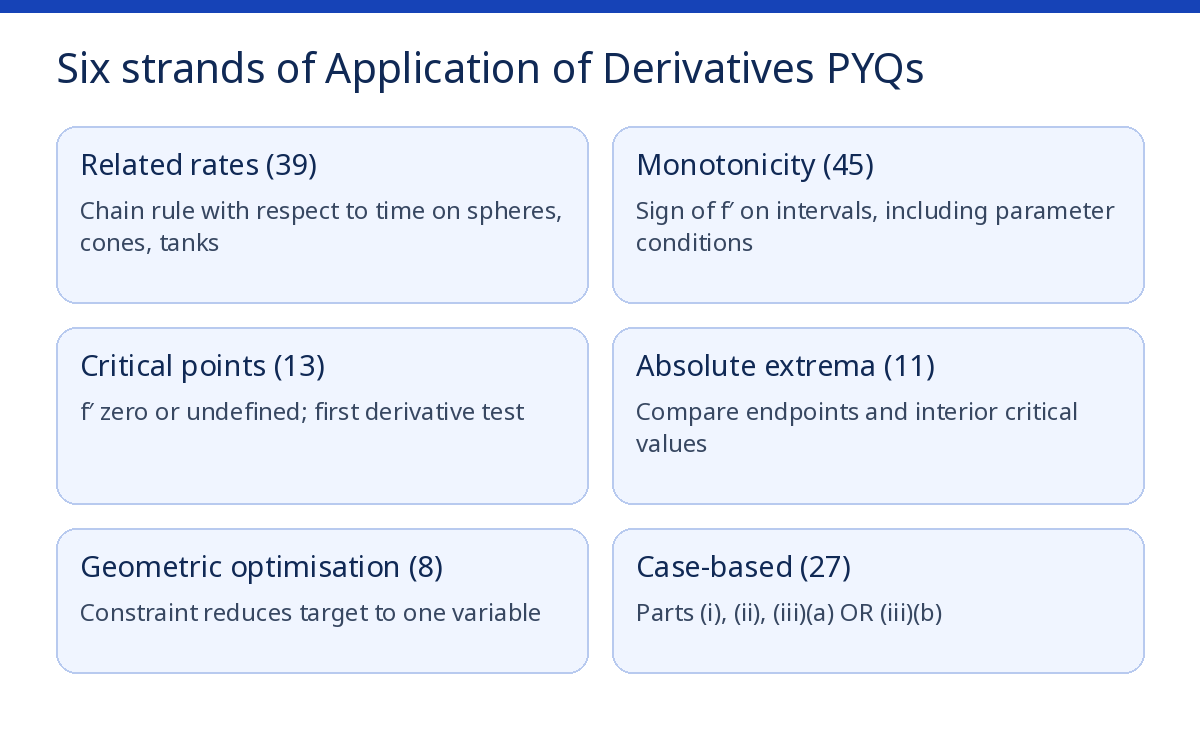
Six tested strands across 143 board questions
The collection gathers 143 CBSE previous-year questions from main and compartment board papers dated 2023–2026. Each question keeps its original number and exam label, and each links to a numbered worked solution.
The topic index sorts the questions into six strands:
- Rates of change and related rates: 39 questions
- Increasing and decreasing functions: 45 questions
- Critical points and local extrema: 13 questions
- Absolute maxima and minima: 11 questions
- Geometric optimisation: 8 questions
- Mixed and case-based applications: 27 questions
Q1–Q39 are MCQs with a single correct answer. The rest are subjective, and many offer an internal choice marked (a) OR (b). Monotonicity is the largest strand.

Application Of Derivatives | Class 12 | Previous Year Paper
In the StudentCurio app
A collection of 143 solved CBSE previous-year questions on applications of derivatives, covering rates of change, related rates, monotonicity and optimisation. It helps Class 12 students practise exam-style questions, including MCQs and case-based problems.
Related rates: fix the relation before you differentiate
Rate questions describe a changing sphere, cube, circle or cylindrical tank. In one stem, sand fills a tank of fixed radius at a given volume rate, and you must find how fast the level rises.
A reliable method has four steps:
- Write the geometric formula linking the quantities.
- Reduce it to one changing variable, using any fixed dimension.
- Differentiate with respect to time using the chain rule: .
- Substitute the instantaneous value only after differentiating.
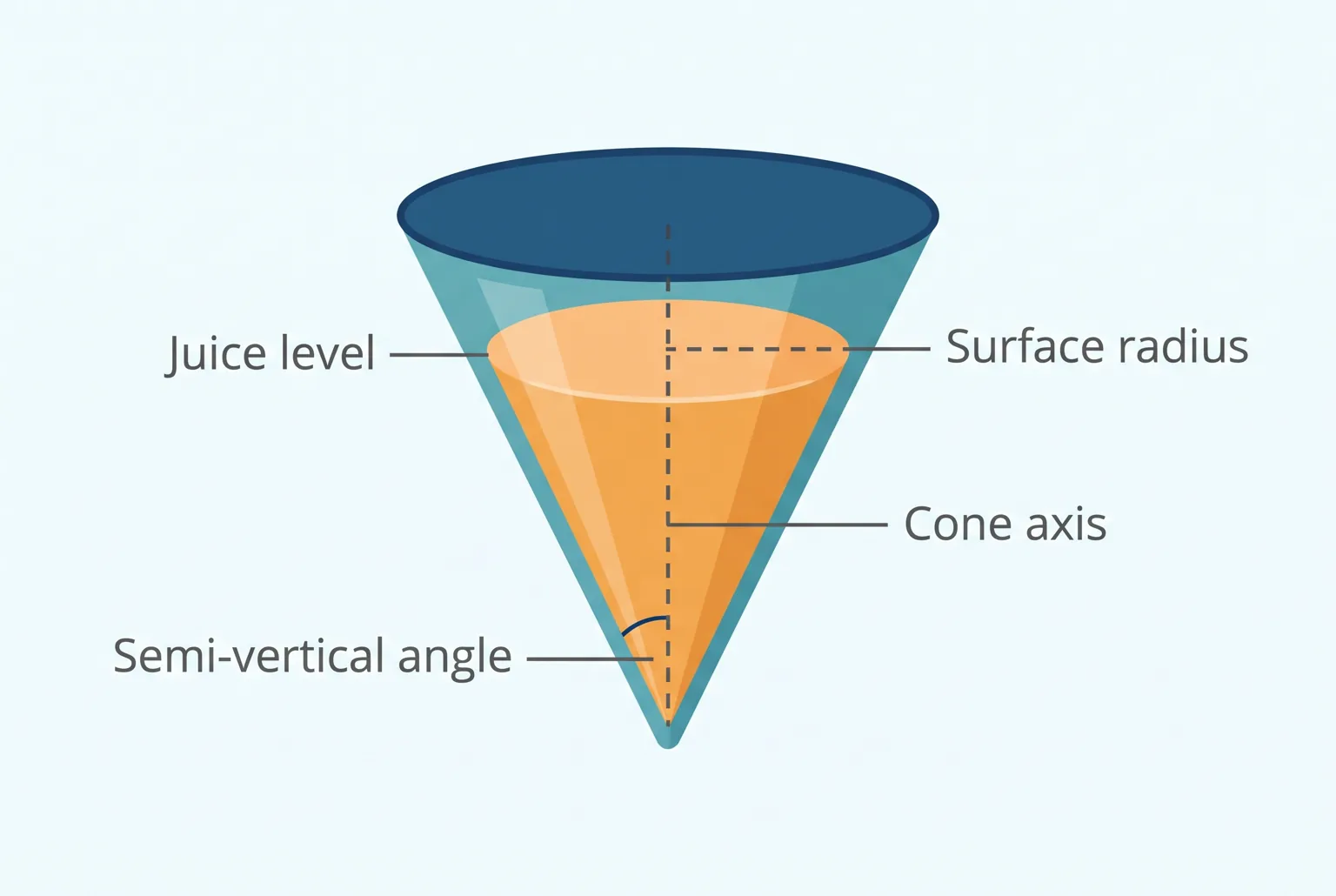
Cones need an extra step. In one question, a conical perfume bottle with semi-vertical angle loses volume steadily. The angle lets you write the surface radius in terms of the level, so the volume depends on height alone.
Check which variable the rate is taken against. One MCQ asks for a sphere's volume rate with respect to its diameter, not its radius. "Show that" questions, such as a balloon losing volume in proportion to its surface area, are proofs rather than calculations.
Increasing and decreasing intervals from the sign of f′(x)
Most monotonicity questions follow one routine. Find , locate where it is zero or undefined, split the domain at those points, and test the sign of in each piece.
The functions vary widely. They include polynomials, , , for , and rational functions with excluded points such as or . Inverse-trigonometric and logarithmic compositions appear on intervals like or . A point excluded from the domain is still a boundary when you split the intervals.
A second pattern uses a parameter. One question asks for the values of that make strictly increasing. The sign condition must then hold for every real , so you must consider the full range of a term such as , not one convenient point.
Critical points and the first derivative test
A critical point is where or where does not exist. A critical point alone does not settle whether there is a maximum or a minimum.
The first derivative test examines the sign of as passes through the point. A sign change signals a local extremum, and its direction tells you which kind. Without a sign change, there is no local extremum. Several MCQs probe this distinction, including questions on points of inflexion.
Some questions run in reverse. Q40 gives a critical point and asks for the constants and in a rational function. Both facts must be used: the point lies on the curve, and the derivative vanishes there.
Absolute maxima and minima on a closed interval
For a continuous function on a closed interval such as or , use the closed-interval method:
- Find the critical points inside the interval.
- Evaluate at those points and at both endpoints.
- Compare all the values.
Discard critical points outside the interval. Some questions need no derivative: is best read from the structure of the expression.
Subjective versions combine results. They may ask for the sum or product of the maximum and minimum values of a trigonometric function such as on , so every candidate value must be computed accurately.
Optimisation and case-based sets with internal choice
Case-based questions build up in parts: (i) set up a relation, (ii) express the quantity or its derivative, and (iii)(a) OR (iii)(b) optimise. Settings in the source include:
- a window shaped as a rectangle topped by an equilateral triangle, with fixed perimeter;
- ladders from a common point on a road to two poles;
- a subscription company losing ten subscribers for every ₹1 rise in fee;
- open cylindrical tumblers with fixed surface area;
- conical juice cups being filled.
A rectangle revolved about one side to sweep out a cylinder of maximum volume recurs with perimeters of 36 cm, 24 cm and 30 cm.
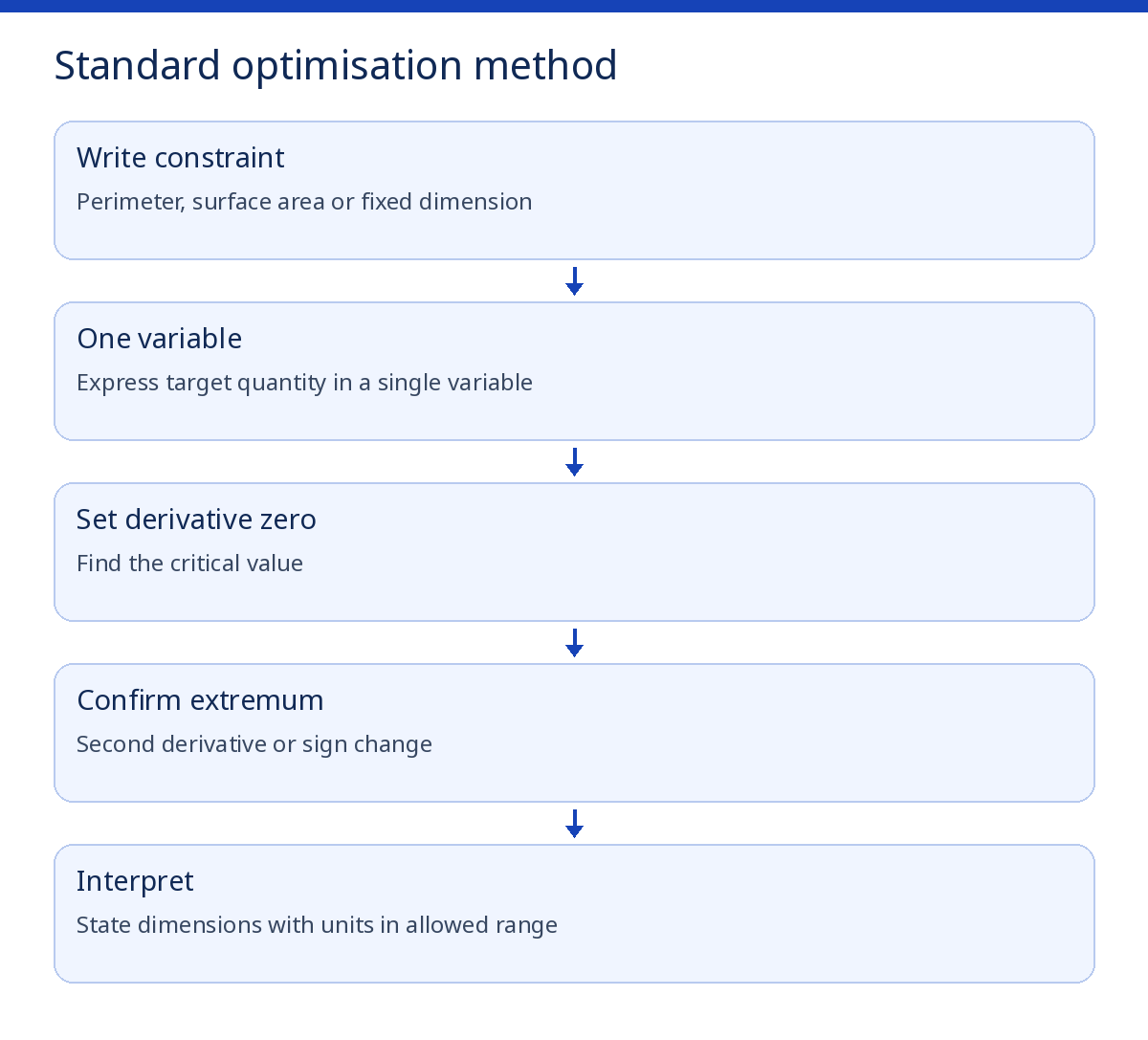
The expected steps are: use the constraint to write the target in one variable; differentiate and set the derivative to zero; confirm the extremum by the second derivative or a sign change; and state dimensions with units within the physically allowed range.
Common mistakes in derivative applications
- Substituting a given value, such as "when ", before differentiating, which turns a variable into a constant.
- Giving the rate against the radius when the question asks for the rate against the diameter, or the reverse.
- Ignoring a stated domain or excluded point, such as or , when listing intervals.
- Leaving out endpoints when finding absolute extrema.
- Treating every critical point as an extremum without checking for a sign change.
- Optimising a quantity that still has two variables because the constraint was never applied.
A practice order for the 143 questions
Start with the MCQs strand by strand, beginning with related rates and monotonicity, which form the bulk of the collection. Move next to subjective questions on critical points and closed intervals. Finish with optimisation and case-based sets, attempting both internal-choice branches.
Write each full method before opening the worked solution. Before relying on any answer key, read the source review notes at the end, which record assumptions and key discrepancies for specific questions.
Frequently asked questions
Which years and formats does this collection cover?
It contains 143 CBSE board questions from 2023–2026, including compartment papers. Q1–Q39 are single-correct MCQs, and the remaining questions are subjective and case-based.
Which topic has the most questions?
Increasing and decreasing functions, with 45 questions, followed by rates of change and related rates, with 39.
Spotted an error? Report a correction. Practise this in the app: notes, formula sheets and mind maps.





























































































































































Loading comments…