CBSE Class 12 Mathematics 2022 Term 2 Paper with Solutions
CBSEMathematics2022 Previous Year Paper
Paper code: 65/2/2 · 2022Use this full CBSE Class 12 Mathematics Term 2 paper from 2022 for a timed attempt or targeted revision. The worked solutions separate the formula, the concept and the steps, so you can check where your reasoning diverged rather than just compare final answers.
This set is one of the year's papers. See every set from 2022, grouped by series.
What this 2022 Term 2 paper contains
This English-language file contains the 2022 main examination paper, code 65/2/2, from the 2021–22 session. It is a year-wise resource organised around one complete paper, not a chapter-wise question bank. The printed time is 2 hours and the maximum is 40 marks. Use those figures when practising this particular paper; they describe its Term 2 format.
All three sections are compulsory. Section A has six short-answer questions of 2 marks each. Section B has four short-answer questions of 3 marks each, and Section C has four long-answer questions of 4 marks each. Some questions offer an internal choice: select one printed alternative when attempting the paper under exam conditions. The final question is a probability case study with two subparts worth 2 marks each.

Mathematics 2022 | Class 12 | Previous Year Paper | Code 65/2/2
In the StudentCurio app
Complete CBSE Class 12 Mathematics 2022 examination paper with worked solutions. It covers questions across topics including probability, vectors, integration, differential equations and three-dimensional geometry.
Probability: distinguish the three kinds of task
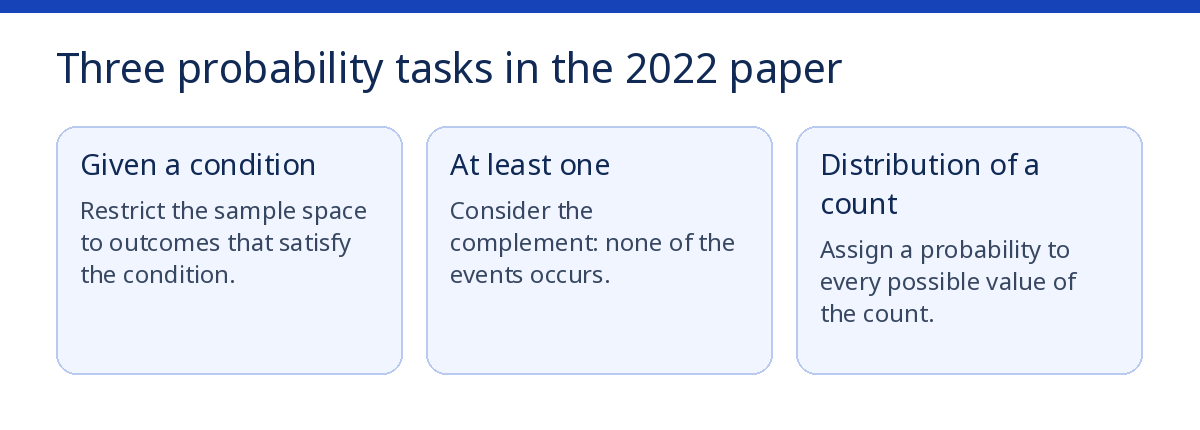
The dice question tests conditional probability. Once a condition is given, the relevant sample space consists only of outcomes that satisfy it. Counting favourable outcomes within that restricted set but dividing by the size of the original sample space would answer a different question. The worked explanation uses ordered dice outcomes, which lets you keep track of which die shows which value.
The independent-attempts question instead asks whether at least one attempt succeeds. The complement is that neither succeeds. Taking a complement does not require independence, but multiplying the two failure probabilities does. The closing coin-toss case study adds a different demand: a probability distribution must give the probability for every possible value of the count, whereas an “at least one” question asks for a single event probability.
Integration: choose a method from the expression
The integration questions reward recognising structure before calculating. A trigonometric quotient can call for an identity, while an exponential expression may suggest a substitution. For a definite integral, if you continue in the new variable, rewrite the bounds in that variable too. In another internal choice, the solutions contrast integration by parts for an inverse trigonometric function with partial fractions for a rational function. Partial fractions depend on the denominator's factorisation, and the resulting antiderivative applies on intervals that avoid its zeros.
The area question changes the starting point: first identify the bounded region, then set up the integral. Intersections determine the limits, and with vertical strips the integrand is the upper boundary minus the lower one. For the parabola alternative, both branches contribute to the enclosed region; using only the upper branch as the integrand would measure the wrong area.
Vectors and 3D geometry: identify the objects first
The vector-angle question uses the dot product to connect two magnitudes with the angle between the vectors. The unit-vector assumption matters: for unit vectors, the dot product equals the cosine of the angle directly. In the coordinate questions, subtracting two distinct points gives a direction for their line. For a collinearity test, one parameter must describe all three coordinates, and internal division requires the parameter to place the point between the endpoints.
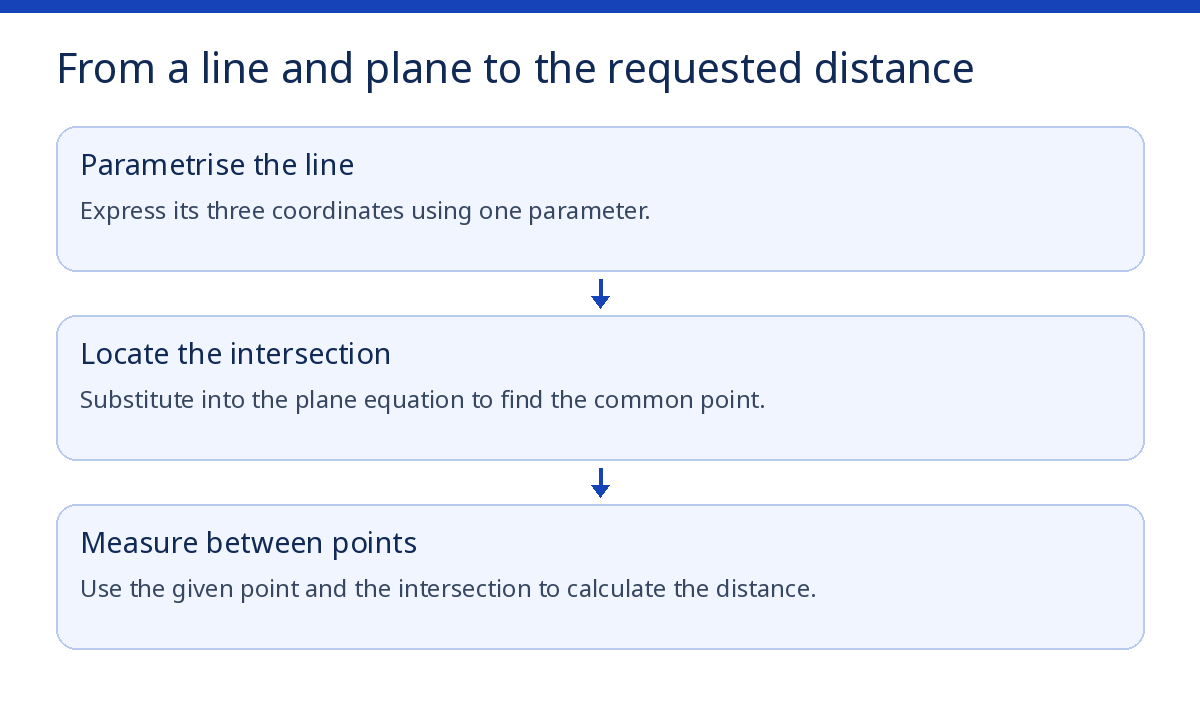
The geometry questions also show why a distance formula should follow, not precede, identification of the objects. A plane through three non-collinear points can be described using a normal obtained from a cross product. A distance formula for parallel lines requires you to check that their directions are parallel. When the question asks for the distance from a point to a line–plane intersection, find the intersection first; the remaining calculation is a point-to-point distance, not a point-to-plane distance.
Common mistake: dividing away a differential-equation solution
The paper distinguishes a particular solution, selected using a supplied condition, from a general solution. In the particular-solution question, the condition determines the integration constant. It also identifies which interval to use if the resulting expression is undefined at a point: the interval must contain the given initial point and cannot extend across the singularity.
The homogeneous-equation solution illustrates a separate issue. The substitution is used where . If separation then involves dividing by , the calculation assumes . Check the excluded case in the original equation rather than assuming it gives no solutions. The worked explanation explicitly accounts for solutions missed by that division.
Before you move on: review the first step that went wrong
For a timed attempt, work from the question pages before opening the solutions. Then use the question-number links to compare your work with the labelled Formula Used, Concept Used and Explanation in Steps blocks. Locate the first point where your reasoning diverged. Choosing the wrong sample space or geometric object calls for a different correction from making an arithmetic slip after a sound setup.
In an untimed review, try the other printed option for an internal-choice question. Both alternatives have worked solutions, and they can test different methods even when they carry the same marks. Before checking the second solution, ask yourself: what feature of the expression or diagram made me choose this method, and what condition did I have to check before applying it?
Spotted an error? Report a correction. Practise this in the app: notes, formula sheets and mind maps.





























































































































































Loading comments…