CBSE Class 12 Mathematics 2025 Paper With Worked Solutions
CBSEMathematics2025 Previous Year Paper
Paper code: 65/2/3 · 2025Practise with the full English-language 2025 CBSE Class 12 Mathematics main examination paper, set 65/2/3. After your attempt, use the worked solutions to check not just your answers but also your choice of method and the conditions that make it valid.
This set is one of the year's papers. See every set from 2025, grouped by series.
What this year-wise resource contains
This file is organised by exam year, not by chapter. It contains the complete 2025 CBSE Class 12 Mathematics main examination paper for set 65/2/3. The paper carries 80 marks and has a duration of three hours. The resource preserves the original English question layout, options and diagrams, and provides worked solutions for all 38 questions, including the alternatives in both printed internal choices.
Because the questions are in paper order, the file lets you practise identifying the topic and choosing a method without a chapter heading to cue you. The question-number navigation then lets you go directly to an explanation during review, without reading the solutions to questions you have yet to attempt.

Mathematics 2025 | Class 12 | Previous Year Paper | Code 65/2/3
In the StudentCurio app
The complete 2025 CBSE Class 12 Mathematics paper, set 65/2/3, with worked solutions across topics including calculus, matrices, probability, vectors and three-dimensional geometry. It helps students practise the board-exam format and review solution methods.
Attempt the paper before opening the solutions
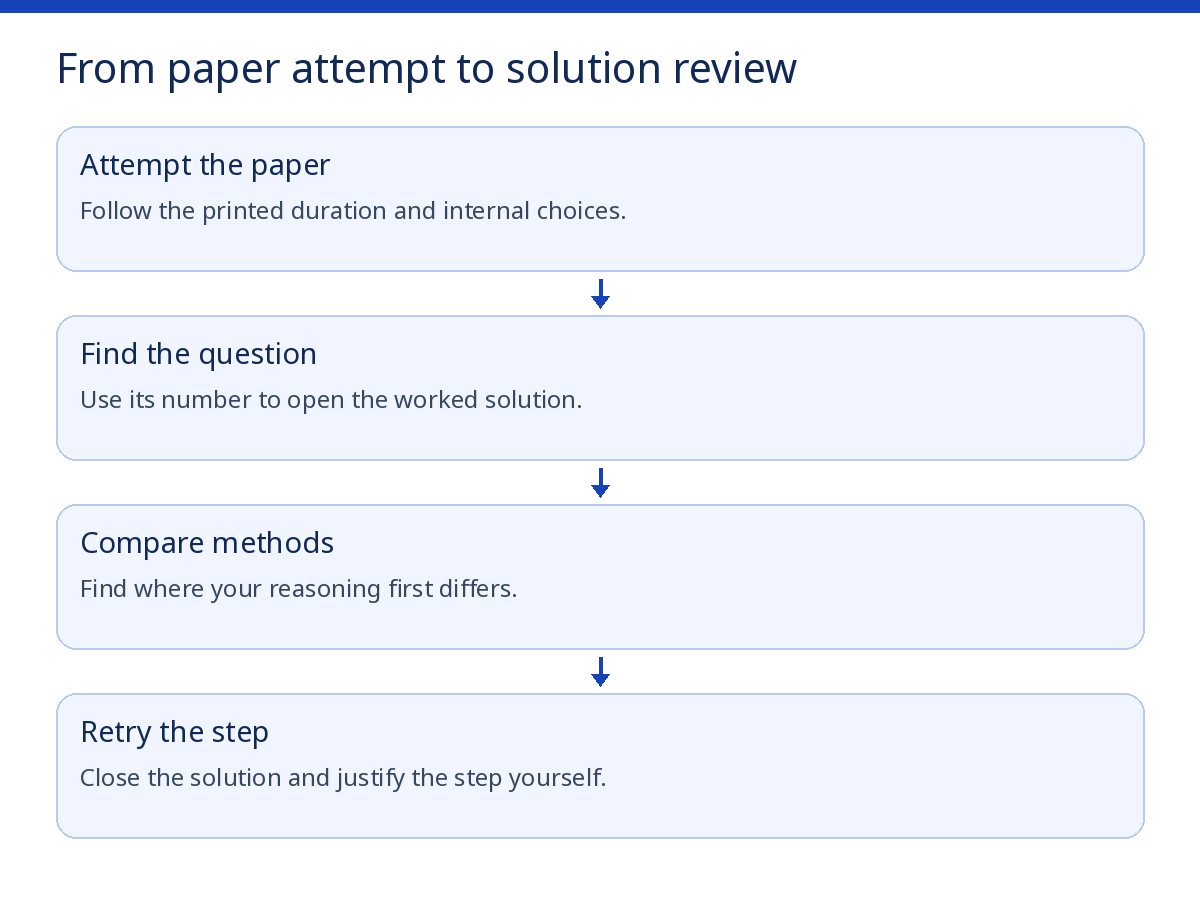
For a board-paper rehearsal, use the printed three-hour duration and follow the paper’s instructions for internal choices. Its worked solutions cover the alternatives for review; that does not mean you should attempt both alternatives during the rehearsal. If you want to practise an unused alternative, save it for a separate attempt after you have reviewed the paper.
On your answer sheet, record the setup even when you cannot finish: a labelled diagram, a relevant identity, or an equation that connects the given information to what you need to find. That record makes the review more useful. A blank final answer does not tell you whether you missed the concept, chose an unsuitable method, or simply ran out of time after a sound start.
Calculus: distinguish the setup from the calculation
The supplied solutions illustrate several different uses of calculus: studying where a function increases, finding an area by integration, and identifying the order and degree of a differential equation. These tasks ask you to read different features of an expression. The sign of a derivative helps determine behaviour on an interval, whereas the order of a differential equation depends on the highest derivative present after the expression is expanded. Degree is read from the power of that derivative when the equation is polynomial in its derivatives.
For an area question, read the diagram before choosing the integral. With horizontal strips, the width is the right-hand boundary minus the left-hand boundary, expressed in terms of the vertical coordinate. Check that your limits describe the vertical extent of the region. A correct antiderivative cannot fix a strip width or limits taken from the wrong boundaries.
Common mistake: treating matrix products like numbers
The matrix solutions are useful for checking habits that ordinary algebra can conceal. When expanding a product of matrices, keep the factors in their original order. Even when both products are defined and have the same dimensions, and need not be equal. Collect terms with the same ordered product rather than combining them merely because they contain the same two letters.
Transpose has a different rule: for a defined product, . It reverses the order as well as transposing each factor. When reviewing a symmetry argument, check the expanded transpose against the original matrix: a symmetric matrix equals its transpose, while a skew-symmetric matrix equals the negative of its transpose.
Keep the roles of vectors and events distinct
In three-dimensional geometry, the parametric form of a line separates a point from a direction. In , with , is the position vector of a point on the line and gives its direction. This distinction helps you check whether you have read the fixed coordinates or the coefficients of the parameter. For scalar projection, check which vector supplies the direction: it is that nonzero vector whose magnitude goes in the denominator.
In conditional probability, the event after the conditioning bar determines the denominator and must have nonzero probability. The numerator represents the intersection of the two events. If the events involve complements, write out that intersection before using a set identity; this keeps the probability calculation tied to the event actually being described.
Quick self-check before reading each worked solution
The explanations separate the formula used, the concept used and the steps. Read those parts against your own work rather than jumping straight to the final answer. If your approach differs, find the first step at which the two methods diverge and check whether both steps are valid. A different route is not itself an error, and a matching final answer does not establish that every step was justified.
- Which feature of the question told me to use this rule rather than another one?
- What condition did I need to check before applying it?
- Can I reconstruct the step I missed after closing the solution, and explain why it follows?
One direction-angle item, Q14, is flagged in the resource because the listed option does not capture every possibility discussed in the solution. This guide omits the disputed option and worked result; use the item to practise checking whether an option claims more than the given information establishes.
Spotted an error? Report a correction. Practise this in the app: notes, formula sheets and mind maps.





























































































































































Loading comments…