CBSE Class 12 Mathematics 2026 Paper with Worked Solutions
CBSEMathematics2026 Previous Year Paper
Paper code: 65/5/1 · 2026Use the full 2026 CBSE Class 12 Mathematics main examination paper (65/5/1) for a three-hour mock, then review your reasoning with the worked solutions. The English-language file preserves the original question layout, options and diagrams.
This set is one of the year's papers. See every set from 2026, grouped by series.
Know the format before starting the clock
The paper carries 80 marks across 38 questions. Section A contains 18 multiple-choice questions and two assertion–reason questions, each worth one mark. Section B has five two-mark very short answers, Section C has six three-mark short answers, and Section D has four five-mark long answers. Section E has three case studies worth four marks each, with marks shown against individual parts.
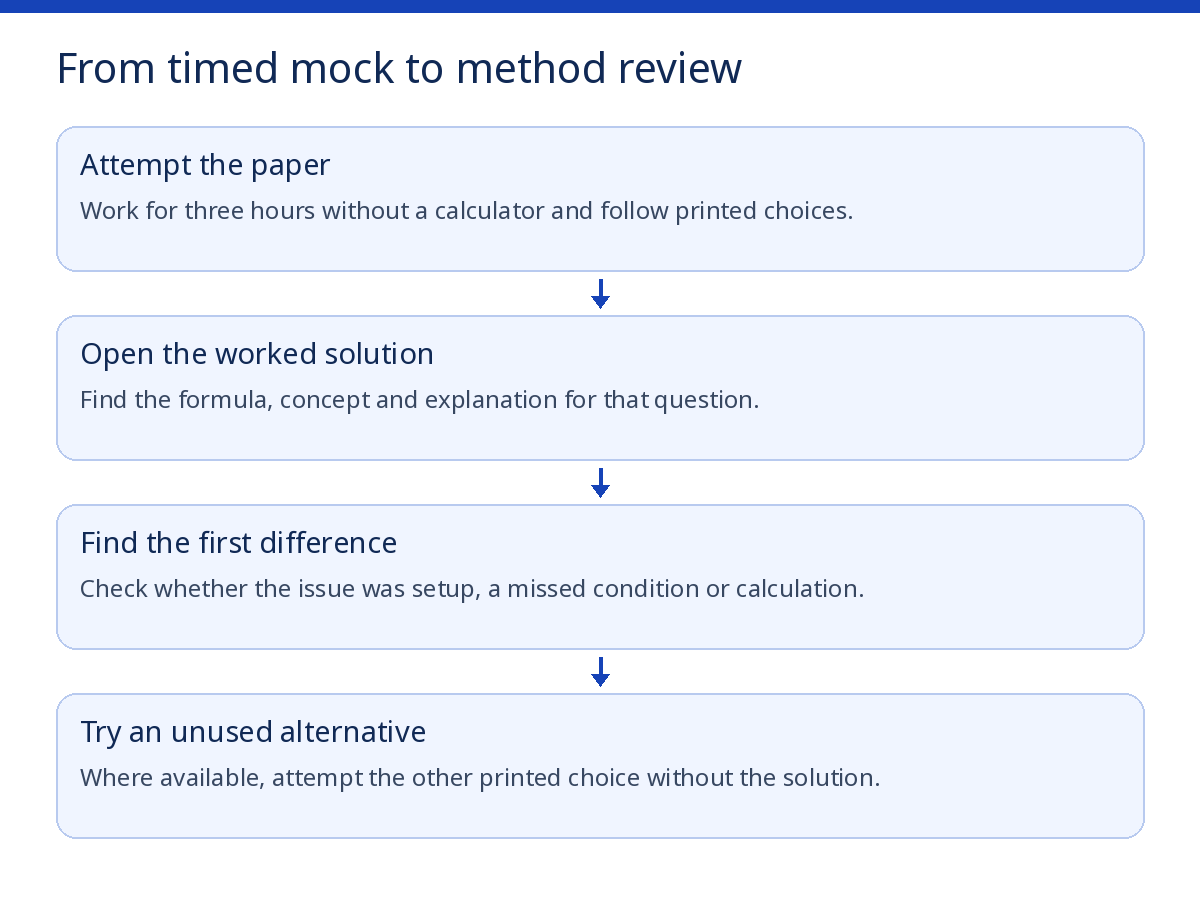
There is no overall choice, and calculators are not allowed. Where an internal choice is printed, choose one alternative for your mock rather than attempting both under the clock. Use the question paper’s general instructions and the printed alternatives to identify where choices apply. Save the unattempted alternatives for a later practice pass.

Mathematics 2026 | Class 12 | Previous Year Paper | Code 65/5/1
In the StudentCurio app
Complete CBSE Class 12 Mathematics paper for 2026 with worked solutions covering topics including matrices, probability, calculus, vectors, differential equations and linear programming. Helps students practise exam-style questions and review solution methods.
Matrices, relations and inverse trigonometry
The matrix questions range from interpreting identities involving square matrices to translating a set of fruit prices into simultaneous equations. These tasks start differently: an identity gives you an algebraic condition to use, while a word problem first requires you to define the unknowns and keep their order consistent across equations. If you use an inverse to solve a square system, check that the coefficient matrix is nonsingular before proceeding.
The relations case study separates three ideas that are easy to conflate: being a relation, being a function and being an injective function. Check that each input has exactly one output before asking whether distinct inputs have distinct outputs. For inverse trigonometry, distinguish the allowed inputs from the principal range: an inverse trigonometric function returns an angle on its specified branch, not necessarily the angle you started with.
Calculus: identify what changes and what stays fixed
The paper tests continuity, differentiation, integration and their applications. In a piecewise continuity problem, simplifying an expression away from the joining point can help you find the limit, but it does not change the value defined at that point. Continuity requires the limit to agree with the defined value. In a question about increasing behaviour, respect breaks in the domain before using the sign of the derivative to reason about intervals.
The balloon problem links rates of change, while the open-top tumbler case study asks about volume when surface area is held fixed. In the latter, height and radius cannot vary independently. When reviewing the setup, check that the expression for surface area represents the actual open container. The differential-equation questions ask for different skills: identifying order and degree in one setting, and choosing a method to find a general solution in another.
Good to remember: a graph can serve different purposes
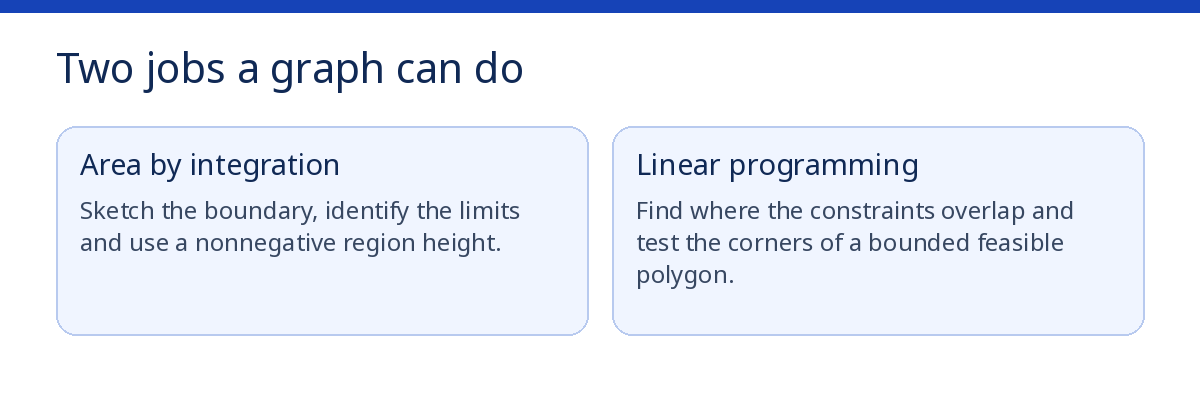
The paper asks you to sketch an ellipse for an area calculation and to draw a feasible region for a linear programming problem. For an area integral, the sketch helps you identify bounds and the nonnegative height of the region. A definite integral of a function below the horizontal axis gives a signed contribution, not the geometric area by itself.
For linear programming, each inequality determines which side of a boundary is allowed. The feasible region consists of the points that satisfy all the constraints at once. When that region is a nonempty bounded polygon, a linear objective attains a maximum and a minimum at corner points, though an optimum need not be unique. Check that the points you test belong to the feasible region, not merely to intersecting boundary lines.
Match the vector operation to the geometry
The vector and three-dimensional geometry questions ask about perpendicular directions, triangle area, angles between lines and distances. Start by identifying what the vectors represent. A position vector locates a point relative to the origin, while a direction vector describes the orientation of a line. For nonzero directions, a zero dot product tests perpendicularity. For the area of a triangle, the magnitude of the cross product of two side vectors from a common vertex gives the area of the corresponding parallelogram, so the triangle takes half of that area.
Keep the distance tasks distinct, too: finding the foot from a point to a line asks for a point on that line, whereas finding the shortest distance between two lines concerns their relative positions and directions.
Quick self-check: what are you conditioning on?
The probability questions include conditioning in a die experiment, testing independence in a card experiment with replacement, and reversing the direction of conditioning in a case study. Before calculating, read the event after the vertical bar as the information you are given. Reversing the events generally changes the probability. In the card problem, replacement resets the available cards for the second draw, but that does not establish independence for every pair of events defined using those draws. Can you explain why an event involving the sum can still depend on what happened on the first draw?
Review the method, not just the final line
Keep the worked solutions closed during the mock. Afterwards, use the question-number links to compare your work with the formula used, concept used and explanation in steps. Look for the first place your reasoning diverged: the model you set up, a condition you missed, or a calculation error. Then try an unused internal alternative to see whether you can apply the method without following the worked steps.
This guide omits Q10 because the printed integral gives no interval fixing the sign of the cosine, Q18 because its probability givens are inconsistent, and Q33(a) because the logarithm’s argument is not explicitly grouped.
Spotted an error? Report a correction. Practise this in the app: notes, formula sheets and mind maps.





























































































































































Loading comments…