Application of Integrals: CBSE Class 12 PYQs and Solutions
CBSEMathematicsApplication Of Integrals
Application of Integrals in CBSE Class 12 asks you to turn a sketched region into a definite integral and evaluate its area. This guide explains vertical and horizontal strips, symmetry in circles and ellipses, areas between curves, absolute-value regions and the case-based and MCQ formats in a 73-question PYQ collection.
How 73 PYQs spread across six area patterns
This collection gathers 73 previous year questions labelled from 2022 to 2026. They come from main board papers, compartment papers and 2022 Term 2 papers, and the original set codes are kept.
The topic index sorts them into six groups:
- circles and ellipses (21)
- parabolas and straight lines (19)
- areas under curves and axes (13)
- trigonometric and absolute-value regions (9)
- areas between curves (6)
- case studies (5)
Questions appear in the original source order. Subjective questions run from Q1 to Q56 and include the case-based Q2–Q4. Single-correct MCQs follow as Q57–Q73. Several subjective items offer an internal choice marked OR, and each question links to a numbered worked solution. The counts show that conics and parabola–line regions together account for more than half the collection.

Application Of Integrals | Class 12 | Previous Year Paper
In the StudentCurio app
Solved CBSE Class 12 previous-year questions on finding areas bounded by curves, lines and coordinate axes using definite integrals. Includes worked applications involving parabolas, circles, ellipses and other curves to help students practise setting up and evaluating area integrals.
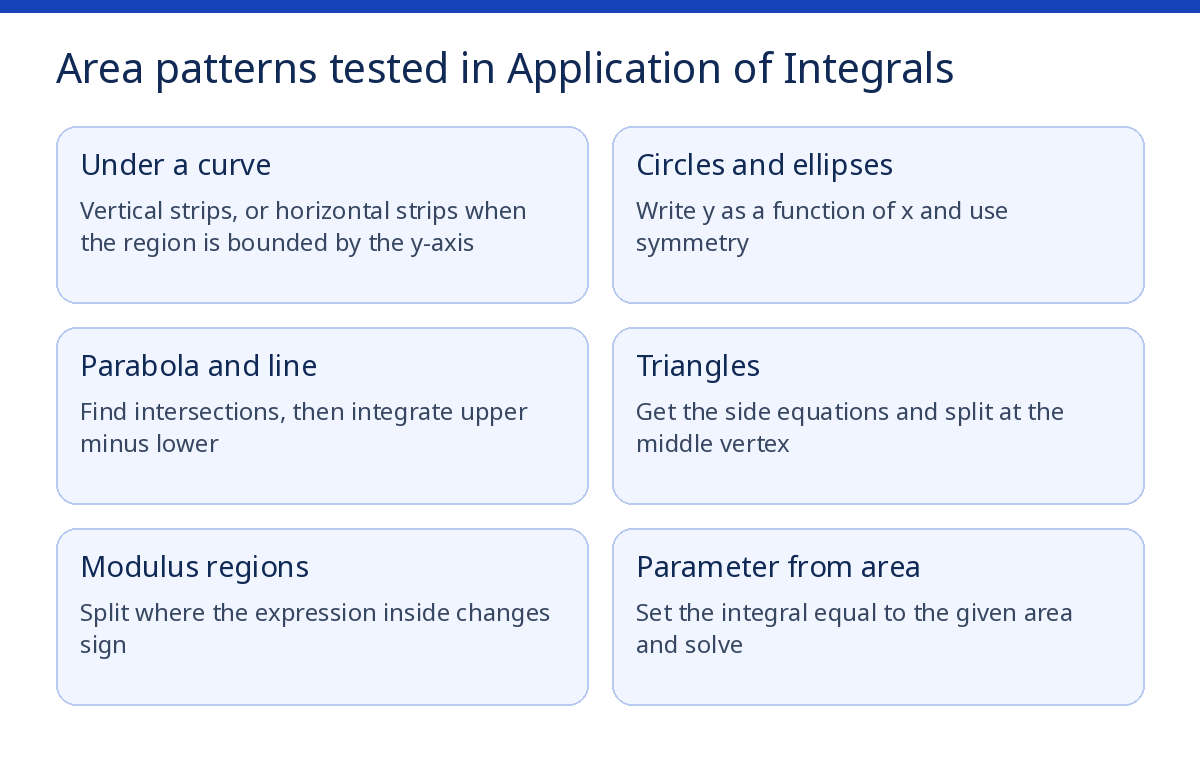
Choosing vertical or horizontal strips
The basic idea is that area is a sum of thin strips. For a region under above the x-axis between and , use vertical strips: .
When a region is bounded by the y-axis and horizontal lines, horizontal strips are more natural: . Here you write the curve as in terms of .
Several questions test this switch:
- with the y-axis between and
- with the lines , and the y-axis
- the region bounded by , , and the y-axis
The MCQs Q59, Q65 and Q66 ask you to choose the correct integral expression rather than a number. In those questions the real skill is matching the variable of integration and its limits to the shaded region.
Using symmetry for circles, ellipses and segments
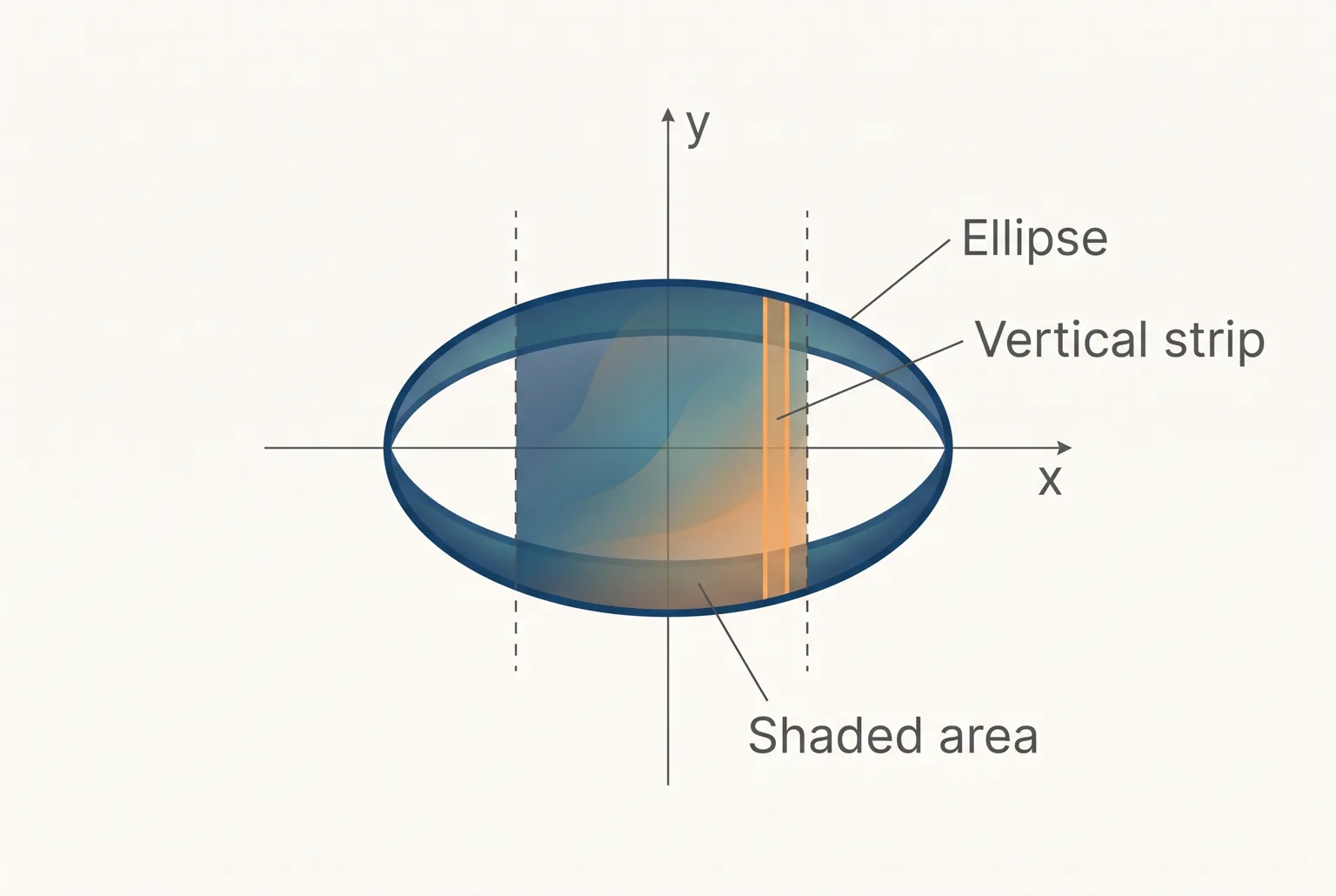
Circle and ellipse questions first need as a function of . For example, becomes , so the upper half is .
The key integral is the standard NCERT result:
Symmetry removes a lot of work. A full ellipse or circle is four times its first-quadrant part. A region between and is symmetric about both axes, so you can integrate from to and multiply.
Recurring variants include:
- the minor segment of cut off by
- the part of a circle bounded by a line through the origin such as or
- the smaller region between an ellipse and a chord such as
Areas between curves, lines and triangles
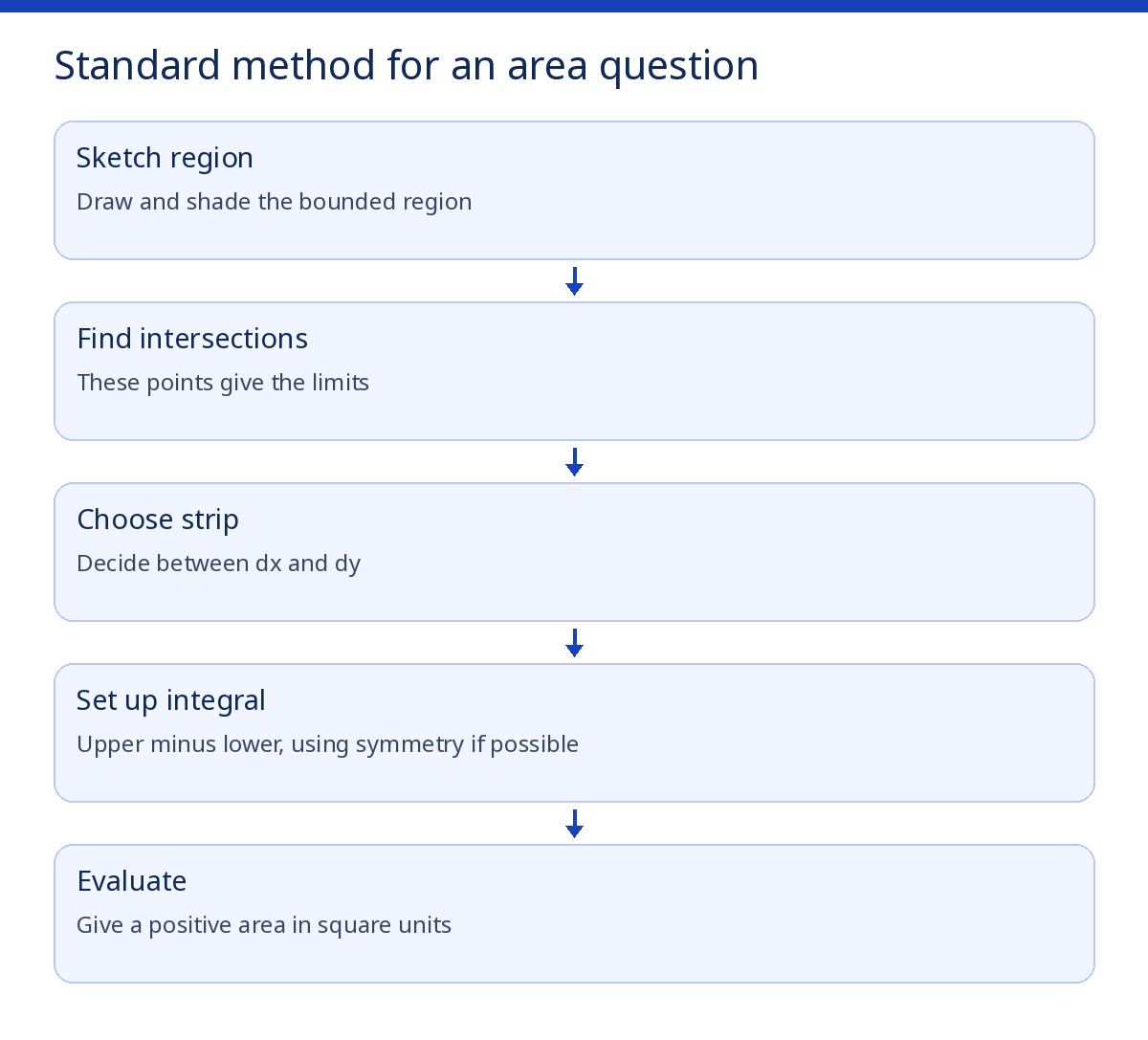
When two boundaries enclose a region, find their points of intersection first. These points become the limits. The area is then .
Some questions use set notation for the region. In , the inequalities tell you the parabola is the lower boundary and the line is the upper one.
Triangle questions appear in two forms. Some give three vertices, such as , and . Others give three side equations. In both cases you:
- find each side's equation, or the vertices from the given lines;
- split the triangle at the middle vertex's x-coordinate;
- add the two integrals.
Regions like combine both ideas: the region lies inside the circle and on the far side of the line.
Splitting absolute-value and $x|x|$ regions
With or , the expression changes form where the quantity inside the modulus is zero. Split the integral at that point and write each piece without the modulus.
The curve appears in Q6, Q27, Q58 and Q63. It equals for and for , so part of the curve lies below the x-axis.
Area is never negative. A part below the axis must be counted with its sign reversed. On symmetric limits, a single signed integral would let the two halves cancel, which does not give the area.
Reverse problems: finding $m$, $a$ or a ratio
Some questions give the area and ask for a parameter. Examples include finding when and enclose square units, or finding from the area cut off by on .
The method is the same as a direct question, but the limits or integrand contain the parameter. You set the evaluated integral equal to the given area and solve. Keep the stated restriction (, ) when you choose the final value.
Q23 asks for the ratio of two parabola regions. That needs two separate integrals before you compare them.
How case-based questions and MCQs are framed
The case studies build up the setup in stages:
- a triangular park with vertices , ,
- a circular roundabout around a pond
- a 3 m racing track around the ellipse
Parts (i) and (ii) ask for a line equation, a diagram or . Part (iii) carries an OR choice of areas to find by integration. An ant crawling along turns up as a one-step MCQ.
Subjective items often say "sketch" or "draw a rough sketch". Show the labelled figure, the intersection points, the integral with its limits and the evaluation as separate visible steps.
Common slips and a practice order
Common mistakes:
- Integrating in when the region is bounded by the y-axis and horizontal lines.
- Taking only the upper half of when the region lies on both sides of the x-axis.
- Using limits that do not match the region asked for, such as the whole circle instead of the first quadrant or the minor segment.
Practice order: start with areas under curves and axes, then absolute-value regions, then parabolas and lines. Move on to circles and ellipses, then triangles and two-curve regions, and finish with the case studies. Attempt each question before opening its linked solution.
Quick self-check: for a region between and , can you write both a vertical-strip and a horizontal-strip integral and explain where the factor of 2 comes from?
Frequently asked questions
Which years and papers does this collection include?
The questions are labelled from 2022 to 2026. They include main board sets, compartment sets, Delhi and Outside Delhi sets and 2022 Term 2 papers, with the original set codes kept.
Which question formats appear?
Subjective questions (Q1–Q56), case-based questions (Q2–Q4) and single-correct MCQs (Q57–Q73). Many subjective items offer an internal choice marked OR.
Spotted an error? Report a correction. Practise this in the app: notes, formula sheets and mind maps.





























































































































































Loading comments…