Three-Dimensional Geometry: Class 12 CBSE Practice Guide to Lines
CBSEMathematicsThree-Dimensional Geometry
This guide explains the ideas tested in Chapter 11, Three-Dimensional Geometry, of Class 12 CBSE Mathematics, using an 89-question assessment with worked solutions. It covers direction cosines and ratios, the vector and Cartesian forms of a line, angles and perpendicularity, intersection and shortest distance, and feet of perpendiculars.
Direction cosines versus direction ratios
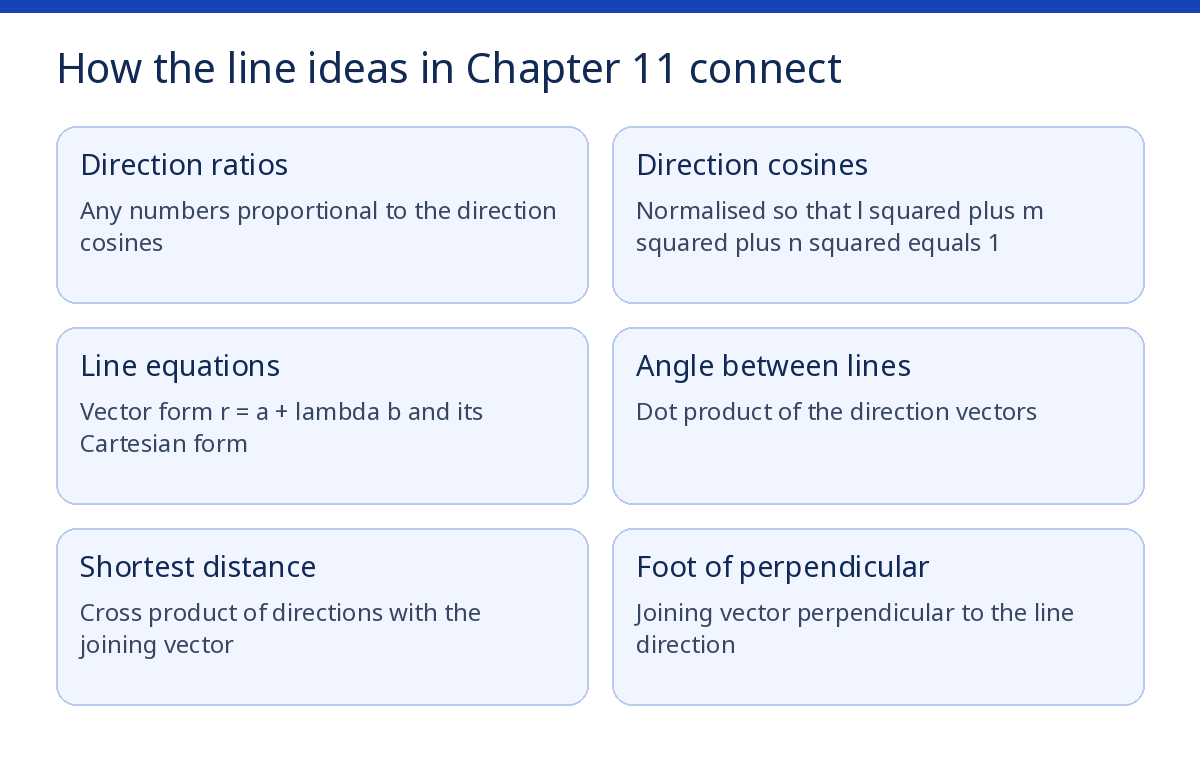
Every question in this chapter starts with how a line is pointed. If a line makes angles with the positive , and directions, its direction cosines are , , . They always satisfy .
Direction ratios are any three numbers proportional to the direction cosines. A line therefore has infinitely many sets of direction ratios but only two sets of direction cosines, one for each orientation. To convert ratios into cosines, divide each by . To go the other way, multiply all three cosines by the same nonzero number.
The joining vector gives direction ratios . The reversed vector describes the same line. The solutions point this out more than once, and several questions ask for both orientations.

Three-Dimensional Geometry | Class 12 | CBSE Assessment
In the StudentCurio app
A Class 12 CBSE assessment resource with questions and worked solutions on lines in space, including direction ratios and cosines, intersections, and shortest distances between skew lines. Includes objective, long-answer, and case-based practice to help students prepare for mathematics assessments.
Using the identity $l^2+m^2+n^2=1$ with angle data
Topic Practice 1 (18 questions: objective Q1–5, very short answer Q6–15, short answer type I Q16–18) relies heavily on this identity. If two angles are known, the third cosine follows, but only up to sign. When a question asks for every possible angle, both signs matter. When it says the angle is acute, only the positive cosine is allowed.
The same identity drives trigonometric results. Rewriting as , or as , turns the expression into one that uses .
One objective item makes a subtle point. An algebraic manipulation can produce a candidate value that no real line can have. Its accompanying note observes that the candidate forces a negative . Before you accept a result, check that each squared cosine lies between and .
The cover diagram shows a related idea. The perpendicular from meets the -axis at : the foot keeps the coordinate along the axis. The distance from the point to the axis is then the distance from to that foot.
Writing a line in vector and Cartesian form
Topic Practice 2, Lines in Space, is the largest set. It has 43 questions: objective Q1–5, very short answer Q6–12, short answer type I Q13–18, short answer type II Q19–38 and long answer Q39–43.
The solutions use the vector form , with . Here is the position vector of a known point and is a direction vector. Equating components and eliminating gives the Cartesian (symmetric) form:
For a line through two points, take the difference of their coordinates as .
Many questions disguise the symmetric form. Expressions such as or must be rewritten until each numerator reads (variable minus constant) with coefficient . Only then can you read off the direction ratios.
A zero denominator, as in the options for a line parallel to an axis, is conventional shorthand for a fixed coordinate. It is not division by zero.
Angles, parallel lines and perpendicular directions
The angle between two lines comes from their direction vectors alone:
The fixed points play no role. Proportional direction vectors mean parallel lines. A zero dot product means perpendicular directions.
Several questions hide an unknown such as , or inside a direction ratio. You find it by setting the dot product to zero, after first putting both lines in standard form.
Some long questions then ask whether the same pair of lines intersects. Perpendicular directions do not settle that. Lines in space can be perpendicular in direction and still never meet, and the chapter-practice wording makes this distinction explicit.
When a line must be perpendicular to two given lines, its direction must be perpendicular to both direction vectors. In NCERT this is obtained through the cross product .
Shortest distance and whether lines intersect
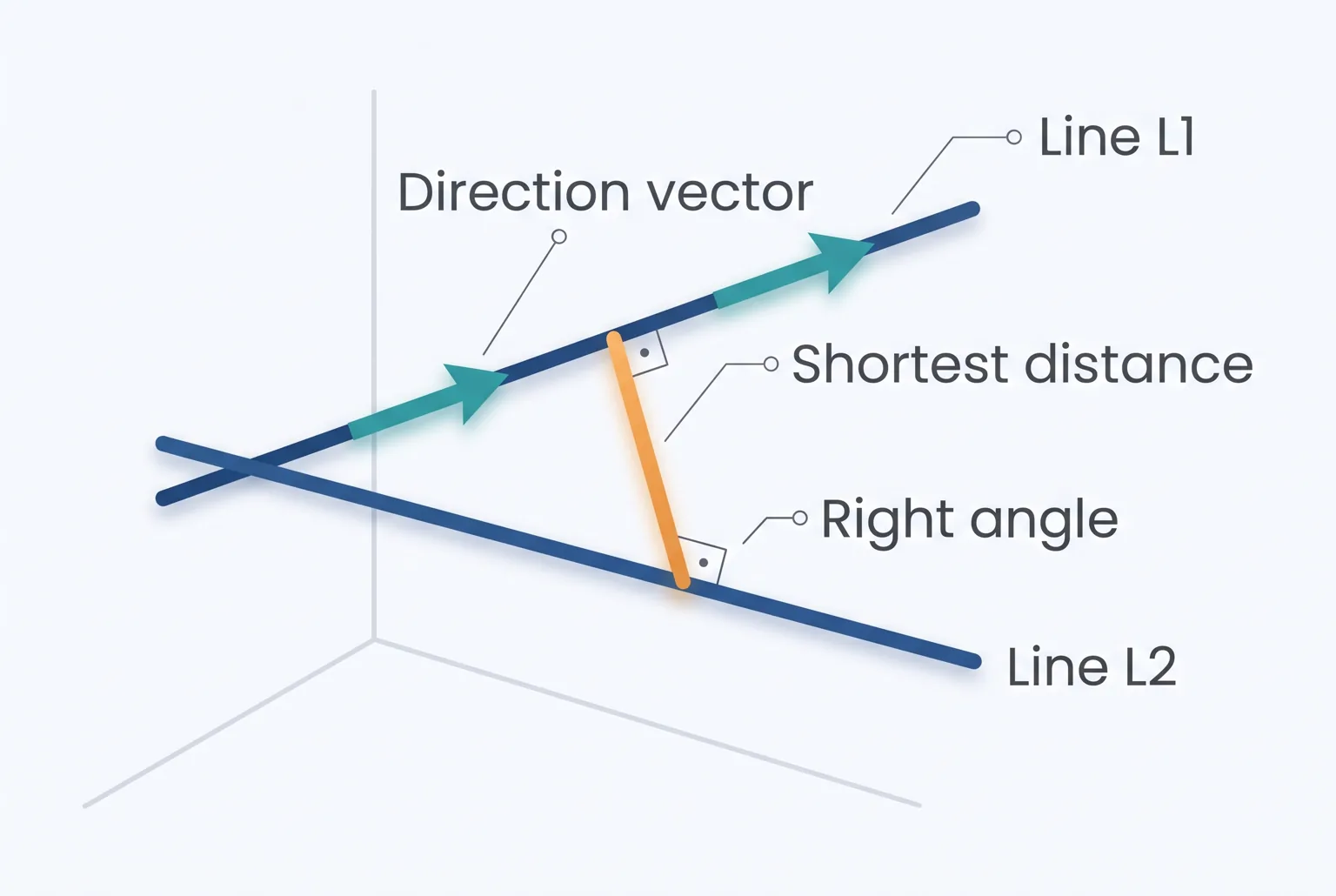
Skew lines are neither parallel nor intersecting. For lines and , the NCERT shortest-distance formula is:
The set uses this result in two ways. Some questions ask directly for . Others ask you to decide, by computing the distance, whether two lines intersect.
Lines given in parametric form, such as , must first be split into a fixed-point part and a direction part.
The long-answer versions go further. They ask for the points on each line where the common perpendicular meets them, or for the equation of the line of shortest distance. Write a general point on each line using its parameter, and require the joining vector to be perpendicular to both directions.
Foot of the perpendicular and the image of a point
Several short answer type II and long-answer questions ask for the foot of the perpendicular from a point to a line. Some then ask for the image of the point in that line or for the perpendicular distance.
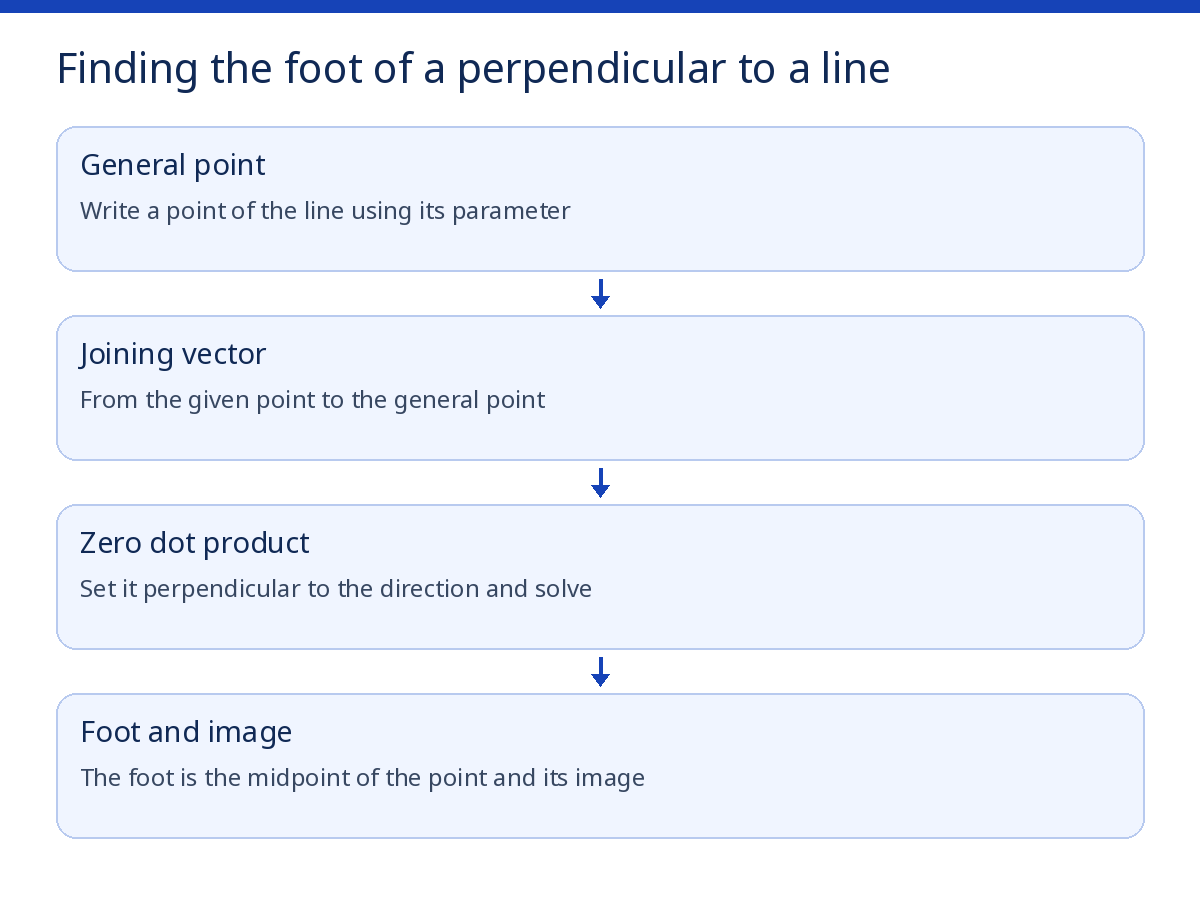
The standard reasoning has four steps:
- Write a general point of the line in terms of its parameter.
- Form the vector from the given point to this general point.
- Set its dot product with the line's direction vector to zero and solve for the parameter.
- Treat the foot as the midpoint of the point and its image to find the image.
The perpendicular distance is the length from the point to the foot.
Mixed chapter practice and the missile case study
Chapter Practice has 28 questions that mix every idea above. The breakdown is objective Q1–4, very short answer Q5–14, short answer type I Q15–16, short answer type II Q17–23 and long answer Q24–27. Two long proofs involve the body diagonals of a cube.
Case-based Q28, titled "Motion along a straight line", gives a missile's position as , , , with in seconds and distance in kilometres. Its three objective parts test whether you can recognise as a line through the origin, test points against it and measure distance along it.
A sensible order is Topic Practice 1, then Topic Practice 2, then Chapter Practice. The clickable index links each question to its worked solution. Attempt a full question type before opening the solutions, then compare your rewriting and sign handling step by step.
Spotted an error? Report a correction. Practise this in the app: notes, formula sheets and mind maps.





























































































































































Loading comments…