CBSE Class 12 Mathematics 2023 Paper with Worked Solutions
CBSEMathematics2023 Previous Year Paper
Paper code: 65/3/1 · 2023Practise with the full English version of the 2023 CBSE Class 12 Mathematics main examination, set 65/3/1. Use the worked solutions after your attempt to check not just your answers, but also how you chose a method and justified each step.
This set is one of the year's papers. See every set from 2023, grouped by series.
Know the paper before you start
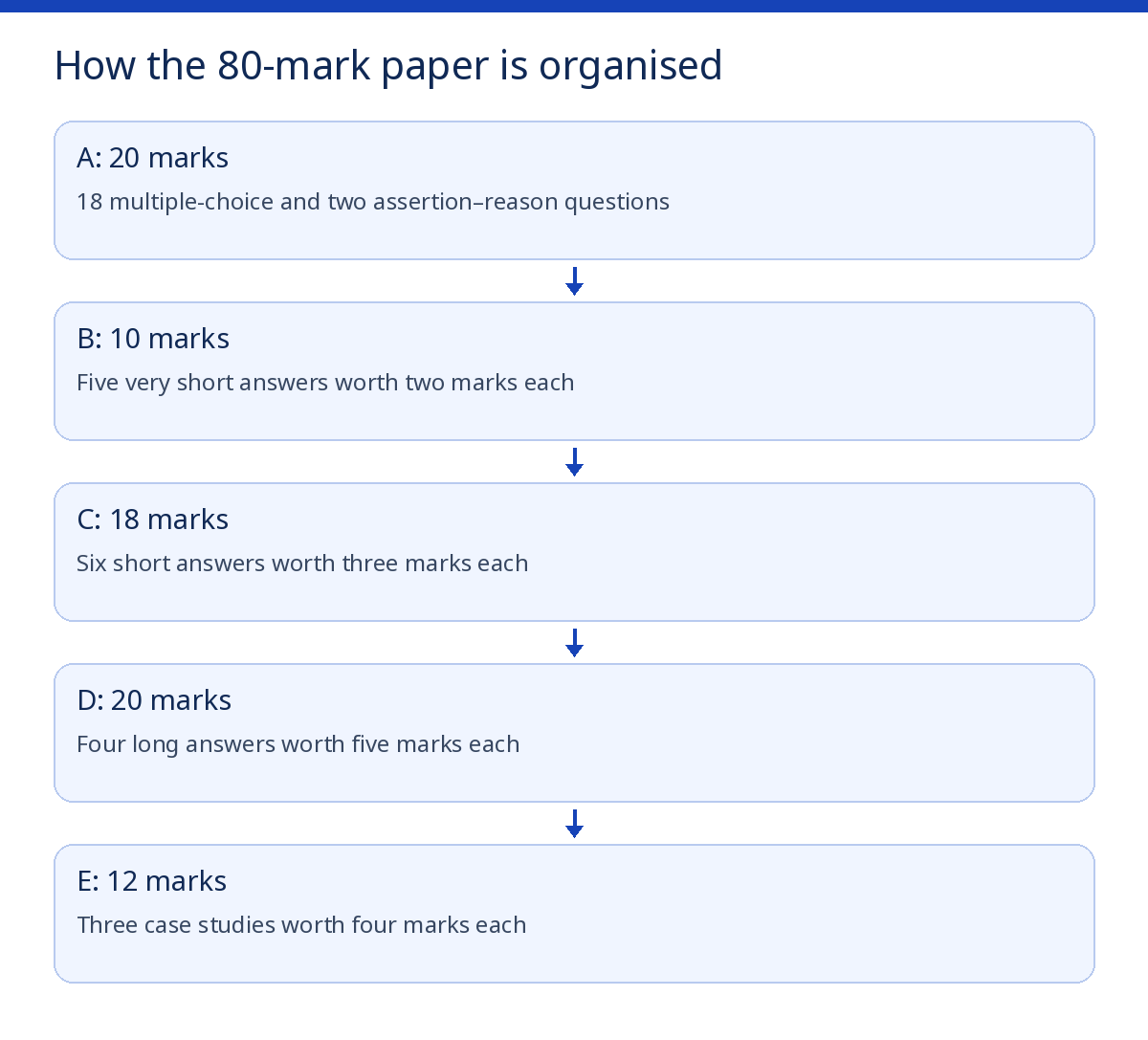
This is a year-wise previous paper, not a chapter test. It carries 80 marks, allows three hours and does not permit calculators. Its 38 questions are arranged in five sections. Section A contains 18 multiple-choice questions and two assertion–reason questions, each worth one mark. Section B contains five two-mark very short answers; Section C has six three-mark short answers; and Section D has four five-mark long answers. Section E contains three four-mark case studies.
There is no overall choice. Internal choices appear in two questions in Section B, three in Section C, two in Section D and two in Section E. In a timed attempt, choose one of the printed alternatives where offered. Save the other for revision: it gives you another task to attempt without repeating the one you have already seen.

Mathematics 2023 | Class 12 | Previous Year Paper | Code 65/3/1
In the StudentCurio app
Complete CBSE Class 12 Mathematics paper for 2023 (set 65/3/1), with worked solutions across topics including matrices, calculus, vectors, three-dimensional geometry, probability and linear programming. Helps students practise the board-exam format and review solution methods.
What the questions ask you to do
The paper moves between direct recognition and multi-step reasoning. Matrices and determinants appear in questions on symmetry, matrix identities and inverse methods for systems of equations. The functions questions include principal values of inverse trigonometric functions, reading a range from a restricted graph, and proving that a function is both one-one and onto. For an onto proof, the stated codomain is part of the task: showing that distinct inputs have distinct outputs does not show that every element of the codomain is reached.
Calculus covers differentiation, integration and differential equations, with applications to monotonicity, enclosed area and optimisation. Vectors and three-dimensional geometry move from projections and directions to equations of lines, intersection and perpendicular distance constructions. Probability includes conditional reasoning and discrete distributions. Linear programming asks you to interpret a shaded region and to optimise an objective graphically. Review those as two distinct skills: identifying where the constraints hold is not the same as comparing objective values.
Where a domain check changes the method
When an integrand is simplified by cancelling a factor, the simplified expression agrees with the original only where that factor is nonzero. Keep the original exclusions in view and state the interval on which an antiderivative is valid. Similarly, if separating a differential equation requires division by a variable expression, note where that expression vanishes. If a candidate solution was excluded by division, test it against the original equation rather than assuming it is valid or invalid.
For monotonicity, identify the intervals on which the function is defined before interpreting the sign of its derivative. A sign test on separate intervals does not by itself establish how values compare across a gap in the domain. For a restricted inverse-trigonometric graph, distinguish the principal range of the parent function from the range obtained on the particular input interval.
Read each case study as a mathematical model
The case studies use three settings: a numbered octagonal prism, a rainwater harvesting tank and a volleyball serve. For the prism, the table describes a discrete random variable. Separate the requirement that all probabilities sum to one from the task of finding an event probability, which uses only the outcomes belonging to that event. A mean is different again: it weights each possible value by its probability.
In the tank problem, distinguish the fixed capacity from the dimensions that can vary. The volume constraint connects the square base and depth, so the cost model can be expressed in one variable before differentiation. The volleyball question supplies a height function rather than asking you to build one. There, continuity and maximum height call for different justifications: one concerns the behaviour of the function on its time domain, and the other concerns where its greatest value is attained.
Common mix-ups in graphs and three-dimensional geometry
A feasible point satisfies every constraint; it does not have to be a corner. In a graphical linear programming problem, boundary lines help locate the feasible region, but the inequality directions determine which sides to keep. Check the shading against the constraints before using the objective function.
For lines in three dimensions, direction vectors describe orientation, not location. Proportional direction vectors alone do not tell you whether two lines coincide or are distinct and parallel. To establish an intersection, a candidate point must satisfy both line equations. When reviewing a line question, check whether your working establishes the claimed relationship between the lines themselves or only between their directions.
Use the worked solutions to diagnose your attempt
The file preserves the English question layout, options and diagrams and provides navigation by question number. The worked solutions separate the formula used, the concept used and the explanation in steps, and the file covers both printed alternatives where an internal choice appears. After an uninterrupted attempt, use those labels to locate your first point of departure: did you select an unsuitable method, miss a condition, or make an algebraic error after setting the problem up correctly?
For assertion–reason questions, review the truth of each statement separately before deciding whether the reason explains the assertion. For longer responses, compare the reasoning that connects one line to the next, not just the final line. If your method differs from the printed one, check whether it starts from the same assumptions and satisfies the original question. This guide omits the item-level interpretation of Question 2 because the extracted notation does not clearly distinguish the matrix expressions from the determinant quantities used in the worked solution.
Spotted an error? Report a correction. Practise this in the app: notes, formula sheets and mind maps.





























































































































































Loading comments…