CBSE Class 12 Mathematics 2026 Previous Year Paper
CBSEMathematics2026 Previous Year Paper
Paper code: 65/4/2 · 2026Practise the 2026 CBSE Class 12 Mathematics main examination with the full English paper for set 65/4/2. Use the worked solutions after your attempt to check why a method applies, not just whether your final answer matches.
This set is one of the year's papers. See every set from 2026, grouped by series.
What this 2026 paper contains
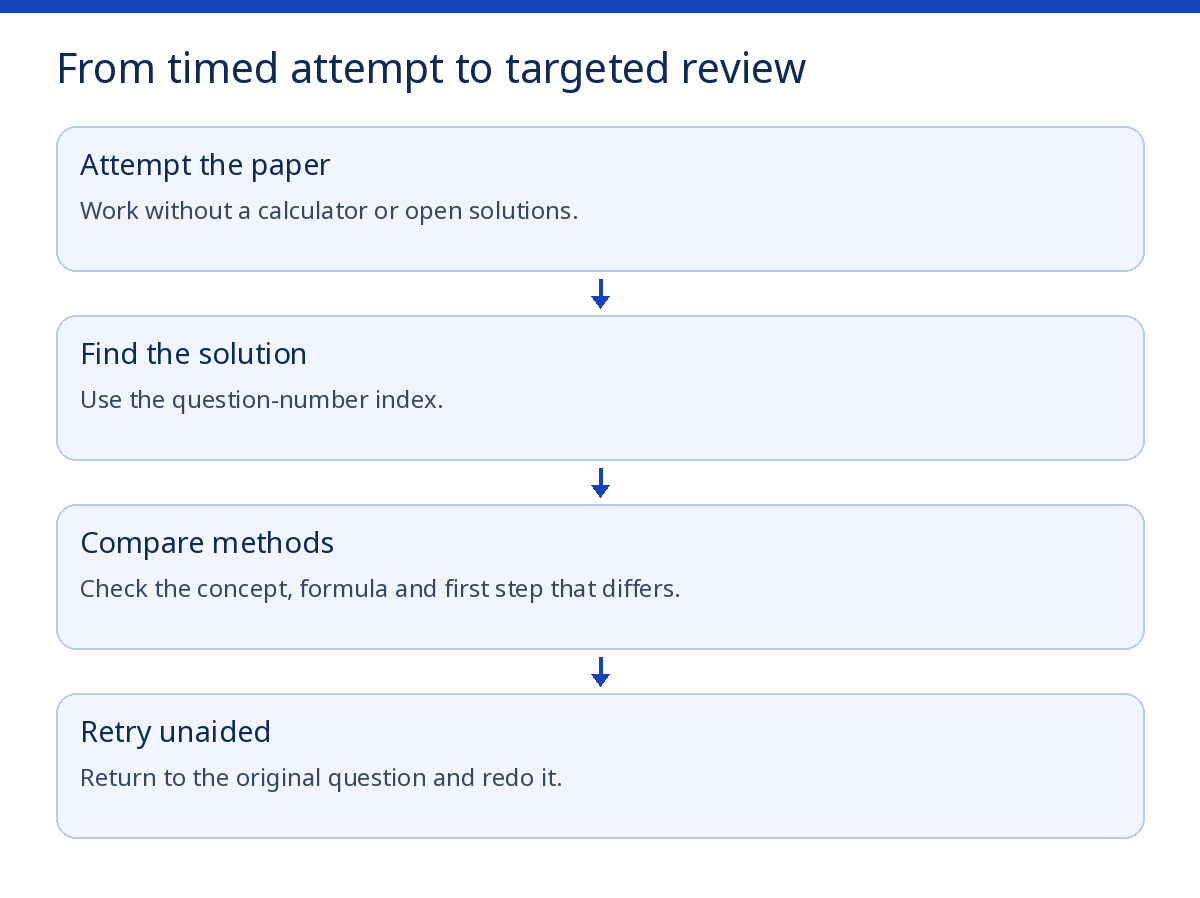
This year-wise resource pairs the full 2026 CBSE Class 12 Mathematics main examination paper with worked solutions. The English question paper retains the original layout, options and diagrams. The file separates the question paper from the solutions and provides a question-number index, so you can attempt the paper without looking at the working, then return directly to the questions you want to review.
The paper gives you 3 hours for 80 marks, with no calculator allowed. Those conditions matter if you are using it as a mock: reading graphs, interpreting case-study prompts and carrying out calculations by hand all take time. Keep the solutions closed until you finish so that your review reflects the decisions you made independently.

Mathematics 2026 | Class 12 | Previous Year Paper | Code 65/4/2
In the StudentCurio app
This complete CBSE Class 12 Mathematics examination paper covers questions across the syllabus and includes worked solutions. It helps students practise the board-exam format and review problem-solving methods.
Read the five sections before you start
The paper contains 38 questions across five sections:
- Section A: Questions 1–18 are multiple choice; Questions 19–20 are assertion–reason. Each is worth 1 mark.
- Section B: Five very short answer questions worth 2 marks each.
- Section C: Six short answer questions worth 3 marks each.
- Section D: Four long answer questions worth 5 marks each.
- Section E: Three case-study questions worth 4 marks each.
There is no overall choice. The instructions list internal choices in two questions in Section B, three in Section C, two in Section D and two in Section E. In a timed attempt, use the alternatives only where they are printed. In a case study, check whether an alternative applies to a particular subpart rather than to the entire question. Save any unattempted alternatives for later practice.
What the paper asks you to do across topics
The paper samples relations and functions, inverse trigonometry, matrices, calculus, differential equations, vectors, three-dimensional geometry, linear programming and probability. It tests those topics in different ways. You might recognise an inverse trigonometric function from a graph, but elsewhere you have to evaluate an inverse trigonometric expression under a principal-value convention. Matrix questions range from reading indexed entries and transposing a matrix to expressing a set of verbal constraints as a matrix equation.
The case studies make the translation from words to mathematics especially visible. The cap-selection case distinguishes the probability of observing a colour from the probability of a particular box given that colour. The conical-cup case connects dimensions with rates of change, while the wooden-box case turns statements about dimensions into simultaneous equations. When reviewing these questions, check your setup before checking the computation.
Calculus checks: branches, boundaries and signs
For inverse trigonometry, an angle that gives the right trigonometric value is not necessarily the principal value. Check the range of the inverse function you are using before accepting an angle. Likewise, in a monotonicity problem, find increasing intervals only within the stated domain. An excluded point separates intervals even if the derivative has the same sign on either side.
At a junction of a piecewise function, continuity requires the two one-sided limits to agree with the function value. That alone does not establish differentiability: the one-sided difference quotients must also approach the same finite value. In an area problem, check where the curve is above or below the axis. A definite integral gives signed accumulation; for geometric area between the curve and the axis, split at changes of sign and count the pieces below the axis positively.
Probability check: what does the wording justify?
For an “at least one” event, taking the complement of “none” is valid without an independence assumption. What does require mutual independence is replacing the joint probability that none occurs with a product of their individual non-occurrence probabilities. Separate probabilities for individual events do not, by themselves, establish that the events are independent.
That distinction matters for the city-rain multiple-choice item: the solution notes that a unique numerical result does not follow from the stated probabilities alone. This guide omits that numerical answer and the disputed option label in the vector triangle-area solution. Neither is needed to practise the underlying methods or to review the other questions.
Review the first step where your method diverged
The worked pages separate Formula Used, Concept Used and Explanation in Steps. Start with the concept when you did not know how to begin. For a graphical linear programming question, for example, distinguish drawing a boundary line from choosing the half-plane allowed by the inequality. The feasible region is where all the allowed half-planes overlap, including any non-negativity restrictions. An objective value calculated at a point outside that region is not a candidate for the optimum.
If you chose the right method but made an error, use the step-by-step explanation to find the first line where your working diverged. That tells you whether to revisit a condition, such as the sign of an inequality, or to correct the algebra. For assertion–reason items, make three separate checks: whether the assertion is true, whether the reason is true, and whether the reason actually explains the assertion. After reviewing, close the solution and redo the question from the original prompt.
Spotted an error? Report a correction. Practise this in the app: notes, formula sheets and mind maps.





























































































































































Loading comments…