CBSE Class 12 Mathematics 2025 Paper: Set 65/1/1
CBSEMathematics2025 Previous Year Paper
Paper code: 65/1/1 · 2025Use the complete 2025 CBSE Class 12 Mathematics paper, set 65/1/1, for a three-hour board-exam practice attempt. Then use the worked solutions to check not just your answers, but whether you chose methods that fit each question’s conditions.
This set is one of the year's papers. See every set from 2025, grouped by series.
What this 2025 paper includes
This file contains the English version of the 2025 CBSE Class 12 Mathematics main examination, with a maximum of 80 marks. It preserves the original question layout, options and diagrams. The cover indexes all 38 questions, and the file provides worked solutions for all 38 as well as both printed internal choices. It is organised as one complete paper from a particular year and set, not as a chapter-wise question bank.
The solution pages separate the formula used, concept used and explanation in steps. That distinction is useful: a formula tells you what operation to perform, while the concept explains why that operation fits the question. Use the question index to revisit a specific item after attempting the paper.

Mathematics 2025 | Class 12 | Previous Year Paper | Code 65/1/1
In the StudentCurio app
Complete 2025 CBSE Class 12 Mathematics board paper, set 65/1/1, with worked solutions. Helps students practise the board-exam format and review solution methods across the paper’s topics.
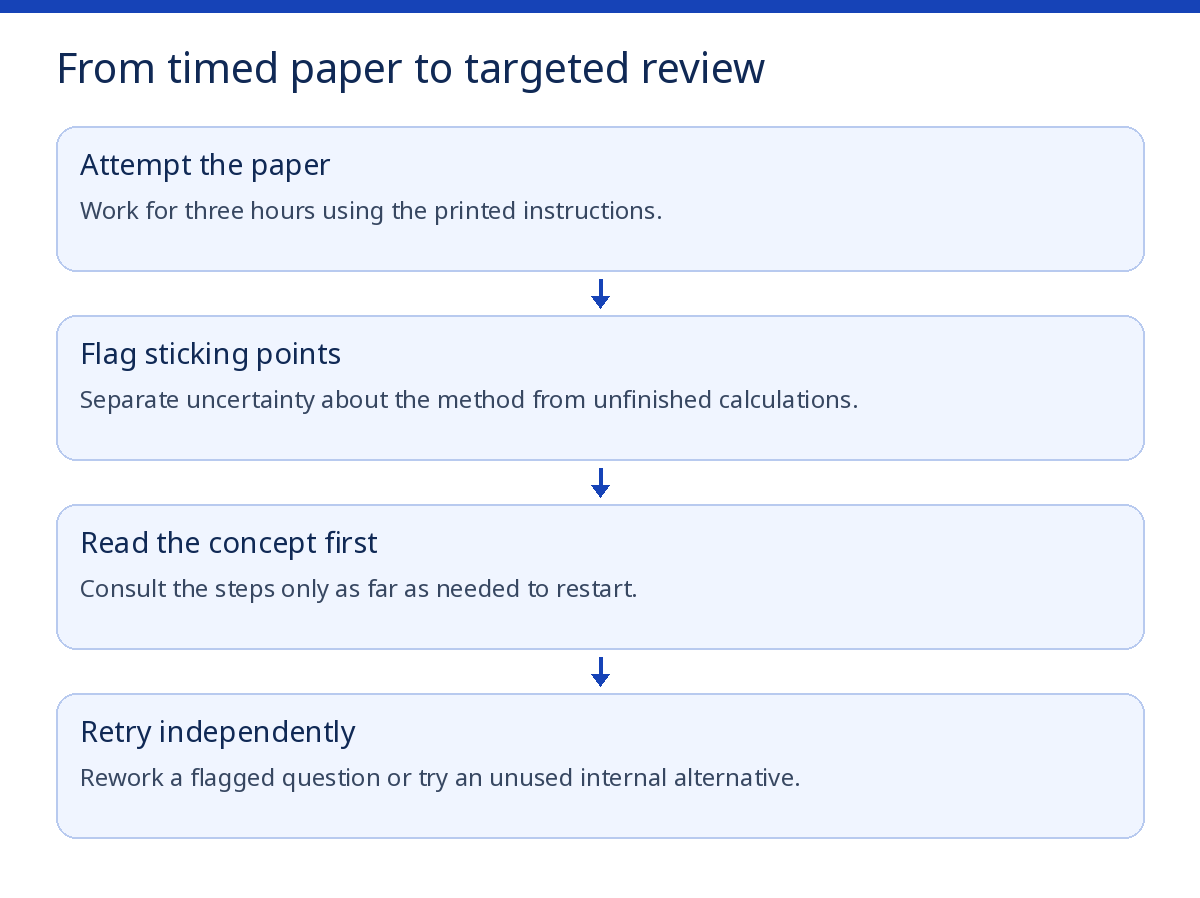
Make the first attempt a three-hour board practice
Start with the question-paper pages and keep the worked solutions closed. Set a three-hour limit and follow the printed instructions, including the directions for internal choices. Where the paper asks you to choose, attempt only the required alternative during the timed sitting. Save the other alternative for a fresh attempt during review; doing both under the clock changes the task you are practising.
When a question stalls you, leave a brief note beside your last step: perhaps you could not identify the condition that made a rule applicable, or you had a method but could not finish the algebra. Those are different problems. The notes help you decide whether to revisit a concept or practise carrying a valid setup through to the end.
Common mistakes: Check dimensions and vector assumptions
The solutions include scalar matrices, matrix products, determinants and inverse identities. Before multiplying matrices, check the inner dimensions: a matrix of order can multiply one of order in that order, producing a matrix of order . Even when both multiplication orders are possible, reversing the order need not give the same product. In inverse identities, order matters too: for invertible square matrices of the same order, .
In the vector questions, distinguish computing a dot product from interpreting it. A zero dot product establishes perpendicularity when both vectors are nonzero. The zero vector also has zero dot product with every vector, but it does not supply a direction for defining an angle.
Calculus: Separate continuity, differentiability and extrema
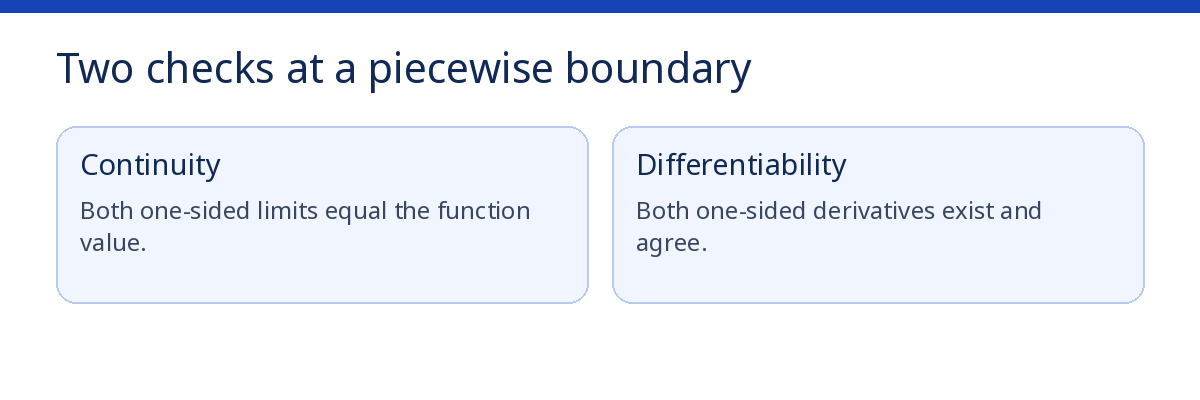
At a boundary between pieces of a function, continuity requires the two one-sided limits to agree with the function value. Differentiability is a separate test: the one-sided derivatives must exist and agree. A graph can join without a break and still have a corner. This guide uses the general distinction only; it omits Q5’s answer choice and worked conclusion.
The extrema material calls for a different check. For a continuous function on a closed, bounded interval, absolute extrema exist. To find them, compare the function values at the endpoints and at relevant interior points where the derivative is zero or does not exist. Solving only gives possible interior candidates, not the absolute maximum or minimum. In your review, check whether you listed all candidates before comparing their values.
Read the diagram before calculating
The area-by-integration material gives you a reason to pause over the original diagram. If you use vertical strips, identify the upper and lower boundaries and the horizontal limits of the shaded region. The strip height is the upper function minus the lower function; when the lower boundary is the horizontal axis, its contribution is zero. In review, compare this setup with the worked method before checking the integration itself. A correct antiderivative cannot fix limits taken from the wrong region.
In linear programming, the diagram represents a different object: the feasible region determined by the constraints. For a nonempty, closed and bounded feasible polygon, a linear objective attains both a maximum and a minimum. Compare objective values at feasible vertices, rather than assuming that the vertex farthest to the right or highest on the page is best.
When the rule applies: Independence and inverse graphs
In probability, the paper uses the fact that complementing an event preserves independence. If and are independent, then and are independent too. But writing also requires . The independence statement and the condition that makes the conditional probability defined are two separate checks.
The inverse-trigonometric graph material illustrates another kind of restriction. To obtain the principal inverse of cosine, first restrict cosine to , where it is one-to-one. Reflect that branch across , not the entire periodic graph. The chosen branch determines the inverse: its domain is and its range is . In a graph question, check both before comparing the curves.
Turn the worked solutions into a second attempt
Start with questions you left blank, guessed at or finished without being sure why the method worked. Read the concept used first and try to restart without looking at the steps. If you still cannot proceed, reveal enough of the explanation to locate the first point where your reasoning diverged. Rewrite that step with its justification instead of copying the whole solution.
Use the unattempted internal alternatives to check whether you can choose and justify a method without remembering a sequence of steps. Keep your review tied to this set: note which methods you could select independently and which conditions you missed. That is more useful for planning revision than treating one year’s paper as a forecast of the next.
Spotted an error? Report a correction. Practise this in the app: notes, formula sheets and mind maps.





























































































































































Loading comments…